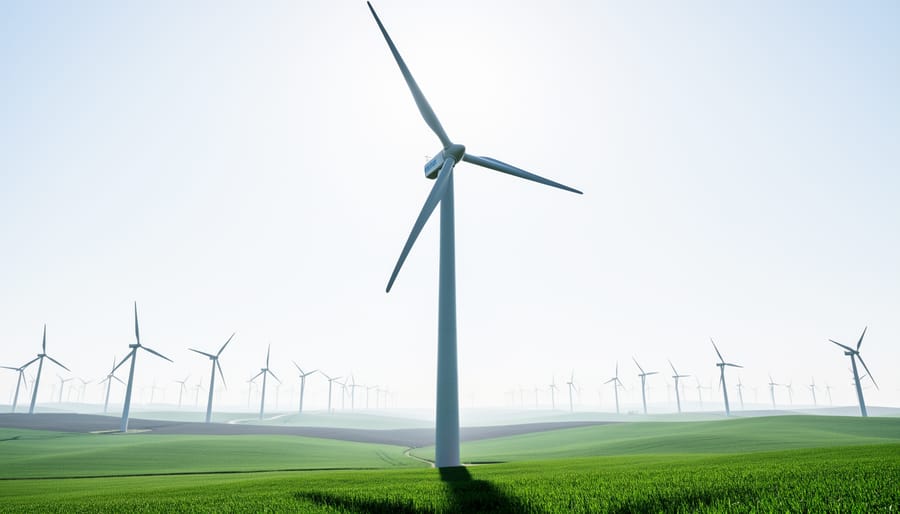
Wind energy efficiency refers to how effectively a turbine converts the kinetic energy in moving air into usable electricity. Modern wind turbines typically convert 35% to 45% of available wind energy into power, making them one of the most efficient renewable energy technologies operating at commercial scale today.
This performance matters because efficiency directly determines how much electricity a wind farm generates, how quickly it recovers its construction costs, and whether it can compete economically with fossil fuels without subsidies. As of 2026, wind power supplies a growing share of the global electricity mix, and understanding its efficiency helps evaluate its role in decarbonizing energy systems.
The question of wind energy efficiency isn’t as straightforward as comparing miles per gallon in vehicles. Wind turbines face physical limits governed by aerodynamic principles, yet they’ve achieved remarkable gains through advances in blade design, turbine height, and grid integration systems. The Betz limit, a theoretical maximum, caps wind turbine efficiency at 59.3% of the energy passing through the rotor area. No machine can exceed this threshold, but modern designs now operate much closer to it than earlier generations.
This article examines what efficiency means in wind energy contexts, how turbines convert wind into electricity, the components that influence performance, and recent technological improvements that have pushed efficiency boundaries. You’ll see data comparing wind to other energy sources, understand why location and wind speed dramatically affect output, and learn which innovations are making 2026’s turbines far more productive than those installed just a decade ago.
What Wind Energy Efficiency Means
When people ask if wind energy is efficient, they’re usually wondering whether turbines convert enough wind into electricity to justify their cost and footprint. But efficiency in wind energy isn’t a single number. It encompasses several interconnected metrics that measure different aspects of performance, and understanding these distinctions is essential for evaluating wind power fairly.
The most commonly cited measure is capacity factor, which compares a wind farm’s actual electricity output over time to what it would produce if running at full capacity continuously. A capacity factor of 40% doesn’t mean the turbine is only 40% efficient at converting wind to electricity. It means that wind conditions, maintenance schedules, and grid constraints result in the turbine producing 40% of its theoretical maximum annual output. This metric reflects real-world operational performance rather than conversion efficiency.
Conversion efficiency, by contrast, measures how effectively a turbine transforms the kinetic energy in moving air into electrical energy. Here, physics imposes a hard limit. The Betz’s law power limit states that no turbine can capture more than 59.3% of the wind’s kinetic energy, because extracting all the energy would mean stopping the wind entirely, preventing any further airflow through the rotor. Modern turbines typically achieve 75-80% of this theoretical maximum, translating to real-world conversion efficiencies of 45-50%.
- Capacity Factor
- The ratio of actual electricity generated to the maximum possible output if the turbine ran at full power continuously. Typical values range from 35-50% onshore and 50-60% offshore.
- Betz Limit
- The theoretical maximum efficiency of 59.3% for converting wind’s kinetic energy to mechanical power, derived from fundamental aerodynamic principles. No wind turbine can exceed this physical threshold.
- Conversion Efficiency
- The percentage of available wind energy that a turbine actually converts to electricity, accounting for aerodynamic, mechanical, and electrical losses. Modern turbines reach 45-50%.
- Power Coefficient
- A dimensionless measure of how efficiently a rotor extracts energy from the wind, expressed as a fraction of the Betz limit. High-performance turbines achieve coefficients of 0.45-0.50.
These metrics differ fundamentally from how we measure efficiency in fossil fuel plants, where efficiency describes the conversion of chemical energy in fuel to electrical energy, with typical coal plants at 33-40% and combined-cycle gas plants reaching 60%. Solar panels are rated by their conversion efficiency of sunlight to electricity, usually 15-22% for commercial installations. Wind’s capacity factor shouldn’t be confused with these conversion metrics. A 40% capacity factor paired with 47% conversion efficiency means the turbine is highly efficient at converting available wind, but wind itself is intermittent. This distinction matters when comparing renewable sources to dispatchable fossil generation.
How Wind Energy Conversion Works
The Energy Conversion Process
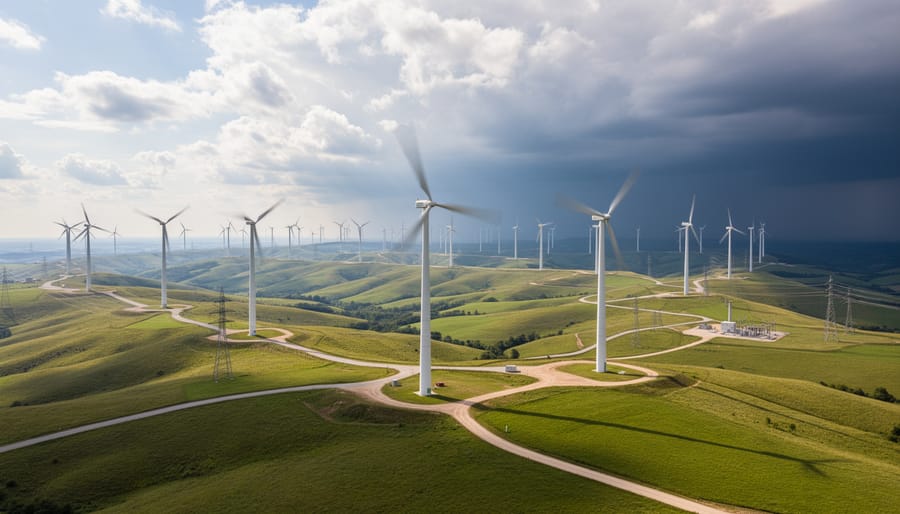
Wind turbines transform moving air into usable electricity through a four-stage energy conversion process that begins the moment wind strikes the blades. First, the aerodynamic blade design creates lift and drag forces that cause the rotor to spin, capturing kinetic energy from wind speeds typically between 3 and 25 meters per second. Modern three-blade designs optimize this initial capture, with blade pitch adjusting automatically to maintain ideal angles as wind conditions change.
Second, the rotating blades turn a low-speed shaft connected to a gearbox that increases rotational speed from roughly 10-20 revolutions per minute to 1,200-1,800 RPM. This mechanical acceleration is necessary because generators require high-speed rotation to produce electricity efficiently. Some newer direct-drive turbines eliminate the gearbox entirely, using specialized generators that work at lower speeds.
Third, the high-speed shaft drives a generator where electromagnetic induction converts mechanical rotation into alternating current electricity. Copper coils spinning within magnetic fields generate voltage, typically producing power at 690 volts. Finally, a transformer steps up this voltage to 33,000 volts or higher for grid transmission, minimizing energy loss over long distances. Power then flows through substations and distribution networks to reach homes and businesses, completing the journey from wind movement to wall socket in under a second.
Efficiency Losses and Limitations
Even under ideal conditions, wind turbines cannot capture all available energy from passing air. The theoretical maximum conversion efficiency, known as the Betz limit, sits at 59.3%, meaning no turbine can extract more than this percentage of wind’s kinetic energy regardless of design perfection.
Real-world turbines operate well below this threshold due to multiple loss pathways. Aerodynamic losses account for the largest efficiency drain as blades encounter drag forces and generate turbulence that reduces energy capture. Blade tip vortices alone can waste 5-10% of potential energy.
Mechanical losses occur throughout the drivetrain. Friction in bearings, gearbox inefficiencies, and shaft resistance convert motion into waste heat rather than electricity. Modern gearboxes lose roughly 2-4% of captured energy during speed conversion from slow rotor rotation to the faster speeds generators require.
Electrical conversion adds another 2-3% loss as generators transform mechanical rotation into electrical current, and power electronics condition that electricity for grid compatibility. Resistance in cables and transformers dissipates additional energy as heat during transmission.
Combined, these losses typically hold modern turbines to 35-45% conversion efficiency under optimal wind conditions, still substantially higher than coal plants, which waste two-thirds of fuel energy as heat.
Components That Determine Wind Turbine Efficiency
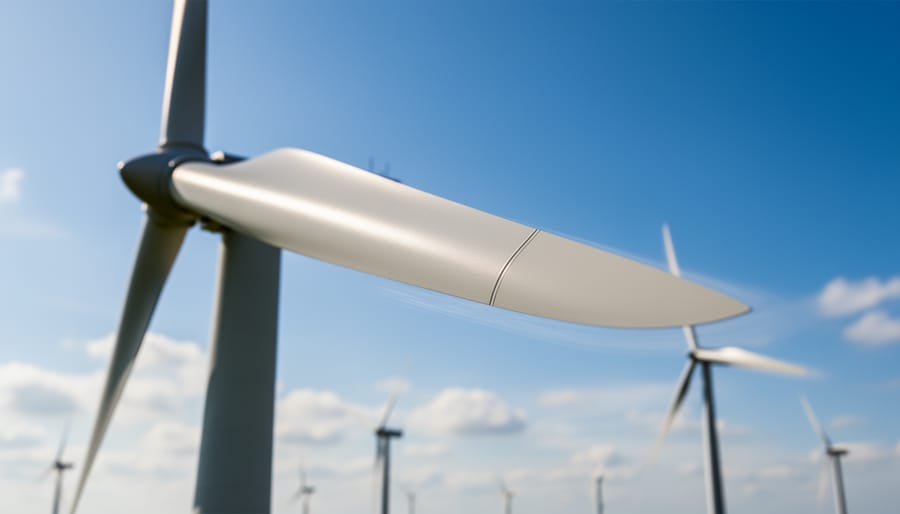
Wind turbine efficiency depends on a complex interplay of mechanical and electrical components working in concert. Each part of the system, from the blades cutting through the air to the electronics managing power output, contributes to or constrains how much electricity a turbine generates from available wind resources.
Blade design stands as perhaps the most critical efficiency factor. Modern turbine blades use aerospace-grade materials and airfoil profiles engineered through computational fluid dynamics to maximize lift while minimizing drag. The blade’s twist and taper, how its angle and width change from root to tip, determine how effectively it captures wind energy across varying speeds. Small improvements in blade aerodynamics can yield substantial efficiency gains across a turbine’s 20-30 year lifespan.
Rotor diameter directly influences energy capture potential. A turbine with a 150-meter rotor sweeps roughly 2.8 times more area than one with a 90-meter rotor, capturing proportionally more wind energy. This relationship explains the industry’s push toward larger rotors: each meter added to the diameter increases the swept area quadratically, allowing turbines to maintain high capacity factors even in moderate wind sites. The 2024 generation of onshore turbines commonly features rotors exceeding 170 meters in diameter, compared to 120 meters just five years earlier.
Tower height matters because wind speed increases with altitude, away from ground-level friction and obstacles. A turbine at 120 meters elevation typically encounters 15-25% stronger winds than at 80 meters, translating directly to greater power output since energy increases with the cube of wind speed. Taller towers also reduce turbulence exposure, allowing steadier operation and less mechanical stress.
The drivetrain configuration determines how mechanical energy becomes electricity. Major components that affect turbine efficiency include:
- Blades: Capture wind energy through aerodynamic lift and transfer rotational force to the rotor hub
- Nacelle: Houses critical components and protects them from weather while minimizing weight and drag
- Generator: Converts mechanical rotation into electrical current with typical efficiencies above 95%
- Gearbox: Steps up slow rotor rotation to generator speed, introducing 2-3% efficiency losses through friction
- Control systems: Optimize blade pitch, yaw orientation, and power output in real-time based on wind conditions
- Tower structure: Supports components at optimal height while withstanding extreme loads and minimizing vibration
Direct-drive generators eliminate the gearbox entirely, reducing mechanical losses but requiring larger, heavier components. Geared systems remain common because they allow smaller generators, reducing nacelle weight and costs despite the efficiency penalty.
Control systems increasingly leverage advanced algorithms to squeeze additional performance from existing hardware. These systems continuously adjust blade pitch angles and yaw orientation to maintain optimal alignment with shifting winds. In gusty conditions, intelligent controls can feather blades to prevent overspeeding while maximizing energy capture during calmer periods. The latest systems use turbine-to-turbine communication to minimize wake interference across wind farms, improving collective efficiency by 2-5%.
Current Efficiency Performance: The Numbers
Modern wind turbines achieve capacity factors between 35% and 50% for onshore installations, meaning they generate electricity at 35-50% of their maximum rated capacity over a year. Offshore wind farms perform even better, typically reaching 50-60% capacity factors due to stronger, more consistent ocean winds. These numbers represent significant improvements from the 25-30% capacity factors common in wind installations from the early 2000s.
The conversion efficiency of wind turbines, how much of the wind’s kinetic energy they actually capture, typically ranges from 35% to 45% of the theoretical maximum known as the Betz limit. This 59.3% ceiling, established by physicist Albert Betz in 1919, represents the absolute physical maximum of wind energy that any turbine design can extract from moving air. Modern commercial turbines have pushed remarkably close to this theoretical boundary.
A utility-scale turbine rated at 3 megawatts with a 43% capacity factor will generate approximately 11,300 megawatt-hours annually. For context, that’s enough electricity to power roughly 1,000 average homes for a year. The actual output depends heavily on local wind conditions; sites with average wind speeds above 7 meters per second consistently outperform those with slower, more variable winds.
Peak efficiency occurs at specific wind speeds, typically between 12 and 16 meters per second for most turbine models. Below this range, turbines capture less energy per unit of wind; above it, they often limit power output to protect mechanical components, a process called curtailment. This creates an efficiency curve rather than a flat performance rate.
Recent data from the National Renewable Energy Laboratory shows that capacity factors for new U.S. wind projects installed in 2024-2025 averaged 42% nationwide, with top-performing projects in the Great Plains exceeding 50%. European offshore wind farms commissioned in the North Sea during 2025 reported capacity factors between 55% and 58%, demonstrating how site selection and modern turbine technology combine to maximize real-world performance.
These numbers tell a clear story: while wind turbines cannot capture all available energy due to physical laws, they extract a substantial and growing portion of it in practice.
Recent Wind Energy Improvements Driving Efficiency Gains
Turbine Design Innovations
Modern turbine blades have grown dramatically, reaching lengths beyond 100 metres on leading models in 2026, capturing more wind energy per rotation. Manufacturers now use carbon-fibre composites and glass-fibre hybrids that reduce weight while maintaining structural strength, allowing longer blades without excessive loads on the drivetrain. Advanced aerodynamic profiles, refined through computational fluid dynamics and wind tunnel testing, minimize drag and maximize lift across varying wind speeds. Serrated trailing edges, inspired by owl wing feathers, cut noise and turbulence, while vortex generators on blade surfaces delay airflow separation, keeping blades efficient even at high angles of attack. Smart blade coatings prevent ice buildup and erosion from rain and airborne particles, preserving aerodynamic performance over years of operation. These design refinements increase the Betz coefficient closer to theoretical limits, extracting more usable power from the same wind resource. Larger rotor diameters also smooth output variability, making grid integration easier and reducing the need for backup generation.
Smart Controls and AI Integration
Modern wind turbines use artificial intelligence and machine learning algorithms to maximize power output by continuously adjusting operational parameters. These smart control systems analyze real-time data from sensors monitoring wind speed, direction, turbulence, and grid demand to make split-second decisions about blade pitch angle and rotor orientation.
Machine learning models predict incoming wind patterns by processing historical weather data and current atmospheric conditions, allowing turbines to position themselves optimally before wind gusts arrive. This predictive capability reduces the lag time between wind changes and turbine response, capturing energy that older reactive systems would miss.
AI-driven controls also coordinate multiple turbines within a farm to minimize wake interference. By adjusting upstream turbines to redirect their wake away from downstream units, these systems can increase total farm output by 10-20% compared to independent turbine operation. The algorithms balance individual turbine performance against collective efficiency, sometimes deliberately reducing one turbine’s output to boost overall generation.
Advanced control systems extend component lifespan by detecting early signs of mechanical stress and adjusting operations to reduce wear. This predictive maintenance capability improves efficiency over the turbine’s lifetime by preventing performance degradation and minimizing downtime.
Offshore Wind Advancements
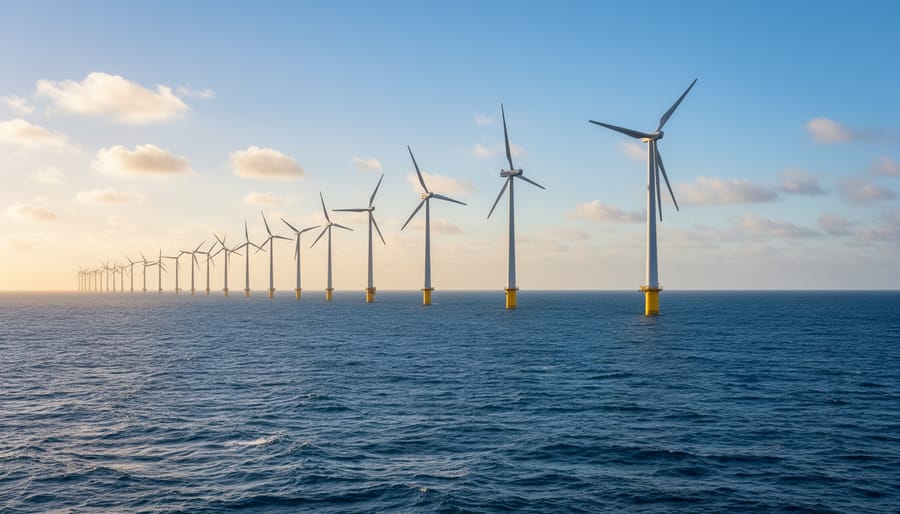
Offshore wind farms consistently achieve capacity factors of 50-60%, significantly outperforming onshore installations due to stronger, more consistent ocean winds. The real breakthrough since 2024 has been floating turbine platforms, which unlock sites in waters deeper than 60 meters where fixed-bottom structures become economically impractical. These floating systems use semi-submersible or tension-leg designs that remain stable while allowing turbines to access the powerful, unobstructed winds found far from shore.
Deeper-water installations face less turbulence and atmospheric friction than coastal sites, enabling turbines to capture energy more reliably throughout the day. The lack of terrain obstacles means wind approaches turbines with minimal directional variation, reducing stress on yaw systems and improving conversion efficiency.
Recent projects off Scotland and the U.S. West Coast demonstrate that floating platforms paired with 15+ MW turbines achieve capacity factors exceeding 55% in their first operational years. Advanced mooring systems and real-time motion compensation controls minimize energy losses from platform movement. While installation costs remain higher than onshore wind, the efficiency gains and access to superior wind resources are narrowing the levelized cost gap, making offshore wind increasingly competitive for grid-scale power generation.
Factors That Affect Wind Farm Efficiency
Even perfectly designed turbines cannot operate at peak performance if site conditions and operational practices work against them. Wind farm efficiency depends as much on where and how turbines are deployed as on the technology itself.
Wind resource quality stands as the single most critical factor. Sites with consistent, strong winds at optimal speeds (roughly 12-25 mph) deliver dramatically higher capacity factors than locations with intermittent or weak winds. A turbine in a Class 4 wind resource area (average speeds of 7.0-7.5 m/s) typically generates 40-60% more energy annually than an identical turbine in a Class 2 area (5.6-6.4 m/s), despite using the same equipment. This explains why offshore installations, which access steadier and faster winds, routinely outperform onshore farms by 15-20 percentage points in capacity factor.
Turbine spacing and layout create unavoidable trade-offs. Placing turbines too close together maximizes power density per acre but triggers wake interference, where downstream turbines operate in the turbulent, slowed air from upwind units. This wake effect can reduce efficiency by 10-20% for affected turbines. Optimal spacing (typically 5-9 rotor diameters apart) balances land use with energy capture, but terrain, prevailing wind direction, and property boundaries often force compromises.
Maintenance practices directly impact lifecycle efficiency and annual output. Turbines operating with blade erosion, pitch system faults, or yaw misalignment can lose 5-15% of potential generation. Predictive maintenance programs using sensor data and AI now identify issues before they cascade into failures, keeping turbines online longer. Offshore farms face harsher conditions (salt corrosion, limited access windows) that make proactive maintenance especially valuable.
Grid integration challenges introduce another efficiency layer. Curtailment, where operators intentionally reduce or halt turbine output due to transmission constraints or low demand, wastes potential generation. Some U.S. wind farms curtailed 3-8% of possible output in 2025 during periods when grid capacity couldn’t absorb available wind power. Upgrading transmission infrastructure and adding battery storage can recapture much of this lost efficiency.
How Wind Energy Efficiency Compares to Other Sources
Comparing wind energy efficiency to other power sources requires examining multiple metrics beyond simple conversion rates. Each energy source operates on fundamentally different principles, making direct comparisons nuanced.
Wind turbines convert 35-50% of available wind kinetic energy into electricity (onshore), while offshore installations reach 50-60%. Solar photovoltaic panels typically achieve 15-22% conversion efficiency from sunlight, though concentrated solar thermal systems can reach 30-40% in ideal conditions. However, these figures only tell part of the story.
Fossil fuel plants present a different picture. Natural gas combined-cycle plants achieve 50-60% thermal efficiency, converting fuel energy to electricity more efficiently than coal plants at 33-40%. Nuclear power stations operate at roughly 33% thermal efficiency due to thermodynamic limits, though they produce far more total energy per facility.
Energy Return on Investment (EROI) provides better context for sustainability. Modern wind farms deliver an EROI of 18-25:1, meaning they generate 18-25 times more energy over their lifetime than required for manufacturing, installation, and maintenance. Solar achieves 10-15:1, while fossil fuels have declined from historical highs of 30:1 to current ranges of 5-15:1 as easily accessible reserves deplete. Nuclear scores around 15-20:1 when uranium enrichment costs are included.
Land use efficiency favors wind significantly. Turbines occupy less than 1% of a wind farm’s footprint, allowing agricultural or ecological use between towers. Solar requires dedicated ground coverage, though rooftop installations mitigate this. Understanding how hydropower works reveals similar multi-use benefits for reservoir areas. Examining is hydropower reliable alongside wind performance shows both renewable sources face weather-dependent variability, though hydro offers storage advantages.
Lifecycle efficiency accounting for emissions, waste, and decommissioning costs increasingly favors wind. No fuel costs, minimal water use, and recyclable components give wind structural advantages that pure conversion efficiency metrics cannot capture.
Common Questions About Wind Energy Efficiency
Many readers have questions about how wind energy efficiency works in practice and what limits its performance. Understanding these common concerns helps clarify both the technology’s capabilities and its constraints.
Why don’t wind turbines spin all the time?
Turbines require wind speeds between roughly 7-55 mph to operate safely and efficiently; below this range there’s insufficient energy to overcome friction, while speeds above trigger automatic shutdown to prevent damage. This intermittency is factored into capacity factor calculations.
Is wind energy getting more efficient over time?
Yes, capacity factors have improved from 25-30% in early 2000s installations to 35-50% for modern onshore turbines and 50-60% offshore, driven by larger rotors, taller towers, and smarter controls. Conversion efficiency gains continue through aerodynamic refinements and AI-optimized operation.
How does weather affect wind energy efficiency?
Consistent, moderate winds (15-25 mph) yield optimal efficiency, while gusty or turbulent conditions reduce performance and increase mechanical stress. Temperature, air density, and atmospheric stability also influence how much energy turbines can extract from available wind.
Can wind turbine efficiency be improved further?
Physical limits like the Betz limit (59.3% theoretical maximum) constrain direct conversion efficiency, but practical gains remain possible through better materials, advanced blade designs, improved siting, and hybrid systems that combine wind with storage or other generation sources.
These questions reveal a common theme: wind energy efficiency depends on both technological capability and natural variability. While engineers can’t change wind patterns, ongoing improvements in turbine design, predictive controls, and site selection continue pushing real-world performance closer to theoretical limits. The technology faces inherent constraints that fossil fuels don’t, yet its efficiency trajectory shows consistent upward movement as the industry matures and learns from operational data across thousands of installations worldwide.
Wind energy’s efficiency, while bounded by physics, has evolved from a theoretical concern into a practical strength. Modern wind turbines operate at 35-50% capacity factors onshore and 50-60% offshore, converting roughly 45-50% of captured wind into electricity. These aren’t disappointing numbers; they reflect mature technology extracting the maximum practical energy from an intermittent resource.
The improvements since 2023 matter more than the absolute percentages. Larger rotors capture more wind. Taller towers access steadier currents. Smart controls squeeze extra performance from every gust. Offshore platforms reach previously inaccessible wind resources. These advances haven’t rewritten the laws of thermodynamics, but they’ve pushed real-world performance closer to theoretical limits while dramatically reducing costs.
Efficiency comparisons with fossil fuels miss the point. Coal plants may achieve higher thermal conversion rates, but they waste enormous energy extracting, transporting, and burning fuel. Wind turbines convert a free, endless resource with minimal losses beyond the capture phase itself. The relevant metric isn’t peak efficiency but total system performance, cost per kilowatt-hour, and lifecycle energy return.
The 2026 wind industry delivers reliable, cost-competitive power at scale. Continued innovation in materials, controls, and siting will extend these gains. For meeting climate targets while maintaining grid stability, wind energy’s efficiency has crossed the threshold from adequate to essential. The technology works, the economics work, and the performance keeps improving.