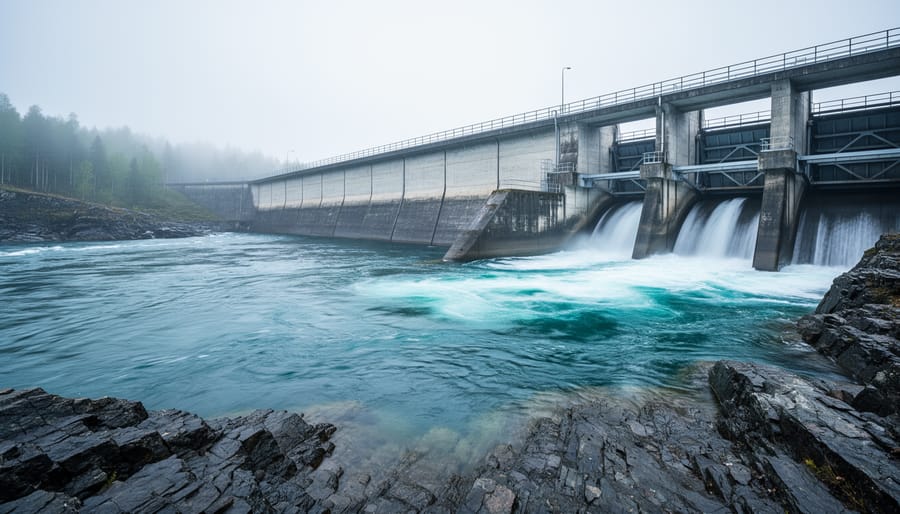
Hydroelectricity is generated by capturing the kinetic energy of flowing or falling water and converting it into electrical power through turbines connected to generators. This process, which accounts for approximately 16% of global electricity production, represents the world’s largest renewable energy source and has powered communities for over a century.
The physics behind hydroelectric generation are straightforward: water stored at height possesses gravitational potential energy that transforms into kinetic energy as it descends. When directed through turbines, this movement spins massive blades connected to electromagnetic generators, producing alternating current that feeds into power grids. The greater the water volume and vertical drop, known as head, the more electricity a facility can produce.
Understanding how hydroelectricity works matters now more than ever. As nations pursue aggressive decarbonization targets and seek reliable alternatives to fossil fuels, hydropower offers both baseload capacity and grid flexibility that intermittent sources like solar and wind cannot match. Facilities can ramp generation up or down within minutes, providing crucial stability as renewable penetration increases across electrical networks.
This article explains the complete hydroelectric generation process, from reservoir management through turbine mechanics to transmission. You’ll learn how different facility designs serve distinct purposes, from massive dam installations that regulate entire river systems to run-of-river plants that generate power with minimal environmental disruption. We’ll also examine recent innovations pushing efficiency boundaries and expanding hydropower’s role in modern energy systems, giving you a comprehensive view of this mature yet evolving technology.
What Hydroelectricity Means: The Science Behind Water Power
Hydroelectricity is the process of generating electricity by harnessing the energy of moving water. When water flows or falls from a height, it carries kinetic energy, energy of motion, that can be captured and transformed into electrical power through turbines and generators. This conversion relies on fundamental physics principles that have made hydropower one of humanity’s oldest and most reliable renewable energy sources.
The process begins with gravitational potential energy. Water stored at elevation, whether in a natural lake or behind a dam, possesses energy due to its position in Earth’s gravitational field. When released, gravity pulls the water downward, converting that stored potential energy into kinetic energy as the water accelerates. The greater the vertical drop and the larger the volume of water, the more energy becomes available for capture.
- Hydroelectricity
- Electrical power generated by converting the kinetic energy of flowing or falling water into electricity through turbines and generators.
- Kinetic Energy
- The energy an object possesses due to its motion; in hydropower, this refers to the energy of moving water.
- Potential Energy
- Stored energy an object has because of its position or elevation; water held at height has gravitational potential energy that converts to kinetic energy when released.
- Turbine
- A rotating machine with blades that captures the kinetic energy of flowing water and converts it into mechanical rotational energy.
- Generator
- An electrical device connected to the turbine that uses electromagnetic induction to convert mechanical rotation into electrical current.
- Head
- The vertical distance water falls from its source to the turbine; higher head means greater potential energy and more power generation capacity.
Water proves remarkably effective as an energy carrier because of its density and mass. Unlike air, which is diffuse and requires enormous volumes to generate meaningful power, water’s density means even modest flows deliver substantial force. A cubic meter of water weighs approximately one metric ton, so when thousands of cubic meters pass through turbines each second, the cumulative energy transfer is immense. This density advantage, combined with water’s renewable cycle through precipitation and runoff, explains why hydroelectricity accounts for a significant portion of global renewable generation capacity in 2026.
How Hydroelectricity Generation Works
The Role of Water Flow and Pressure
The amount of electricity a hydropower plant produces hinges on two physical factors: head and flow. Head is the vertical distance water falls from its reservoir or intake level to the turbine, think of it as stored gravitational potential energy. Flow, measured in cubic meters per second, is the volume of water passing through the turbine. Together, these determine output because power depends on head and flow in a straightforward relationship: more height or more water means more energy available to convert.
The basic formula engineers use is Power = ρ × g × Q × h × η, where ρ is water density, g is gravitational acceleration, Q is flow rate, h is head, and η is overall system efficiency. In practical terms, doubling the head doubles the power output if flow stays constant; similarly, doubling the flow doubles the power if head remains the same. A high-head facility with a modest river can match the generation of a low-head plant on a massive river, illustrating why site selection carefully weighs topography against water availability to maximize capacity.
Turbines and Generators: Converting Motion to Electricity
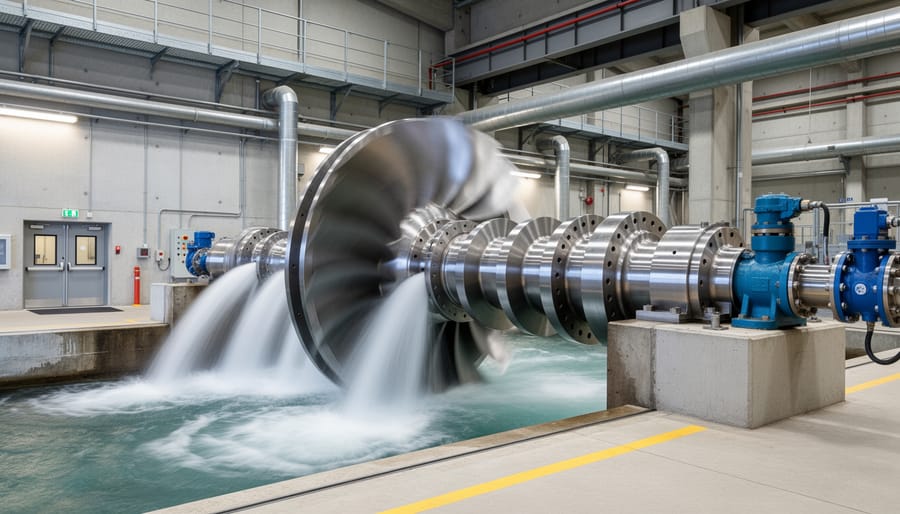
The turbine-generator assembly forms the heart of any hydroelectric plant, where mechanical motion becomes electrical current through a process called electromagnetic induction. As pressurized water strikes the turbine blades, it imparts rotational energy that spins the turbine shaft at speeds ranging from 60 to 750 revolutions per minute, depending on the facility design.
Connected directly to this shaft, the generator consists of two main components: a rotating element called the rotor and a stationary outer ring known as the stator. The rotor carries powerful electromagnets or permanent magnets that create a magnetic field, while the stator houses coils of copper wire wound in precise configurations. When the rotor spins inside the stator, the moving magnetic field cuts through the stationary wire coils, inducing an electric current, the principle Michael Faraday discovered in 1831.
This electromagnetic relationship converts roughly 90% of the mechanical energy into electricity, making hydroelectric generation remarkably efficient. The generator produces alternating current at the grid’s required frequency, typically 50 or 60 hertz. Larger facilities use synchronous generators weighing hundreds of tons, with rotors several meters in diameter, capable of producing 700 megawatts or more from a single unit.
Main Types of Hydroelectric Facilities
Impoundment (Reservoir) Systems
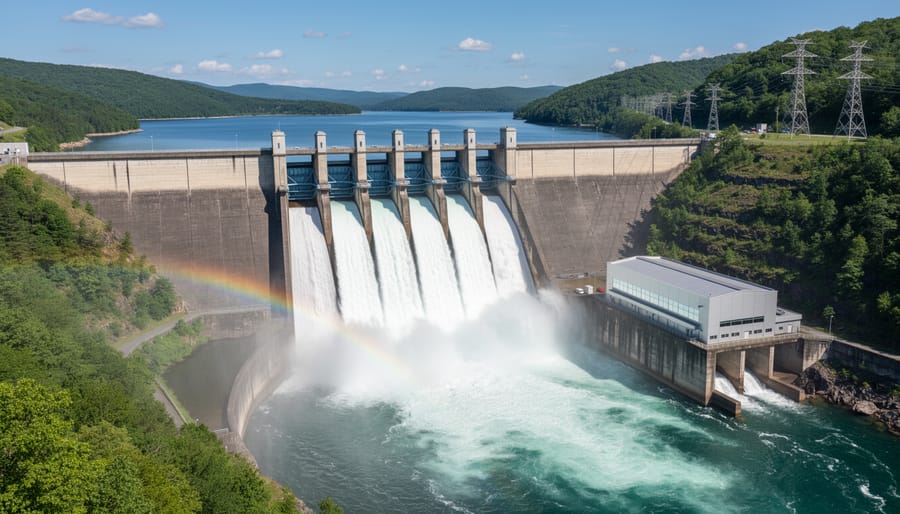
Impoundment systems represent the most common and powerful form of hydroelectric generation. These facilities rely on large dams that create artificial reservoirs, accumulating vast volumes of water at elevation. By controlling when and how much water flows through the turbines, operators can dispatch electricity precisely when the grid needs it, during morning peaks, evening surges, or emergency shortfalls.
The stored water acts as a battery of potential energy. A typical reservoir can hold days or weeks of generation capacity, allowing the plant to ramp up from zero to full output in minutes. This flexibility makes impoundment plants invaluable for grid stability. They achieve capacity factors often exceeding 50%, far higher than run-of-river installations, because generation isn’t tied to natural flow patterns.
Major examples include the Three Gorges Dam in China (22,500 MW) and Grand Coulee in the United States (6,809 MW), which anchor regional power supplies and provide flood control and irrigation benefits alongside electricity production.
Run-of-River Systems
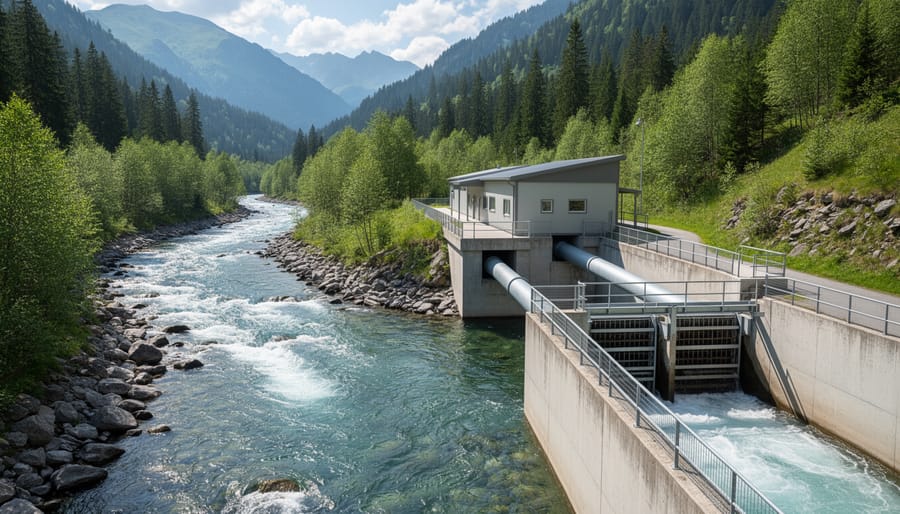
Run-of-river systems divert a portion of a river’s natural flow through turbines without creating large reservoirs. Unlike impoundment dams, these facilities typically use small weirs or intake structures that maintain the river’s baseline flow and ecology. Water passes through a penstock or canal to the powerhouse, spins the turbines, and returns downstream within a short distance, often less than a kilometer.
Because generation depends on real-time river discharge, output fluctuates with seasonal rainfall and snowmelt. During dry periods, capacity can drop significantly; wet seasons yield peak production. This variability makes run-of-river plants less suitable for baseload supply but ideal for supplementing grids in regions with consistent year-round streamflow. The minimal impoundment reduces sediment trapping, preserves fish migration corridors, and avoids displacing communities, advantages that have made run-of-river designs popular for small-scale and environmentally sensitive projects worldwide.
Pumped-Storage Hydropower
Pumped-storage hydropower functions as a large-scale rechargeable battery, storing energy by moving water between two reservoirs at different elevations. During periods of low electricity demand, typically overnight or mid-day when solar generation peaks, excess grid power drives electric motors that pump water from a lower reservoir uphill to an upper storage basin. When demand surges, operators reverse the process: releasing water downward through turbines to generate electricity on demand, often within minutes.
This bidirectional capability makes pumped storage uniquely valuable for grid stability. The round-trip efficiency ranges from 70% to 85%, meaning most of the energy used for pumping is recovered during generation. Unlike chemical batteries, these facilities can operate for 50 to 100 years with minimal capacity degradation, and they scale to gigawatt levels, storing enough energy to power millions of homes for hours. As wind and solar contribute more variable generation to grids, pumped storage increasingly serves as the backbone technology for balancing renewable supply with real-time demand.
Emerging Marine and Tidal Systems
Unlike conventional hydropower plants that rely on dams and reservoirs, marine and tidal systems extract energy directly from ocean movements without disrupting freshwater ecosystems. Tidal stream generators deploy underwater turbines in areas with strong tidal currents, capturing the predictable ebb and flow of coastal waters. These turbines resemble wind turbines but operate in denser fluid, generating consistent power during tidal cycles. Wave energy converters use various mechanisms, oscillating water columns, point absorbers, or attenuators, to transform surface wave motion into electricity. Ocean current turbines tap into steady deep-water flows like the Gulf Stream. While these technologies remain largely experimental or pilot-scale in 2026, they represent substantial untapped potential for coastal nations, offering renewable generation with minimal visual impact and no water storage requirements.
Hydropower Innovations Shaping the Industry
The hydropower sector is experiencing a technological renaissance driven by the dual imperatives of maximizing efficiency and minimizing ecological impact. Innovations emerging in 2026 are transforming both new installations and existing facilities, making hydroelectricity more adaptive, environmentally responsible, and economically viable.
Fish-friendly turbine designs represent one of the most significant ecological advances. Traditional turbines pose mortality risks to migrating fish, but new geometries, such as Alden turbines and Voith’s StreamDiver, feature larger blade spacing, slower rotation speeds, and optimized pressure gradients that allow safe fish passage while maintaining generation efficiency. Field trials at Columbia River dams have documented survival rates exceeding 98 percent for salmon passage through these redesigned units.
Digital monitoring and artificial intelligence are revolutionizing plant operations. Sensors embedded throughout facilities collect real-time data on flow rates, turbine vibration, sediment loads, and generator temperatures. Machine learning algorithms analyze these streams to predict optimal gate positions, schedule predictive maintenance before failures occur, and adjust output in milliseconds to match grid demand fluctuations. The Pacific Northwest National Laboratory has partnered with utilities to deploy AI systems that have increased generation efficiency by 7-12 percent while reducing unplanned downtime.
Several innovation areas are reshaping the industry’s technical frontier:
- Advanced composite materials in turbine blades resist cavitation damage and extend service life by decades
- Real-time data analytics platforms enable remote monitoring of distributed micro-hydro networks
- Ecological bypass systems integrate fish ladders and sediment flushing mechanisms into dam designs
- Modular micro-hydro units scale from 5 kW to 500 kW for decentralized rural electrification
- Energy storage integration combines pumped storage with battery arrays for flexible grid services
Hybrid solar-hydro systems are emerging as particularly promising. Floating photovoltaic arrays installed on reservoir surfaces generate daytime solar power while reducing evaporation, and shared transmission infrastructure lowers costs for both technologies. Portugal’s Alto Rabagão facility, retrofitted with 840 kW of floating solar in 2022, has demonstrated the model’s viability; projects ten times larger are under construction in Southeast Asia.
Sustainable retrofitting of aging dams unlocks capacity without new environmental footprints. Adding generators to non-powered dams, replacing 1960s-era turbines with modern variable-speed units, and deepening intakes to access cooler water for improved efficiency collectively represent a low-impact pathway to expand hydropower. The U.S. Department of Energy estimates that retrofitting existing infrastructure could add 12 gigawatts of capacity nationally, equivalent to building dozens of new wind farms, using structures already in place.
Where and How Hydroelectricity Is Used
Hydroelectric power serves multiple critical roles in modern energy systems, anchoring both large-scale grids and off-grid applications. Its versatility stems from the ability to scale generation instantly and provide reliable, carbon-free electricity across diverse geographic and economic contexts.
Base-Load Supply and Grid Stability
Most hydroelectric facilities operate as baseload power plants, delivering continuous electricity to national and regional grids. Countries with substantial water resources, such as Norway, Brazil, Canada, and China, rely on hydropower for 50% to nearly 100% of their domestic electricity generation. Beyond steady output, hydro plants excel at frequency regulation and voltage control. Operators can ramp turbines up or down within seconds, compensating for sudden demand spikes or renewable intermittency far faster than thermal plants. This rapid-response capability makes hydropower indispensable for grid operators integrating variable solar and wind capacity.
Remote and Rural Electrification
Small and micro-hydro systems bring electricity to isolated communities where grid extension is prohibitively expensive. Run-of-river installations rated below 10 MW power villages across the Himalayas, Southeast Asia, and the Andes with minimal infrastructure, often paired with local microgrids. These projects reduce diesel dependence and improve quality of life without the environmental footprint of large dams.
Industrial and Hybrid Applications
Energy-intensive industries, aluminum smelting, chemical production, data centers, site facilities near major hydro plants to secure low-cost, low-carbon power. Meanwhile, hybrid systems combine hydropower with solar or wind farms, using reservoirs as giant batteries: solar panels generate during the day, water is saved or pumped uphill, then released at night to fill the generation gap.
Common Questions About Hydroelectricity Generation
Hydroelectricity prompts recurring questions about its practical performance, environmental footprint, and economic viability compared to other renewable sources. Understanding the answers clarifies both the technology’s strengths and the trade-offs involved in deploying it at different scales.
How efficient is hydroelectricity compared to other renewables?
Hydroelectric plants convert 85 to 90 percent of available water energy into electricity, far surpassing the 20 to 40 percent efficiency typical of solar panels and wind turbines. This high conversion rate, combined with on-demand generation capability, makes hydropower one of the most efficient renewable technologies.
What are the main environmental concerns with hydropower?
Large dams disrupt river ecosystems by blocking fish migration, altering water temperature and sediment flow, and inundating habitats upstream. Modern mitigation strategies include fish ladders, bypass channels, environmental flow releases, and sediment management protocols to reduce these impacts.
Can hydropower work effectively in small streams?
Micro-hydro systems (under 100 kilowatts) and pico-hydro installations (under 5 kilowatts) generate reliable power from modest flows and low heads, making them viable for remote communities and off-grid applications. These small-scale projects require minimal infrastructure and avoid many environmental concerns associated with large dams.
How long do hydroelectric facilities last?
Well-maintained hydro plants operate for 50 to 100 years or longer, with concrete dams and civil structures lasting over a century. Turbines and generators require refurbishment every 30 to 40 years, but the core infrastructure far outlives solar panels (25-year lifespan) and wind turbines (20 to 25 years).
Cost competitiveness varies by project scale and geography. Large hydro installations have high upfront capital costs but deliver electricity at some of the lowest levelized costs once operational, often below five cents per kilowatt-hour. Run-of-river and pumped-storage projects carry different economic profiles: run-of-river systems avoid reservoir construction expenses but sacrifice output control, while pumped storage adds value through grid-scale energy arbitrage rather than continuous generation.
Scalability depends on available water resources and topography. Countries with abundant rainfall and mountainous terrain, Norway, Canada, Brazil, generate the majority of their electricity from hydro, while arid or flat regions find wind and solar more practical. Small and medium projects (1 to 50 megawatts) fit into diverse landscapes without displacing large populations, offering flexibility that gigawatt-scale dams cannot match. The technology adapts to local conditions rather than imposing a one-size-fits-all solution.
Hydroelectricity stands as the world’s oldest and most established renewable energy source, delivering reliable, low-carbon power for over a century while continuously adapting to modern environmental and grid demands. The technology’s maturity doesn’t mean stagnation. Innovations in turbine design, digital optimization, and hybrid integration are making hydropower more efficient, fish-friendly, and responsive to variable renewable portfolios than ever before.
As nations accelerate their clean energy transitions, hydropower’s dual role becomes increasingly valuable: it generates substantial baseload electricity while providing the flexible storage and grid stabilization that intermittent sources like wind and solar cannot offer alone. Pumped-storage facilities function as massive batteries, balancing supply and demand across hours and seasons. Run-of-river and modular systems expand access to communities where large dams aren’t feasible.
The path forward depends on continued technological refinement, stricter environmental safeguards, and policy frameworks that recognize hydropower’s unique contributions to energy security and climate goals. With thoughtful planning and investment, this proven resource will remain central to a diversified, resilient global energy system well beyond 2026.