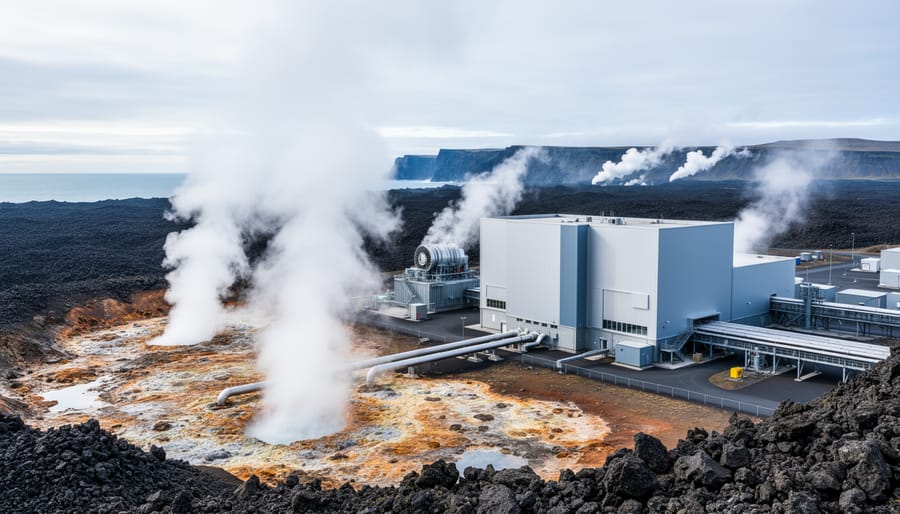
Iceland operates the world’s most sophisticated geothermal energy infrastructure, harnessing volcanic heat beneath the island to generate approximately 30% of its electricity and heat nearly 90% of its homes. Six major power plants tap into high-temperature reservoirs created by the Mid-Atlantic Ridge, where the North American and Eurasian tectonic plates diverge. This geological advantage transforms what could be a destructive force into a reliable geothermal power source that has redefined the nation’s energy landscape.
The country’s approach combines conventional flash-steam and binary-cycle technology with cutting-edge innovations, including the world’s first commercial carbon mineralization facility at Hellisheiði. Unlike most renewable energy sources, geothermal plants provide baseload power around the clock, making Iceland one of the few nations to achieve near-complete energy independence while maintaining some of the lowest electricity costs in Europe.
What makes Iceland’s success particularly relevant in 2026 is not merely the volcanic geology, which few countries share, but the integrated planning, regulatory frameworks, and technological advances that emerged from decades of focused development. From the 120-megawatt Hellisheiði plant serving the capital region to the 303-megawatt Reykjanes facility, these installations demonstrate how strategic investment in site-specific engineering can maximize resource potential. The lessons extend beyond electricity generation to district heating networks, industrial applications, and carbon sequestration methods now being studied for deployment elsewhere.
Why Iceland’s Geology Makes It a Geothermal Powerhouse
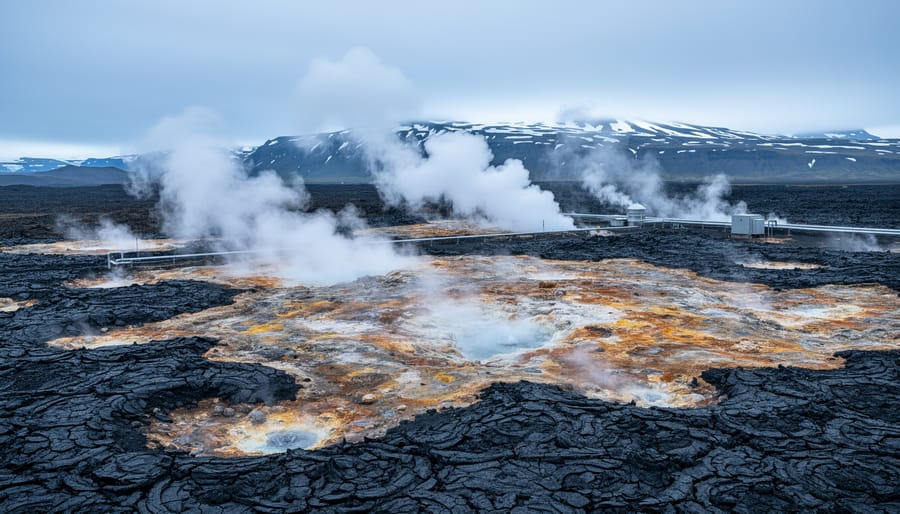
Iceland sits directly atop the Mid-Atlantic Ridge, the underwater mountain range marking the boundary where the North American and Eurasian tectonic plates pull apart at roughly 2 centimeters per year. This placement gives the island nation access to geothermal conditions that few other populated regions can match.
The diverging plates create pathways for magma to rise unusually close to the surface. At depths of just 1,000 to 3,000 meters, shallow by geothermal standards, engineers can tap into reservoirs where temperatures routinely reach 200 to 350°C. These high-temperature fields generate pressurized steam and superheated water suitable for driving industrial-scale turbines, not merely heating buildings.
Iceland hosts approximately 30 active volcanic systems concentrated in a diagonal rift zone running southwest to northeast across the country. Each system comprises fissure swarms, central volcanoes, and associated geothermal areas. Hengill, Reykjanes, and Krafla represent some of the most productive, with extensive fracture networks that allow water to circulate through hot rock and return enriched with thermal energy. This concentration means Iceland packs more exploitable geothermal activity into 103,000 square kilometers than continents spread across millions.
Contrast this with most volcanic regions, where active systems lie scattered or buried under thick continental crust. Countries like Japan and Indonesia have abundant volcanism but typically need to drill far deeper or settle for moderate-temperature resources. Even other rift zones lack Iceland’s combination of shallow magma chambers, fractured basaltic bedrock that facilitates fluid circulation, and high annual precipitation that continuously recharges underground reservoirs. The result is a renewable resource density that makes commercial geothermal power economically viable at scale, positioning Iceland as both an energy exporter and a living laboratory for geothermal engineering.
Iceland’s Major Geothermal Power Plants
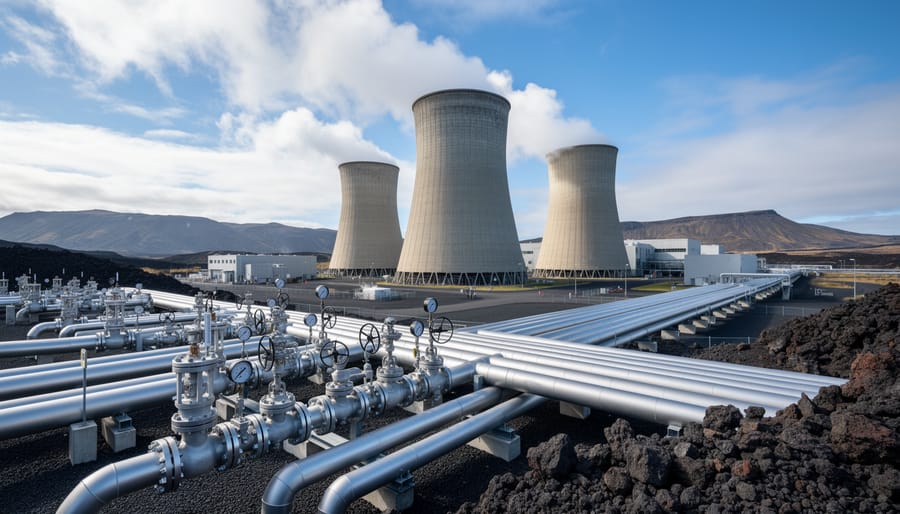
Iceland operates five flagship geothermal power plants that collectively demonstrate the country’s technological sophistication and strategic resource management. These facilities account for the bulk of Iceland’s geothermal electricity generation, with each plant designed around the specific characteristics of its underlying reservoir.
Hellisheiði stands as the crown jewel of Iceland’s geothermal infrastructure. Located approximately 30 kilometers east of Reykjavik on the Hengill volcano, this 303 MW facility commissioned in 2006 ranks among the world’s largest geothermal plants. Hellisheiði distinguishes itself through its pioneering CarbFix system, which captures geothermal CO2 and H2S emissions and mineralizes them into basalt rock. The plant operates six turbines and supplies both electricity to the national grid and hot water to the Greater Reykjavik area through a 26-kilometer pipeline.
Nesjavellir, commissioned in 1990 on the western slopes of Hengill, generates 120 MW of electricity while simultaneously producing 1,800 liters per second of hot water for district heating. The facility taps into reservoirs reaching 300°C and employs a sophisticated system of separator stations to manage steam quality. Its proximity to Þingvallir National Park required careful environmental planning during construction.
| Plant Name | Capacity (MW) | Year Commissioned | Reservoir Temperature | Special Features |
|---|---|---|---|---|
| Hellisheiði | 303 | 2006 | 200-350°C | CarbFix carbon capture, dual power/heat generation |
| Nesjavellir | 120 | 1990 | 280-320°C | High-volume district heating supply, multiple separator stations |
| Krafla | 60 | 1977 | 200-300°C | Operates through volcanic eruption cycles, north Iceland grid anchor |
| Reykjanes | 100 | 2006 | 290-320°C | Seawater reinjection system, Reykjanes Peninsula location |
| Svartsengi | 76 | 1976 | 240°C | Blue Lagoon spa byproduct, combined power/water generation |
Krafla power station, situated in Iceland’s remote northeast near Lake Mývatn, began operations in 1977 and has weathered multiple volcanic eruptions during its lifetime. The 60 MW facility serves as the primary electricity source for north Iceland, demonstrating geothermal’s reliability even in volcanically active zones. Krafla’s wells have occasionally encountered magma intrusions, providing valuable data on extreme reservoir conditions.
Reykjanes, commissioned in 2006 on the Reykjanes Peninsula, generates 100 MW from one of Iceland’s hottest accessible reservoirs. The plant employs a unique seawater reinjection system rather than freshwater, addressing concerns about long-term water availability. Its location on the Mid-Atlantic Ridge makes it particularly valuable for studying plate boundary geothermal systems.
Svartsengi, operating since 1976 near Grindavik, produces 76 MW while creating the renowned Blue Lagoon spa as a beneficial byproduct. The facility combines electricity generation with freshwater production through mineral extraction from geothermal fluids, showcasing multiple revenue streams from a single resource.
These plants are deliberately distributed to match Iceland’s dual constraints: proximity to high-temperature geothermal fields and access to demand centers or transmission infrastructure. The concentration around Reykjavik reflects both exceptional resources on the Hengill volcanic system and the capital’s energy requirements, while Krafla serves the dispersed northern population.
How Geothermal Power Plants in Iceland Generate Electricity
Iceland’s geothermal plants tap into reservoirs of superheated water and steam trapped beneath the surface at temperatures between 200 and 350°C. Production wells, drilled one to three kilometers deep, bring this geothermal fluid to the surface where the generation process begins. Understanding how a geothermal plant works requires following this fluid through two distinct system types.
Most Icelandic facilities use flash steam technology, the dominant method for high-temperature resources. As pressurized geothermal water rises through the production well, the pressure drops rapidly, causing a portion to “flash” into steam. Separator vessels at the surface split this mixture: steam is channeled directly to turbines that spin generators, producing electricity, while the remaining hot water either goes through a secondary flash process at lower pressure to extract more steam or moves to the district heating system.
Binary cycle plants, employed where reservoir temperatures are lower or as secondary systems, use a different approach. The geothermal fluid never contacts the turbine. Instead, it passes through heat exchangers, transferring thermal energy to a secondary working fluid with a low boiling point, typically an organic compound like isobutane. This fluid vaporizes, drives the turbine, then condenses and repeats the cycle in a closed loop.
After steam passes through the turbines and condensers, or after binary systems extract heat, the cooled geothermal fluid faces a critical next step: reinjection. Rather than discard this water, operators pump it back into the reservoir through dedicated injection wells, typically placed at the reservoir’s periphery. This maintains underground pressure, sustains the geothermal system’s productivity over decades, and prevents subsidence. Reinjection also returns dissolved minerals and trace gases to depth, minimizing surface environmental impact. Iceland’s plants reinject 90-100% of extracted fluids, making the process nearly a closed loop and ensuring resource longevity for generations.
Combined Heat and Power: Maximizing Efficiency
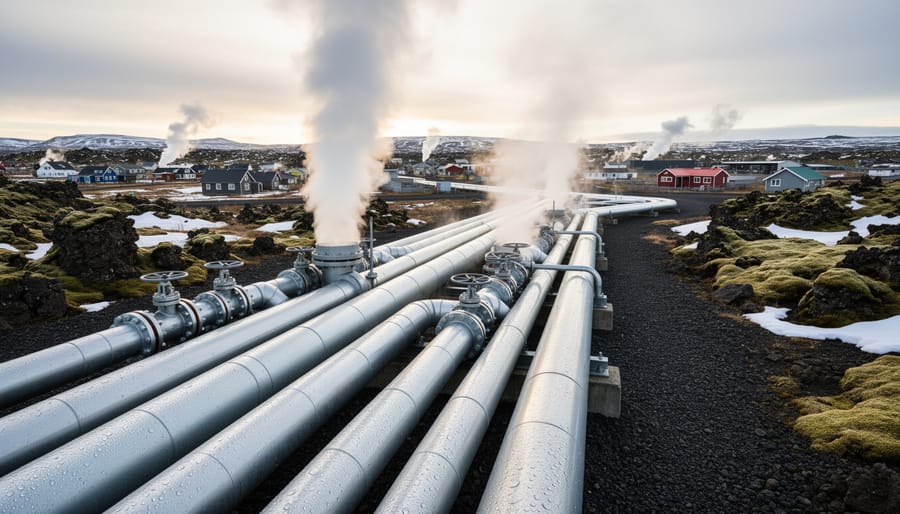
Iceland’s geothermal facilities don’t just produce electricity, they extract maximum value from every drop of hot water. After steam drives the turbines, the remaining hot water (typically 80-120°C) is piped directly to homes and businesses rather than being discarded. This cogeneration approach achieves overall system efficiencies exceeding 85%, far surpassing single-purpose power plants that waste most thermal energy.
Reykjavik operates one of the world’s most extensive district heating networks, with over 3,000 kilometers of insulated pipelines delivering geothermal water to roughly 95% of the capital area’s buildings. The system distributes water from multiple sources, Nesjavellir, Hellisheiði, and smaller regional plants, blending flows to maintain consistent supply temperatures around 80°C for space heating and 65°C for domestic hot water. Computerized control systems balance supply across zones, adjusting for seasonal demand and optimizing pressure to minimize pumping costs.
The infrastructure includes massive storage tanks that buffer supply against demand fluctuations, ensuring residents never experience shortages during consumption peaks. After delivering heat through building radiators and hot water systems, the cooled water (now 30-40°C) returns through separate pipes for reinjection or further heat extraction.
Beyond Reykjavik, smaller communities like Akureyri and Húsavík run their own district systems, collectively heating over 90% of Iceland’s buildings. This integrated model eliminates the need for individual boilers, slashes maintenance costs, and virtually eliminates residential heating emissions, transforming geothermal generation into a comprehensive energy solution rather than mere electricity production.
Environmental Impact and Carbon Capture Innovations
Geothermal power plants do release trace emissions during operation, but the environmental footprint is vastly smaller than fossil fuel alternatives. Geothermal fluids naturally contain dissolved gases, primarily carbon dioxide and hydrogen sulfide, which escape during steam extraction. Iceland’s facilities emit roughly 5-10% of the CO2 per kilowatt-hour compared to coal-fired plants, yet the country recognized that even these modest emissions could be further reduced through innovation.
The Hellisheiði plant, operated by Reykjavik Energy, became the testing ground for CarbFix, a groundbreaking carbon capture and storage technology. Instead of venting CO2 and hydrogen sulfide into the atmosphere, operators capture these gases from the steam separators, dissolve them in water, and inject the carbonated mixture into the surrounding basalt rock formations at depths of 500-800 meters. The dissolved gases react with calcium, magnesium, and iron in the basalt, forming stable mineral carbonates through a natural process that typically requires millennia, but occurs within two years under the engineered conditions at Hellisheiði.
Since 2014, CarbFix has mineralized over 95% of injected CO2, effectively achieving zero-emissions operation and demonstrating significant GHG emissions reductions. The technology’s success has attracted international attention because basalt formations cover roughly 10% of Earth’s land surface and vast ocean floor areas, making the approach potentially scalable to geothermal projects worldwide. Iceland’s operational proof-of-concept has influenced similar pilot programs in the United States, Kenya, and Indonesia, positioning CarbFix as a blueprint for next-generation geothermal facilities that eliminate rather than merely reduce atmospheric impacts.
Economic and Social Benefits for Iceland
Iceland’s geothermal infrastructure delivers measurable economic returns that extend far beyond electricity generation. Residential electricity prices in Iceland average around $0.08 per kilowatt-hour, substantially below the European average of approximately $0.20-0.30, giving households and businesses a significant cost advantage. This pricing stability stems from domestic resource control, insulating the economy from volatile international energy markets and eliminating the need for fossil fuel imports that once drained foreign currency reserves.
Energy independence has reshaped Iceland’s industrial landscape. The country attracts aluminum smelters, silicon production facilities, and data centers that require enormous, reliable power supplies at competitive rates. These energy-intensive industries account for roughly 70% of Iceland’s electricity consumption and contribute substantially to GDP and export revenues. The geothermal sector itself employs thousands in specialized roles spanning drilling operations, plant maintenance, engineering design, and geological surveying, creating high-skill jobs in rural areas near power plants.
Tourism adds an unexpected economic layer. The Blue Lagoon, fed by mineral-rich runoff from the Svartsengi geothermal plant, attracts over 700,000 visitors annually and has become one of Iceland’s most valuable tourism assets. Similar spa facilities have emerged near other plants, turning industrial byproducts into revenue streams while demonstrating geothermal energy’s multifaceted value.
This economic model proves that renewable energy infrastructure can anchor broad-based prosperity rather than representing mere environmental investment.
Lessons for Global Geothermal Development
Iceland’s half-century of geothermal development offers a blueprint that extends far beyond its unique volcanic setting. While few regions can match the shallow, high-temperature reservoirs found along the Mid-Atlantic Ridge, the principles underpinning Iceland’s success translate across diverse geological contexts.
Comprehensive geological assessment forms the foundation. Iceland invested decades in mapping subsurface temperatures, permeability, and fluid chemistry before drilling production wells. Countries exploring geothermal potential must commit to rigorous surveys and exploratory drilling, accepting that early-stage data collection carries financial risk but prevents costly failures later.
Long-term resource stewardship matters as much as initial extraction. Icelandic operators continuously monitor reservoir pressure, temperature, and chemistry, adjusting extraction rates and reinjection strategies to maintain equilibrium. This contrasts sharply with short-term exploitation models that deplete fields within decades. Countries adopting Iceland’s meticulous reinjection protocols and adaptive management can sustain output for centuries rather than exhausting resources prematurely.
Regulatory clarity accelerates development while protecting resources. Iceland’s framework assigns subsurface rights clearly, requires environmental impact assessments, and mandates monitoring, yet streamlines permitting enough to avoid bureaucratic paralysis. Nations establishing similar transparent, science-based regulations create investor confidence without sacrificing oversight.
Public-private partnerships distribute risk effectively. Iceland’s model blends state geological expertise with private capital and operational efficiency. Governments can derisk exploration through early-stage funding and data sharing, then transition successful projects to private operators.
Global geothermal capacity reached approximately 16 gigawatts by late 2024, with projections suggesting 25-30 GW by 2030 as countries like Kenya, Indonesia, and the Philippines expand operations. The technology Iceland refined, binary cycle plants, carbon capture integration, cogeneration systems, now serves as standard practice worldwide. Even regions without Iceland’s exceptional geology can achieve competitive returns by applying these operational principles, proving that while the resource is geographically constrained, the knowledge is universally applicable.
Common Questions About Iceland’s Geothermal Power
How long will Iceland’s geothermal resources last?
Iceland’s geothermal resources are considered renewable on human timescales when managed properly. Sustainable extraction rates, combined with reinjection of cooled water to maintain reservoir pressure and heat, allow these systems to operate indefinitely. The heat source, magma chambers beneath active volcanic zones, continuously replenishes thermal energy.
Can geothermal plants cause earthquakes?
Geothermal operations can trigger minor seismic events, particularly during drilling or fluid injection, but these are typically low-magnitude tremors that pose no danger to infrastructure or populations. Iceland’s operators monitor seismic activity continuously and adjust injection practices to minimize induced seismicity.
Why doesn’t every volcanic country replicate Iceland’s success?
Iceland benefits from exceptionally accessible high-temperature reservoirs close to population centers, stable governance, and decades of technical expertise. Many volcanic regions have suitable geology but face challenges like remote locations, lack of capital for initial development, inadequate transmission infrastructure, or political instability that deters long-term investment.
How much of Iceland’s total energy comes from renewables?
Renewables supply virtually all of Iceland’s electricity and heating needs. Geothermal accounts for roughly 30% of electricity generation and nearly 90% of home heating, while hydropower produces the remaining 70% of electricity. Fossil fuels are used primarily for transportation and fishing vessels.
What challenges do geothermal operators face?
Operators contend with corrosive geothermal fluids that degrade equipment, requiring specialized materials and frequent maintenance. Reservoir management demands careful monitoring to prevent overextraction and cooling, while trace gas emissions necessitate carbon capture systems. Drilling costs remain substantial, and locating productive wells involves geological uncertainty.
Despite its success, Iceland’s geothermal sector requires constant vigilance. Operators balance extraction rates against reservoir recharge, invest heavily in corrosion-resistant turbines and piping, and adapt to each field’s unique chemistry. The country’s small population and compact geography simplify grid integration, but scaling these lessons to larger nations with dispersed demand introduces complexities around transmission losses and regional variability in geothermal potential.
Iceland’s geothermal power infrastructure stands as a living laboratory for renewable energy, proving that volcanic geology can underpin an entire nation’s electricity and heating needs. Over fifty years of continuous operation have yielded not just reliable baseload power but also breakthrough innovations in carbon capture, reservoir management, and integrated cogeneration systems. While few regions possess Iceland’s geological advantages, accessible high-temperature reservoirs and concentrated tectonic activity, the technical frameworks, sustainability protocols, and long-term planning approaches developed here translate across diverse settings.
The country’s experience demonstrates that geothermal energy, when properly managed, delivers more than clean electricity. It creates energy independence, stabilizes costs, enables climate-intensive industries, and sustains resources across generations. As global energy systems pivot away from fossil fuels, geothermal capacity is expanding beyond traditional volcanic zones through enhanced geothermal systems and deeper drilling technologies. Iceland’s half-century track record offers crucial operational data, engineering solutions, and policy models. The volcanic island didn’t just tap its underground heat, it built a replicable blueprint for integrating geothermal power into comprehensive, resilient energy systems that can accelerate decarbonization worldwide.