Eight windmills refers to the primary categories of wind turbine designs and configurations that have emerged as the backbone of modern wind energy generation, classified by axis orientation, blade architecture, and operational scale. These distinct turbine types range from massive offshore three-blade horizontal-axis machines generating over 15 megawatts to compact vertical-axis designs suited for urban rooftops, each engineered to extract kinetic energy from wind under specific environmental and economic constraints.
Understanding these eight configurations matters because selecting the wrong turbine type for a given site can cut energy output by 40 percent or more while inflating maintenance costs. Wind project developers, energy consultants, and sustainability officers regularly face decisions about whether to deploy upwind versus downwind rotors, fixed-speed versus variable-speed generators, or onshore versus floating offshore platforms. Each choice carries implications for capacity factor, levelized cost of energy, and grid integration requirements.
This article breaks down the operating principles that differentiate these eight windmill categories, examines the mechanical and aerodynamic components that define each type, and maps real-world applications where specific designs deliver measurable advantages. By 2026, global wind capacity has surpassed 1,100 gigawatts, yet many stakeholders still struggle to distinguish between turbine architectures or understand why certain designs dominate particular markets. The technical distinctions explained here provide the foundation for informed infrastructure planning, policy development, and investment decisions in an industry projected to double installed capacity by 2030.
What ‘8 Windmills’ Means in Wind Energy Innovation
In wind energy innovation, “8 windmills” represents a framework for understanding eight distinct turbine architectures and deployment strategies that collectively push the boundaries of renewable power generation. Rather than a literal count of identical structures, this refers to categorically different approaches, horizontal-axis machines, vertical-axis designs, offshore floating platforms, distributed small-scale units, hybrid systems, airborne energy devices, dual-rotor configurations, and adaptive intelligent turbines. Each represents a leap in how wind energy is captured, converted, and delivered to the grid.
This classification serves as both a technical reference and a teaching framework. Engineers use it to distinguish fundamental design philosophies, while policymakers and investors employ it to assess which solutions fit specific geographic and economic contexts. Understanding these eight categories clarifies why no single turbine type dominates all markets, coastal installations demand different engineering than inland farms, and urban environments require approaches unsuitable for open plains.
- Horizontal-Axis Wind Turbine (HAWT)
- A turbine with blades rotating around a horizontal shaft parallel to the ground, representing the most common commercial design. These machines dominate utility-scale installations due to proven efficiency and scalability.
- Vertical-Axis Wind Turbine (VAWT)
- A turbine with blades rotating around a vertical shaft perpendicular to the ground, allowing omnidirectional wind capture. This design excels in turbulent urban environments and small-scale applications.
- Capacity Factor
- The ratio of actual energy output to maximum possible output over a given period, typically expressed as a percentage. Modern offshore turbines achieve capacity factors above forty percent, while older onshore models often remain below thirty percent.
- Floating Offshore Platform
- A moored structure supporting wind turbines in deep waters where fixed-bottom foundations are impractical. This approach unlocks access to stronger, more consistent winds beyond continental shelves.
The framework matters because wind energy improvements depend on matching turbine type to site conditions. A dual-rotor system that maximizes output in steady offshore breezes delivers little advantage in gusty mountain passes, where adaptive pitch controls prove more valuable. Recognizing these eight categories helps stakeholders select appropriate technology rather than applying one-size-fits-all solutions to diverse environments.
How These Eight Wind Turbine Innovations Work
Aerodynamic and Blade Design Advances
The eight turbine configurations employ distinct blade design strategies to maximize energy capture under varying conditions. Traditional horizontal-axis models use slender, swept blades with optimized twist distributions that adjust angle of attack along the span, while vertical-axis variants feature straight or helical blades that capture wind from any direction without yaw mechanisms. Offshore floating and dual-rotor designs integrate lighter composite materials, carbon fiber reinforced with glass layers, to reduce structural loads while maintaining stiffness at extended lengths beyond 100 meters.
Airflow optimization differs markedly across types. Horizontal-axis turbines refine leading-edge profiles to delay flow separation at high angles, whereas vertical-axis designs incorporate vortex generators and adaptive pitch control to stabilize torque output. Computational fluid dynamics modeling and aerodynamic efficiency assessment guide these refinements, targeting lift-to-drag ratios above 100:1 in premium blade sections. Airborne and adaptive turbines push boundaries further with morphing geometries that alter camber in real time, responding to wind shear gradients at altitude or during gusty conditions, extracting 15-20% more energy than fixed profiles under the same wind regime.
Power Conversion and Grid Integration
The eight windmill configurations employ sophisticated power conversion architectures that transform mechanical rotation into grid-ready electricity with minimal losses. Modern permanent magnet synchronous generators have largely replaced older geared systems, operating at variable speeds to capture maximum energy across changing wind conditions. These direct-drive units eliminate gearbox friction and maintenance issues while improving efficiency by 2-3 percentage points.
Power electronics serve as the critical interface between turbine and grid. Full-scale converters decouple rotor speed from grid frequency, allowing turbines to operate at optimal rotation rates regardless of wind fluctuation. Advanced inverters convert variable-frequency AC output to DC, then reconvert to grid-synchronized AC at precisely 50 or 60 Hz. This two-stage process enables turbines to provide reactive power support and voltage regulation services previously impossible with fixed-speed designs.
Smart grid integration represents the final advancement. Real-time communication protocols allow turbines to respond to grid operator signals within milliseconds, adjusting output to match demand or providing ancillary services like frequency stabilization. Forecasting algorithms predict wind patterns hours ahead, enabling grid managers to coordinate conventional generation sources and reduce curtailment of wind energy during high-production periods.
The Eight Windmill Types and Configurations
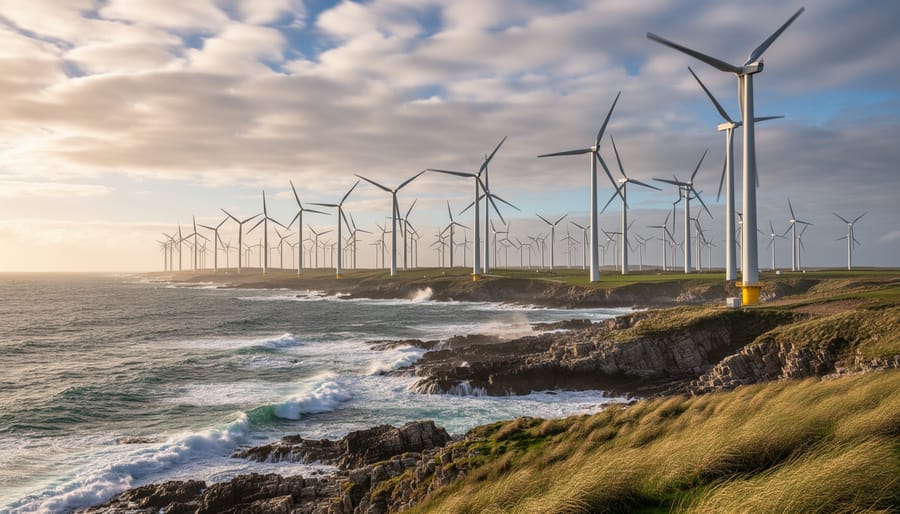
The eight windmill innovations represent distinct evolutionary branches in turbine design, each addressing specific challenges in wind energy deployment and efficiency.
Horizontal-Axis Wind Turbines (HAWTs) remain the dominant commercial design, featuring three-blade rotors mounted on tall towers that rotate perpendicular to the wind direction. Modern HAWTs incorporate advanced pitch control systems that adjust blade angles in real-time, optimizing energy capture across varying wind speeds. These turbines now reach hub heights exceeding 150 meters and blade lengths surpassing 80 meters, accessing stronger, more consistent winds at altitude. Their proven reliability and economies of scale make them the workhorse of utility-scale wind farms.
Vertical-Axis Wind Turbines (VAWTs) mount their generator at ground level and capture wind from any direction without requiring yaw mechanisms. The Darrieus rotor design uses curved blades that create lift through aerodynamic forces, while Savonius turbines rely on drag forces with simpler S-shaped scoops. VAWTs excel in turbulent urban environments where wind direction shifts frequently, innovations like the O wind turbine demonstrate how omnidirectional capture suits building-mounted installations. Their lower center of gravity reduces structural stress, though traditional VAWTs lag HAWTs in efficiency at utility scale.
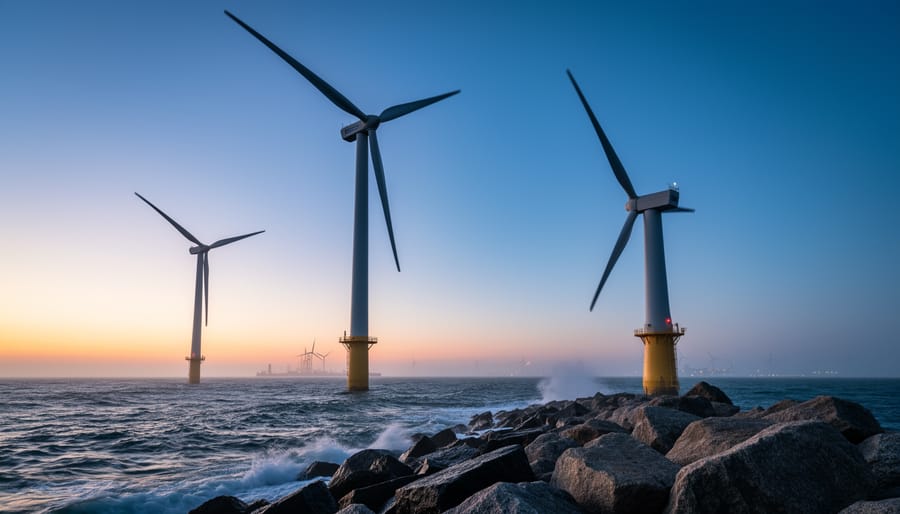
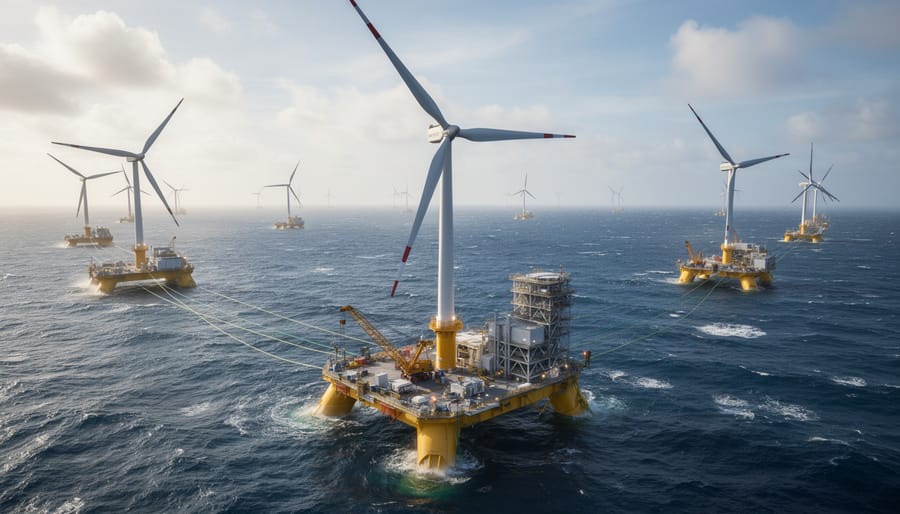
Offshore Floating Platforms extend wind energy to deep waters beyond fixed-foundation limits. Spar-buoy, semi-submersible, and tension-leg platform designs anchor turbines in waters 60 to 300 meters deep, accessing consistent offshore winds previously unreachable. Hywind Scotland demonstrated commercial viability with capacity factors exceeding 50 percent, substantially higher than most onshore installations. These platforms incorporate dynamic positioning systems and mooring configurations that accommodate wave motion while maintaining generator stability.
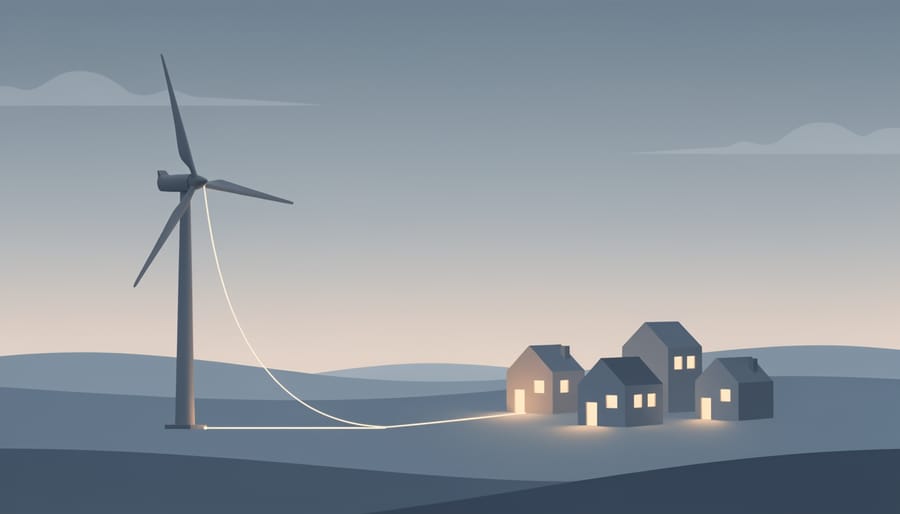
Distributed Small-Scale Units range from rooftop micro-turbines generating 400 watts to community-scale systems producing 100 kilowatts. These units serve remote locations, agricultural operations, and telecommunications infrastructure where grid connection costs prove prohibitive. Modern small turbines feature permanent magnet generators and microprocessor controls that were previously economical only at larger scales, improving performance and reducing maintenance intervals.
Hybrid Systems integrate wind turbines with complementary generation sources, commonly solar photovoltaic arrays and battery storage. Wind-solar hybrids capitalize on inverse generation patterns: wind typically peaks at night and during winter months when solar output drops. Shared inverters, transmission infrastructure, and land use lower the combined installation cost per megawatt compared to standalone facilities. Some hybrid configurations pair wind with pumped hydro storage or hydrogen electrolysis systems.
Airborne Wind Energy (AWE) Devices use tethered wings, kites, or rigid airframes to harvest wind at altitudes between 200 and 600 meters, where jet-stream winds reach higher sustained speeds. Ground-based generators convert the mechanical energy from tensioned tethers into electricity through either fly-gen systems (onboard generators) or ground-gen approaches (tether pulling). AWE systems require 90 percent less material than tower-mounted turbines of equivalent capacity, reducing manufacturing costs and environmental footprint, though operational reliability remains under development.
Dual-Rotor Configurations mount two counter-rotating rotors on a single tower, either co-axial on one hub or on opposite ends of a crossbeam. Counter-rotation cancels gyroscopic forces that stress conventional single-rotor towers, enabling larger swept areas on lighter structures. Vestas and other manufacturers have tested dual-rotor prototypes showing 25 to 40 percent capacity gains over single-rotor equivalents of the same tower height.
Adaptive Intelligent Turbines employ machine learning algorithms and sensor networks to optimize performance parameters continuously. Lidar systems scan incoming wind fields several seconds ahead, allowing predictive pitch and yaw adjustments before gusts arrive. These turbines communicate within wind farm arrays to reduce wake interference, upstream turbines adjust their operation to minimize turbulence affecting downstream units, increasing total farm output by 3 to 8 percent according to field trials.
Applications and Real-World Uses of Advanced Wind Turbines
The eight advanced wind turbine technologies have found deployment across diverse environments, each exploiting specific design advantages to meet distinct energy needs. Utility-scale wind farms remain the most visible application, where large horizontal-axis turbines with aerodynamic blade improvements now operate in wind corridors across the Great Plains, West Texas, and offshore Atlantic sites. These installations benefit from economies of scale and direct high-voltage grid connections, with modern farms often combining multiple turbine types to optimize capture across varying wind conditions.
Offshore installations represent the fastest-growing deployment sector for several of these innovations. Floating platform turbines have opened access to deep-water sites beyond traditional fixed-foundation limits, while dual-rotor configurations maximize energy capture in consistent marine winds. The North Sea, Baltic Sea, and emerging Pacific coast sites now host hundreds of advanced offshore units, taking advantage of stronger, steadier winds unavailable to land-based systems. Geographic considerations here center on water depth, distance from shore for transmission infrastructure, and environmental impact assessments.
Remote and off-grid communities have embraced smaller-scale vertical-axis and distributed turbine systems. Arctic research stations, island populations, and rural industrial facilities use these units to reduce diesel generator dependence, often pairing them with battery storage or solar arrays in hybrid configurations. These deployments prioritize reliability and low maintenance over maximum output, with turbines selected for performance in extreme temperatures or variable wind directions.
Deployment contexts now extend to:
- Offshore deep-water sites using floating platforms in waters exceeding 60 meters depth
- Arctic regions where conventional turbines struggle with icing and extreme cold
- Urban environments employing compact vertical-axis designs on building rooftops
- Developing nations installing community-scale units for village electrification projects
Industrial facilities increasingly integrate airborne wind energy devices and adaptive intelligent turbines into their operations. Manufacturing plants, data centers, and mining operations use these systems to offset grid consumption and meet corporate renewable targets. Grid integration scenarios have evolved to accommodate the variable output profiles of different turbine types, with smart inverters and forecasting algorithms smoothing power delivery and maintaining frequency stability across regional transmission networks.
Performance Improvements Over Traditional Wind Energy
The eight advanced turbine approaches have collectively pushed modern wind installations past what conventional horizontal-axis machines could achieve. Research from Stanford University and MIT found that capacity factors, the actual power output versus theoretical maximum, have improved from roughly 30 percent for older designs to over 45 percent with these innovations. Offshore floating platforms and taller hub heights capture steadier, faster winds, while vertical-axis and dual-rotor configurations extract more energy per swept area.
Levelized cost of energy has dropped dramatically. The National Renewable Energy Laboratory documented a 70 percent cost reduction in onshore wind between 2010 and 2025, accelerated by the manufacturing efficiencies and materials breakthroughs embedded in these eight designs. Offshore installations, particularly floating platforms, saw costs fall from over $200 per megawatt-hour to under $80 as fabrication scaled and supply chains matured.
Wind energy efficiency gains translate directly to environmental benefits. A single 15-megawatt offshore turbine, compared to older 3-megawatt models, displaces five times the fossil fuel generation while occupying the same ocean footprint. University of California research calculated that distributed small-scale units reduce transmission losses by up to 12 percent when deployed near demand centers, cutting overall system carbon intensity.
The hybrid systems and adaptive intelligent turbines deliver further performance jumps. Smart controls optimize blade pitch in real time, boosting annual energy production by 8 to 15 percent according to Technical University of Denmark studies. These improvements compound: higher capacity factors, lower costs, and enhanced GHG emissions reductions together make wind competitive with natural gas in many markets without subsidies.
Common Questions About Advanced Wind Turbine Technologies
Choosing among the eight turbine innovations depends on specific project goals, site conditions, and budget constraints. These designs emerged to address varied contexts, offshore installations face different challenges than urban environments or rural plains. Understanding practical trade-offs helps stakeholders make informed deployment decisions.
Which of the eight types offers the best cost-efficiency?
Dual-rotor horizontal-axis turbines and adaptive intelligent systems generally deliver strong cost-efficiency for utility-scale projects, combining high capacity factors with moderate installation costs. Small-scale distributed units excel where grid connection costs are prohibitive.
Can these designs retrofit existing wind farms?
Adaptive intelligent turbine systems can often integrate with existing infrastructure through controller upgrades and sensor installations. Blade design improvements may work as replacements during scheduled maintenance, but floating platforms and vertical-axis designs typically require new installations.
What are the environmental trade-offs?
Vertical-axis and airborne systems reduce bird collision risks compared to traditional horizontal designs. Floating offshore platforms minimize seabed disruption but introduce marine noise during installation, similar to wind vs hydropower impact comparisons in aquatic ecosystems.
How long do these advanced turbines last?
Most designs target 25-30 year operational lifespans with proper maintenance, comparable to conventional turbines. Airborne and hybrid systems have shorter track records, with manufacturers projecting 20-year service lives pending long-term validation.
Maintenance requirements vary significantly across the eight types. Offshore floating units need specialized vessels for inspections, while distributed small-scale turbines allow ground-level servicing without cranes. Vertical-axis designs centralize mechanical components near ground level, reducing maintenance costs compared to nacelle-mounted systems atop tall towers. Hybrid configurations combining multiple generation sources increase component counts but distribute risk across technologies.
The eight windmill innovations examined here represent a fundamental shift in how wind energy contributes to global power systems. From aerodynamic refinements in horizontal-axis turbines to breakthrough vertical-axis designs and offshore floating platforms, each approach addresses specific technical and deployment challenges that have historically limited wind power’s reach and efficiency.
Collectively, these advancements deliver measurable improvements: higher capacity factors, reduced levelized costs, and expanded geographic suitability. Dual-rotor configurations and adaptive intelligent systems extract more energy from variable wind conditions, while distributed small-scale units and hybrid systems extend renewable power to remote communities and industrial facilities previously dependent on fossil fuels. Airborne wind energy devices access stronger, steadier high-altitude winds, opening entirely new operational zones.
These technologies directly support zero emissions targets by displacing carbon-intensive generation with reliable, scalable renewable capacity. Their combined deployment accelerates grid decarbonization and addresses energy access gaps without requiring speculative leaps. The evidence shows these eight approaches working now, transforming wind energy from a supplementary resource into a primary pillar of modern power infrastructure.