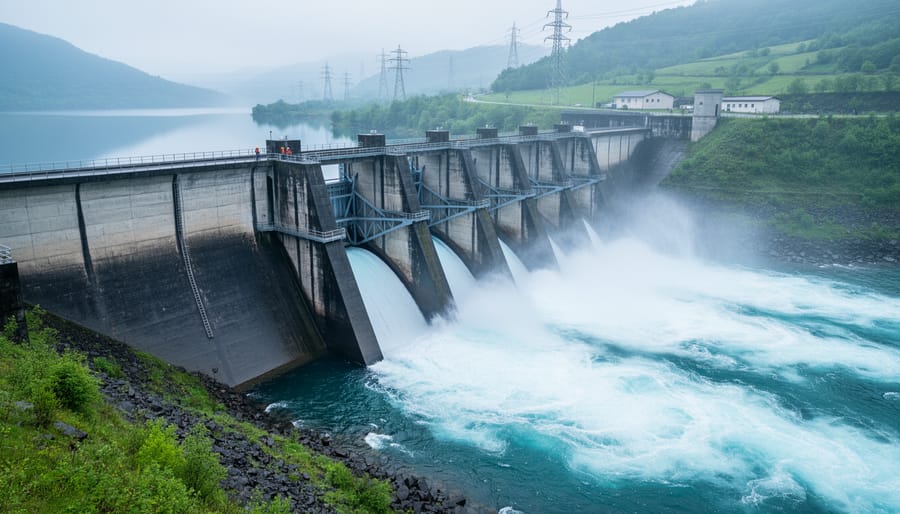
Hydropower is a reliable source of electricity generation, consistently delivering a capacity factor of 40 to 90 percent depending on system design and hydrological conditions. Unlike intermittent renewables such as solar and wind, what is hydropower excels at is providing dispatchable power that operators can ramp up or down within minutes to match grid demand.
This dependability stems from the predictable physics of water flow and elevation. Stored water in reservoirs acts as a massive battery, releasing energy on command. Run-of-river systems tap into steady stream flows, and pumped storage facilities offer grid-scale flexibility that few other technologies can match.
Yet reliability isn’t absolute. Extended droughts can slash output by 30 to 50 percent in regions dependent on snowmelt or seasonal rainfall. Climate variability, sediment accumulation, and aging infrastructure pose real challenges to long-term performance. The question isn’t whether hydropower delivers consistent generation under normal conditions (it does), but rather how various system configurations and environmental factors shape that reliability across different contexts.
This article examines the mechanisms that make hydropower dependable, compares reliability metrics across system types, identifies the variables that affect performance, and explores both the innovations strengthening hydropower’s role in modern grids and the obstacles engineers are working to overcome. Understanding these dynamics is essential for energy planners, policymakers, and anyone evaluating hydropower’s place in a stable, low-carbon energy future.
What Hydropower Reliability Means
When energy professionals assess whether hydropower is reliable, they’re evaluating several precise metrics that go beyond simply asking “does it work?” Reliability in hydropower systems refers to the ability to generate electricity consistently and predictably over time, meeting demand when needed while maintaining stable operations. Unlike fossil fuel plants that can burn fuel on demand, or intermittent renewables like solar and wind that depend on weather conditions, hydropower reliability hinges on water availability, infrastructure performance, and operational flexibility.
The primary measures used to quantify hydropower reliability include:
- Capacity Factor
- The ratio of actual electricity generated over a period to the maximum possible output if the plant ran at full capacity continuously. Hydropower facilities typically achieve capacity factors between 30-60%, varying significantly based on whether they operate as run-of-river vs reservoir systems.
- Availability Factor
- The percentage of time a hydropower plant is capable of generating electricity, regardless of whether it’s actually producing. Well-maintained facilities often exceed 90% availability, outperforming most thermal power plants.
- Dispatchability
- The ability to increase or decrease power output on demand to match grid requirements. Reservoir-based hydropower excels here, ramping output up or down within minutes.
- Baseload Power
- Continuous, steady electricity supply that forms the foundation of grid operations. Large storage hydropower facilities provide dependable baseload generation alongside their flexible capacity.
These metrics reveal that reliability isn’t a simple yes-or-no question. A run-of-river plant flowing through a seasonal river may have high availability but lower overall capacity factor due to natural flow variations. A reservoir facility, by contrast, can achieve both high availability and strong capacity utilization by storing water and releasing it strategically. Compared to solar installations (capacity factors around 15-25%) or wind farms (25-35%), hydropower’s performance demonstrates superior consistency, though the capacity factor definition must account for intentional operational decisions, not just technical limitations.
How Hydropower Systems Generate Dependable Electricity
The Role of Water Storage and Flow Control
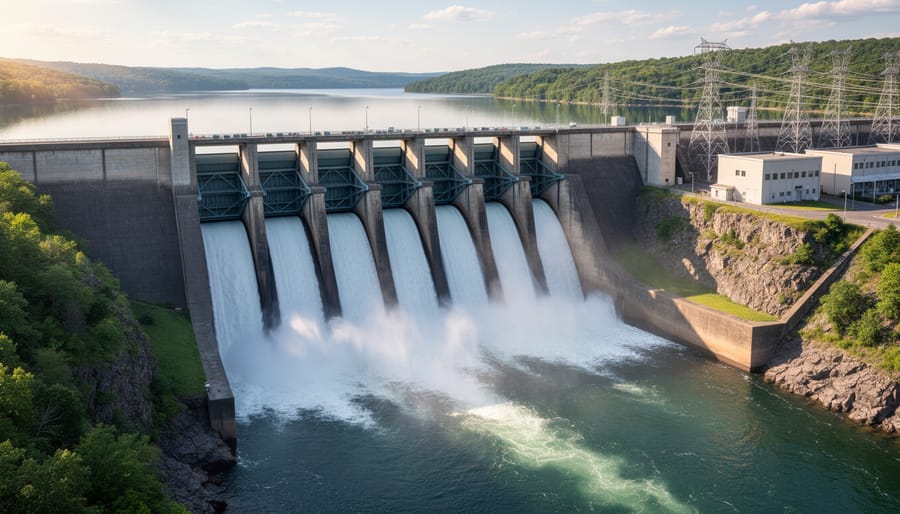
Reservoir capacity is the cornerstone of hydropower’s reliability advantage. Unlike solar panels that go dark at night or wind turbines that idle when breezes drop, storage hydropower plants hold vast quantities of water behind dams, creating a liquid battery of potential energy. Operators control exactly when and how much water flows through turbines, matching electricity generation to grid demand rather than to weather conditions. This stored energy reserve, sometimes holding weeks or months of generation capacity, enables power production on command, regardless of current rainfall.
The controlled release mechanism works through intake gates and penstocks that channel water at precise flow rates. During peak morning and evening demand, operators open gates wider to boost output; during low-demand overnight hours, they restrict flow or halt generation entirely, conserving water for when it’s needed most. This flexibility explains how hydropower works as both a baseload provider and a rapid-response resource. Modern automated systems adjust flows in minutes, responding to real-time grid signals, a capability that positions hydropower as the reliability backbone in renewable-heavy electricity networks where intermittency from other sources must be balanced continuously.
Grid Stability and Load-Following Capabilities
Hydropower plants excel at maintaining grid stability because their turbines can ramp output up or down in seconds, far faster than coal or gas plants. When electricity demand spikes during morning or evening peaks, operators simply increase water flow through the turbines; when demand drops, they throttle back. This responsiveness makes hydropower invaluable for frequency regulation and ramping the technical services that keep grid frequency at exactly 50 or 60 Hz and prevent blackouts.
Beyond demand-matching, hydropower provides spinning reserve, turbines already running that can instantly absorb sudden surges or fill gaps when other generators trip offline. A large reservoir facility can go from idle to full output in under 90 seconds, acting as insurance against grid failures. This load-following agility lets grid operators integrate variable renewables like wind and solar without sacrificing reliability, since hydropower compensates when those sources fluctuate. The same physical characteristics that enable consistent generation, stored potential energy and precise flow control, also make hydropower the grid’s most flexible stabilizing force.
Types of Hydropower Systems and Their Reliability Profiles
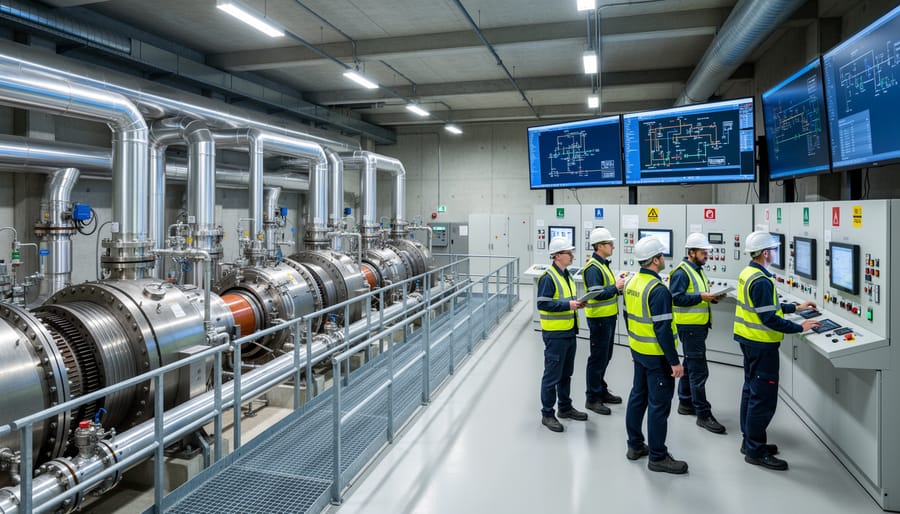
Hydropower reliability varies significantly depending on the system type, with each configuration offering distinct advantages and trade-offs in dependability. Understanding these differences helps explain why hydropower performs differently across regions and applications.
Reservoir (Storage) Hydropower Systems represent the gold standard for reliability. These facilities use dams to store massive volumes of water, creating substantial potential energy reserves. Because operators control when and how much water flows through turbines, reservoir systems deliver electricity on demand regardless of current weather or stream conditions. This stored energy buffer means they maintain capacity factors typically between 40% and 90%, with the ability to generate full power for extended periods. Their reliability makes them ideal for baseload generation and strategic grid support.
Run-of-River Systems operate without significant storage, generating power from natural stream flow. While these installations minimize environmental impact and require lower capital investment, their reliability directly tracks river discharge patterns. During spring snowmelt or rainy seasons, run-of-river plants may produce at full capacity. In dry summer months or droughts, output can drop substantially. Capacity factors average 30% to 60%, making them less predictable than reservoir systems but still more consistent than solar or wind because rivers maintain some flow year-round.
Pumped-Storage Hydropower functions as a massive battery, pumping water uphill during low-demand periods and releasing it through turbines when electricity is needed. These systems achieve exceptional reliability for grid stabilization, responding to demand changes in seconds. Though they consume electricity to pump water upward, their value lies in storing energy and providing rapid dispatchability. Modern pumped-storage facilities can cycle multiple times daily with 70% to 85% round-trip efficiency, making them critical for integrating variable renewables and maintaining grid stability.
Modular and Small Hydropower Systems encompass emerging technologies including in-stream turbines, micro-hydro installations, and standardized small-scale units. These systems typically operate as run-of-river configurations with modest storage or none at all. Reliability varies with local hydrology, but their smaller scale allows strategic deployment in multiple locations to diversify generation. Recent modular designs improve maintenance accessibility and reduce downtime compared to older small installations. When properly sited and integrated into distributed networks supporting broader hydroelectricity generation they contribute meaningful reliability benefits despite individual capacity limitations.
The most reliable grids often combine multiple hydropower types, leveraging reservoir storage for dependable baseload and peak response while using run-of-river systems for supplementary generation during favorable hydrological periods.
Factors That Influence Hydropower Reliability
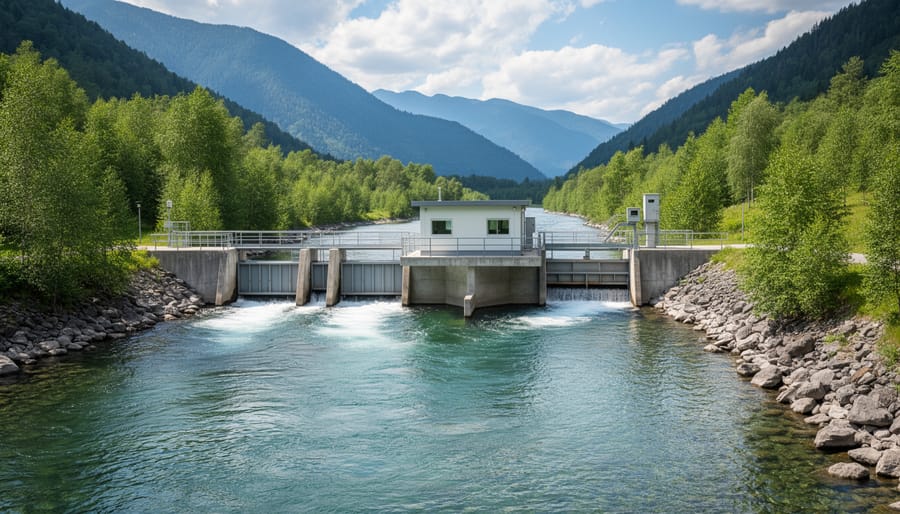
Hydropower reliability doesn’t exist in a vacuum. Several interconnected factors determine whether a facility delivers consistent electricity year after year, and understanding these variables helps explain why some plants maintain near-flawless availability while others face periodic constraints.
Water availability sits at the heart of hydropower dependability. A reservoir-based plant in a region with stable annual precipitation can sustain high capacity factors decade after decade, while a run-of-river facility in a watershed subject to erratic rainfall may experience significant seasonal variation. The same facility that generates at full capacity during spring snowmelt might operate at 30 percent output during late summer when stream flows diminish. Long-term hydrological records provide the foundation for reliability projections, but these historical patterns don’t always predict future conditions.
Climate variability introduces growing uncertainty. Shifting precipitation patterns, intensifying droughts, and altered snowpack dynamics can reduce water availability below design expectations. A plant engineered for twentieth-century hydrology may face twenty-first-century conditions that strain its capacity to deliver rated output consistently. Conversely, regions experiencing increased precipitation may see reliability improve, though managing flood risks becomes a greater operational concern.
The physical condition of infrastructure directly affects dependability. Key factors include:
- Precipitation patterns determining water supply consistency across seasons
- Drought conditions reducing reservoir levels and available generation capacity
- Sediment accumulation decreasing storage volume and turbine efficiency over time
- Equipment maintenance schedules requiring periodic shutdowns for inspection and repairs
- Dam integrity issues demanding emergency drawdowns or decommissioning
- Environmental flow requirements reserving water for ecosystems rather than generation
Aging facilities face compound challenges. Turbines installed fifty years ago require more frequent maintenance than modern equipment, and outdated control systems can’t optimize output as precisely as digital platforms. Infrastructure deterioration, if left unaddressed, escalates from minor efficiency losses to forced outages.
Regulatory requirements for environmental flows now mandate that many facilities release water for downstream ecosystems rather than turbine it for electricity. These obligations, while necessary for ecological health, reduce the water volume available for generation and can constrain a plant’s ability to respond to grid demands during low-flow periods. Balancing environmental stewardship with energy reliability requires careful operational planning and sometimes infrastructure modifications.
How Hydropower Is Used to Support Energy Reliability
Baseload and Peak Power Generation
Large reservoir hydropower facilities excel at dual-mode operation that few other energy sources can match. During off-peak hours, these plants maintain steady baseload generation, providing the constant electricity that keeps hospitals, data centers, and industrial facilities running around the clock. A single large dam can deliver this continuous output for months, drawing from stored water reserves that function as a massive battery.
When demand spikes, typically during morning wake-up hours and evening cooking times, operators open additional gates within minutes. The same facility that was humming along at 40% capacity can ramp to 90% in under ten minutes, meeting peak loads without firing up expensive natural gas peakers. This flexibility makes hydropower uniquely valuable for grid operators balancing supply and demand.
Unlike coal or nuclear plants that take hours to adjust output, hydropower’s mechanical simplicity allows instantaneous response to grid signals, effectively serving as both reliable foundation and rapid-response resource.
Balancing Intermittent Renewables
Hydropower’s rapid response capabilities make it uniquely suited to balance solar and wind fluctuations. When cloud cover drops solar output or wind speeds fall, hydropower plants can increase generation within minutes, often faster than fossil fuel alternatives. Norway’s grid demonstrates this synergy: hydropower provides over 90% of electricity while enabling substantial wind integration by ramping up during calm periods and scaling back when wind farms produce surplus power. California’s grid operators similarly rely on hydropower to smooth the variable output from the state’s massive solar capacity, particularly during evening demand peaks when solar generation drops sharply. Portugal has achieved periods of 100% renewable electricity by pairing wind farms with pumped-storage hydropower that absorbs excess generation and releases it during lulls, effectively functioning as a giant battery that maintains grid frequency within tight tolerances.
Emergency Backup and Black Start Capabilities
When a power grid goes dark, hydropower plants become critical lifelines. Unlike thermal generators that need external electricity to start their systems, many hydropower facilities possess “black start” capability, they can power up independently using stored water energy and small backup generators to activate control systems. Once operational, these plants supply the initial electricity needed to restart other power stations and gradually restore the grid.
This self-starting ability makes hydropower invaluable during cascading failures or natural disasters. Reservoir facilities maintain weeks or months of water storage, providing sustained emergency capacity when other sources fail. Their rapid response, most units reach full output within two to five minutes, allows grid operators to stabilize frequency and voltage quickly during crises. Major blackouts in Brazil, the U.S. Northeast, and Europe have demonstrated how hydropower’s emergency backup capabilities prevent prolonged outages and accelerate recovery, offering a reliability dimension that battery storage and intermittent renewables cannot yet match at scale.
Hydropower Innovations Enhancing Reliability in 2026
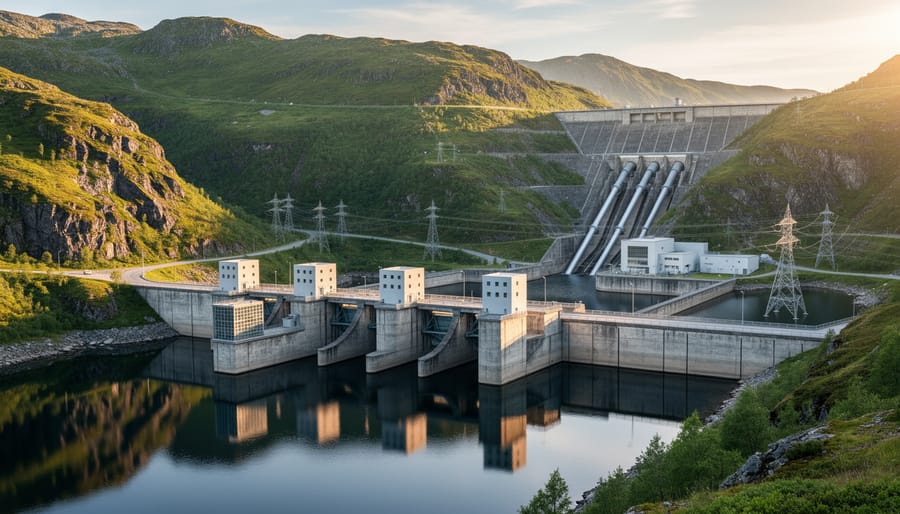
Several breakthrough technologies are dramatically improving hydropower’s reliability profile in 2026, addressing longstanding uncertainties around water availability and operational flexibility. These innovations span predictive analytics, physical infrastructure upgrades, and strategic integration with complementary energy systems.
Artificial intelligence and machine learning have revolutionized water inflow forecasting, a critical factor in maintaining dependable output. Modern systems analyze satellite imagery, weather patterns, snowpack data, and historical hydrological records to predict reservoir levels and generation capacity weeks or months ahead with unprecedented accuracy. Operators can now anticipate drought conditions earlier and adjust release schedules, reservoir management strategies, and maintenance windows accordingly. This forecasting precision reduces unexpected output drops and enables better coordination with grid operators managing diverse energy portfolios.
Digital twin technology, virtual replicas of physical hydropower assets, enables real-time monitoring and predictive maintenance that prevents reliability-compromising failures. Sensors throughout turbines, generators, and dam infrastructure feed data into simulation models that detect efficiency losses, component wear, and potential malfunctions before they cause outages. This proactive approach extends equipment lifespan and minimizes unplanned downtime that undermines dependability.
Variable-speed turbines represent a major hardware advancement, allowing facilities to maintain optimal efficiency across wider flow ranges than traditional fixed-speed units. These turbines adjust rotational speed to match available water flow and grid frequency requirements, generating stable output even when reservoir levels fluctuate or demand patterns shift rapidly. The technology particularly benefits run-of-river and smaller installations where flow variability historically compromised reliability.
Hybrid renewable systems pairing hydropower with solar or wind installations create complementary generation profiles that smooth overall output. Solar-hydro configurations generate daytime solar electricity while conserving reservoir water, then release stored water for evening peak demand when solar drops off. These integrated facilities deliver more consistent combined output than either technology alone, leveraging hydropower’s storage and dispatchability to compensate for intermittent renewables.
Climate adaptation strategies including reservoir expansion, intake modifications for lower water levels, and diversified watershed management help facilities maintain reliable generation despite changing precipitation patterns and prolonged dry periods increasingly affecting traditional operations.
Reliability Challenges and How They’re Being Addressed
Despite its track record, hydropower faces real reliability challenges that demand serious attention and proactive responses. Climate change ranks among the most pressing concerns. Shifting precipitation patterns, prolonged droughts, and accelerated glacier melt alter water availability in ways that disrupt long-term generation forecasts. Reservoirs designed for specific inflow patterns now experience erratic filling cycles, and some regions face multi-year low-water periods that reduce capacity factors dramatically. The Colorado River Basin and parts of Southern Europe have seen output drop by double-digit percentages during recent droughts.
Aging infrastructure compounds these vulnerabilities. Many dams and turbines date back decades, with components nearing or exceeding their design lifespans. Older equipment suffers higher failure rates, requires more frequent maintenance downtime, and operates less efficiently than modern alternatives. Deferred maintenance creates cascading risks: a single critical component failure can take an entire facility offline for months.
Environmental constraints also limit operational flexibility. Ecological flow requirements, sediment management mandates, and fish passage regulations restrict how operators manipulate water releases, sometimes preventing optimal generation scheduling or reservoir drawdown during peak demand.
The industry is responding with targeted modernization efforts. Utilities are retrofitting aging plants with variable-speed turbines and digital monitoring systems that predict failures before they occur. Advanced climate modeling now informs reservoir management, helping operators adapt release schedules to new hydrological realities. Some facilities are installing fish-friendly turbines and automated sediment flushing systems that satisfy environmental requirements without sacrificing significant output. Hybrid configurations pairing hydropower with floating solar arrays or battery storage are emerging to hedge against water scarcity. These adaptations acknowledge the challenges while demonstrating that hydropower reliability can evolve rather than erode.
How Is Hydropower Reliable Works
The reliability mechanism starts with water accumulation behind a dam, creating a reservoir that acts as energy storage, essentially a battery made of elevation and mass. When electricity demand rises, operators open gates to release controlled amounts of water through intake structures. This water accelerates downward through penstocks, large pipes that channel the flow directly to turbines housed in the powerhouse.
The falling water strikes turbine blades with force proportional to the vertical drop and flow rate, spinning them at precise speeds. These rotating turbines connect to generators that convert mechanical rotation into electrical current through electromagnetic induction. The entire sequence, from gate opening to power delivery, happens within seconds, allowing hydropower plants to respond almost instantly to grid needs.
After passing through turbines, water exits to the downstream river, maintaining the cycle. Operators continuously adjust water release rates using automated control systems that monitor grid frequency and demand signals. This real-time control, combined with the predictable physics of falling water and the massive inertia of spinning turbines, creates stable output that can ramp up or down smoothly. The system’s dependability stems from this direct conversion of stored gravitational energy into electricity, with minimal moving parts and no combustion or weather-dependent fuel source.
Common Questions About Hydropower Reliability
Common Questions About Hydropower Reliability
Energy professionals and the public often ask similar questions about hydropower reliability compared to conventional and renewable alternatives. Understanding these practical concerns helps clarify hydropower’s role in modern energy systems.
How does hydropower reliability compare to nuclear and coal plants?
Large reservoir hydropower typically achieves capacity factors of 40-60%, lower than nuclear (90%) or coal (75-85%) due to seasonal water availability and operational flexibility rather than technical limitations. However, hydropower excels at rapid response and load-following, making it more operationally flexible than baseload thermal plants when grid conditions change.
What happens to hydropower generation during drought conditions?
Droughts reduce water availability and can decrease output by 20-50% depending on severity and reservoir size. Facilities with multi-year storage capacity maintain more consistent generation during dry periods, while run-of-river plants experience immediate impacts from reduced streamflow.
Can hydropower support grids moving toward 100% renewable energy?
Yes, hydropower provides critical grid stabilization services that solar and wind cannot deliver alone, including frequency regulation, voltage control, and dispatchable power. Many high-renewable grids rely on hydropower to balance intermittent generation and maintain reliability.
How long do hydropower facilities typically remain operational?
Properly maintained hydropower plants routinely operate for 50-100 years, far exceeding the 20-30 year lifespan of most thermal plants. Many facilities built in the early 1900s continue generating electricity after upgrades, demonstrating exceptional long-term reliability.
These questions highlight that reliability encompasses multiple dimensions beyond simple uptime statistics. Hydropower’s dependability derives not just from consistent operation but from its unique ability to provide flexible, long-lasting infrastructure that adapts to changing grid requirements across decades of service.
The evidence consistently demonstrates that hydropower stands among the most reliable renewable energy sources available today. While hydrological variability and climate change introduce operational challenges, the fundamental advantages, controllable output, rapid response capabilities, and proven longevity, set hydropower apart from intermittent alternatives like wind and solar.
Modern hydropower installations routinely achieve capacity factors between 40% and 90%, depending on system design and water availability. This performance, combined with the ability to provide baseload power, peak generation, and essential grid services simultaneously, explains why hydropower supplies roughly 16% of global electricity despite comprising just 6% of installed capacity.
The sector’s ongoing transformation through advanced forecasting systems, digitalization, climate-adaptive infrastructure, and hybrid integration strategies directly addresses the reliability concerns raised by changing precipitation patterns and aging facilities. Nations successfully balancing high renewable penetration, Norway exceeding 95%, Brazil near 65%, rely heavily on hydropower’s stabilizing presence.
As energy systems transition toward carbon neutrality, hydropower’s dual role as both clean generation and renewable energy enabler becomes increasingly critical. The technology’s century-long track record, coupled with continuous innovation, positions it as an indispensable foundation for reliable, sustainable electricity supply through 2050 and beyond.