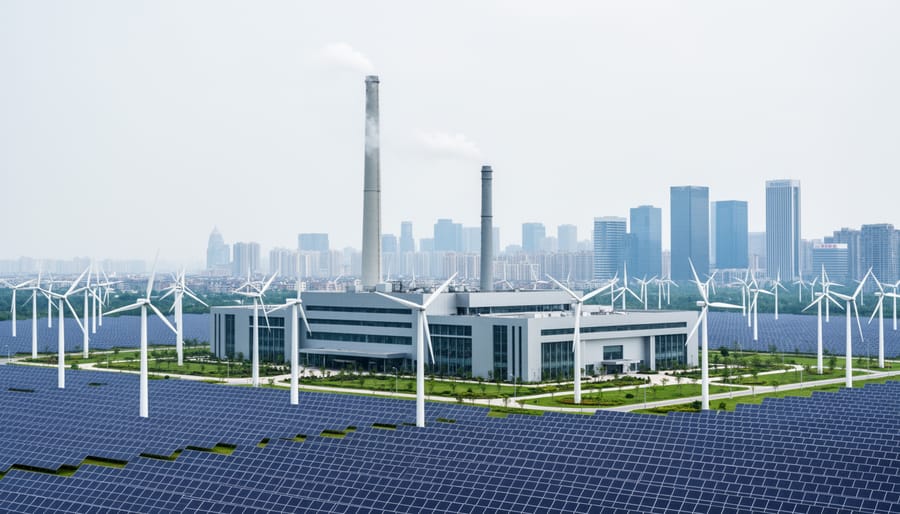
GHG emissions reduction refers to deliberate actions and strategies that decrease the amount of greenhouse gases released into the atmosphere from human activities, primarily targeting carbon dioxide, methane, and nitrous oxide at their sources. Unlike carbon offsets, which compensate for emissions elsewhere, reduction tackles the root cause by preventing gases from entering the atmosphere in the first place.
The stakes couldn’t be higher. Global greenhouse gas concentrations reached record levels in 2025, and the window to limit warming to 1.5°C continues to narrow. Every sector of the economy contributes to the problem: energy production accounts for roughly three-quarters of global emissions, while agriculture, transport, and industrial processes make up the remainder. The scientific consensus is clear: meaningful climate action requires aggressive, economy-wide reductions in emissions rather than relying solely on removal technologies or offset schemes.
What makes emissions reduction complex is that it operates across multiple scales and mechanisms. A manufacturing plant might switch to renewable electricity, redesign production processes to minimize waste heat, or substitute low-carbon materials. A city might electrify its bus fleet while densifying neighborhoods to reduce vehicle miles traveled. A nation might implement carbon pricing, phase out coal power, or mandate energy efficiency standards across building codes. Each approach cuts emissions through different levers: fuel switching, efficiency gains, process innovation, or demand management.
This article breaks down how GHG emissions reduction works in practice, examines the major categories of reduction strategies, and explores where these approaches are being deployed across energy, industry, transport, and land use sectors.
What GHG Emissions Reduction Means
GHG emissions reduction refers to the deliberate decrease in the amount of greenhouse gases released into the atmosphere through human activities. It involves cutting emissions at their source rather than compensating for them elsewhere, whether by improving energy efficiency, switching to cleaner fuels, redesigning industrial processes, or changing consumption patterns. The goal is to lower the absolute quantity of heat-trapping gases entering the atmosphere, thereby slowing the rate of global warming.
This concept sits within a family of related climate terms but carries a distinct meaning. Carbon neutrality means balancing emissions with an equivalent amount of removal or offsetting, resulting in a net-zero impact, though emissions themselves may remain unchanged. Net-zero goes further by requiring deep reductions first, with offsets or removals addressing only the residual emissions that cannot be eliminated. In contrast, emissions reduction prioritizes cutting the flow of greenhouse gases before considering any compensatory measures, making it the foundation of effective climate action.
- GHG Emissions
- The release of greenhouse gases into the atmosphere from sources like fossil fuel combustion, agriculture, and industrial processes. Measured in tonnes of carbon dioxide equivalent (CO₂e) to account for different gases’ warming potentials.
- Emissions Intensity
- The amount of greenhouse gas released per unit of economic output, energy produced, or activity performed. A company can lower intensity while total emissions rise if production scales up faster than efficiency gains.
- Absolute Reduction
- A decrease in the total quantity of emissions released, regardless of business growth or economic expansion. This metric tracks real atmospheric impact rather than efficiency ratios.
- Baseline Year
- A reference point against which future emissions are measured to calculate reduction progress. Organizations typically choose a historical year with reliable data as their starting benchmark.
- Carbon Budget
- The maximum cumulative amount of CO₂ the world can emit while limiting warming to a specific temperature target. Once exhausted, further emissions push temperatures beyond the threshold.
International climate frameworks recognize six main greenhouse gases. Carbon dioxide accounts for the largest share of human-caused warming, primarily from burning coal, oil, and natural gas. Methane, though shorter-lived in the atmosphere, traps heat far more effectively per molecule and comes from agriculture, landfills, and fossil fuel operations. Nitrous oxide, released by fertilizers and certain industrial processes, persists for over a century. The three groups of fluorinated gases, hydrofluorocarbons, perfluorocarbons, and sulfur hexafluoride, are entirely synthetic, used in refrigeration, electronics, and electrical equipment, with some lasting thousands of years once released.
The distinction between reduction and offsetting matters because only reduction directly lowers atmospheric concentrations. Offsets represent emissions avoided or absorbed elsewhere, creating a trade rather than elimination. A company planting trees to balance continued fossil fuel use has not reduced its emissions; it has theoretically neutralized them through a separate activity whose permanence and additionality remain uncertain. Reduction addresses the problem at its origin.
How GHG Emissions Reduction Works
Measuring and Tracking Emissions
Before organizations can reduce their greenhouse gas emissions, they must understand what they’re emitting and where those emissions originate. This measurement challenge has led to the development of standardized accounting frameworks that bring consistency to an otherwise complex process.
The GHG Protocol, developed by the World Resources Institute and the World Business Council for Sustainable Development, serves as the most widely adopted corporate accounting standard globally. It divides emissions into three scopes: Scope 1 covers direct emissions from owned or controlled sources like company vehicles and manufacturing facilities; Scope 2 accounts for indirect emissions from purchased electricity, steam, heating, and cooling; and Scope 3 encompasses all other indirect emissions in a company’s value chain, from raw material extraction through product disposal.
ISO 14064 provides a complementary international standard for quantifying and reporting emissions at both organizational and project levels. While the frameworks differ in technical details, both require organizations to establish a base year, define operational boundaries, select appropriate emission factors, and document their methodology transparently.
Nations typically employ IPCC guidelines for national greenhouse gas inventories, tracking emissions across economic sectors using a combination of activity data and emission factors specific to their circumstances. These inventories form the basis for international climate commitments under the Paris Agreement.
Accurate measurement remains challenging, particularly for Scope 3 emissions where data often comes from suppliers with varying reporting capabilities. Organizations increasingly use software platforms that integrate financial data, supply chain information, and emission factors to automate calculations and improve accuracy across their operations.
Setting Science-Based Targets
Setting science-based targets requires organizations to align their emissions reduction goals with the decarbonization pathways that climate science indicates are necessary to limit global warming. Rather than selecting arbitrary percentage reductions, companies and governments establish targets that contribute their share toward keeping temperature rise well below 2°C, and ideally to 1.5°C, above pre-industrial levels, consistent with the Paris Agreement framework.
The Science Based Targets initiative (SBTi) provides the most widely recognized methodology for corporate target-setting. Organizations submit reduction commitments across relevant emission scopes, and SBTi validates whether these targets reflect the pace of emissions cuts needed at a sector and global level. Approved targets typically mandate absolute reductions of 4.2% annually for 1.5°C alignment, though specific requirements vary by industry. Energy-intensive sectors face steeper challenges, while service-based companies may achieve targets more readily through renewable electricity procurement and operational efficiency.
Targets distinguish between near-term goals (usually 5-10 years) and long-term net-zero commitments by mid-century. Near-term targets focus on reductions achievable through proven technologies, switching to renewables, upgrading equipment, improving logistics, whereas long-term pathways assume some technological advancement and residual emissions management. Understanding how hydroelectricity works for instance, helps organizations evaluate renewable energy options when planning their transition strategies.
Crucially, science-based targets prioritize actual emissions cuts over offsets. Credits may address residual emissions in net-zero strategies, but the primary obligation is reducing the organization’s own footprint through operational and supply chain interventions. This approach ensures collective climate goals rest on tangible decarbonization rather than accounting maneuvers.
Major Categories of GHG Reduction Strategies
Energy Efficiency and Conservation

Energy efficiency targets emissions at their source by reducing the amount of energy required to deliver the same service or output. When a building needs less heating, or a factory uses less electricity to manufacture products, fewer fossil fuels are burned and fewer greenhouse gases enter the atmosphere. This direct reduction approach eliminates emissions rather than displacing them.
In buildings, efficiency measures range from basic improvements like LED lighting and improved insulation to comprehensive retrofits incorporating smart thermostats, heat pumps, and advanced building management systems. Commercial buildings can achieve 20-40% energy reductions through operational adjustments and equipment upgrades without major structural changes.
Industrial facilities reduce emissions through process optimization, waste heat recovery, and equipment modernization. A cement plant might capture exhaust heat to generate steam, cutting fuel consumption. Manufacturing lines eliminate idle running and right-size motors to match actual loads. These changes lower both energy costs and carbon output.
Transportation efficiency includes vehicle technologies like improved aerodynamics and fuel-efficient engines, alongside operational changes such as route optimization and reduced idling. Fleet operators combining these approaches routinely achieve double-digit percentage reductions in fuel use per kilometer traveled, directly translating to lower emissions.
Renewable Energy Transition

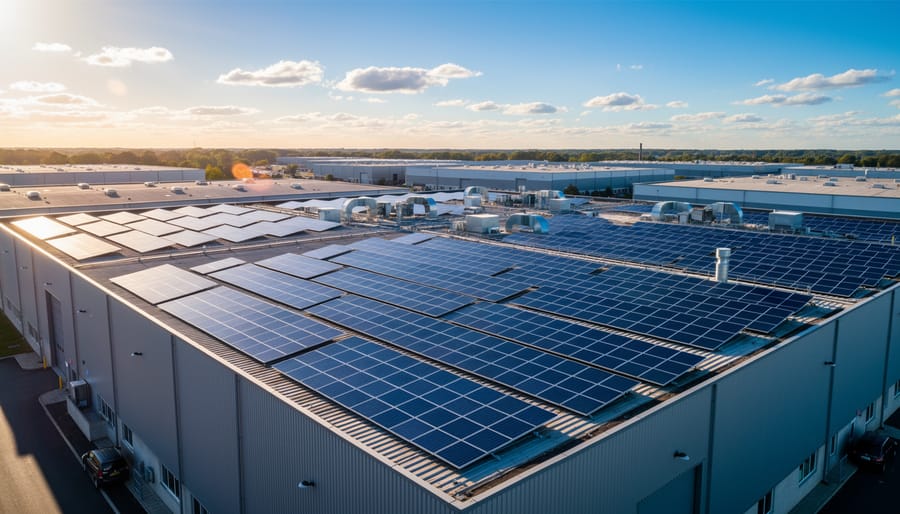
Switching from coal, oil, and natural gas to renewable energy sources cuts greenhouse gas emissions by replacing combustion-based power generation with clean alternatives. Solar panels convert sunlight to electricity without burning fuel, while wind turbines harness kinetic energy from air movement. Hydroelectric facilities capture the force of flowing water, and geothermal plants tap heat stored beneath Earth’s surface. Each technology produces power without releasing carbon dioxide during operation, though manufacturing and installation carry small embedded emissions.
Grid decarbonization occurs when utilities increase the share of renewables feeding the electrical grid, reducing fossil fuel dependency across all sectors using that power. A factory running on a grid supplied 60% by wind and solar produces fewer scope 2 emissions than the same facility on a coal-heavy grid. Distributed generation accelerates this transition by placing solar arrays on rooftops, wind turbines in communities, and batteries near demand centers, cutting transmission losses and improving resilience. Improvements in wind energy efficiency and solar panel conversion rates make these systems cost-competitive with fossil alternatives in many regions, driving faster adoption without subsidies.
Industrial Process Improvements
Manufacturing and heavy industry account for roughly one-quarter of global greenhouse gas emissions, making process improvements in these sectors essential for meaningful climate progress. Unlike energy or transport, industrial emissions often stem from chemical reactions intrinsic to production, cement calcination releases CO₂ regardless of the energy source, while steelmaking traditionally requires carbon as both fuel and reducing agent.
Fuel switching replaces coal and natural gas with lower-carbon alternatives: hydrogen in steel production, biomass in cement kilns, or renewable electricity for heat. Electrification converts fossil-fuel-dependent processes to run on clean power, electric arc furnaces for steel, heat pumps for industrial heating, and plasma torches replacing combustion.
Carbon capture and storage technologies intercept CO₂ at emission sources before it reaches the atmosphere, particularly valuable where process emissions can’t be eliminated through fuel changes alone. Circular economy principles reduce emissions by keeping materials in use longer, recycling aluminum saves 95% of the energy needed for primary production, while remanufacturing extends product lifecycles without new resource extraction.
These approaches often work in combination. A cement plant might use alternative fuels, capture remaining process emissions, and incorporate recycled materials to lower its carbon intensity across multiple pathways simultaneously.
Transportation Decarbonization

Transportation accounts for roughly a quarter of global CO₂ emissions, making decarbonization of this sector essential to meaningful reductions. The most visible pathway is electrification, replacing internal combustion engines with battery-electric powertrains in passenger cars, buses, and delivery vans. Electric vehicles eliminate tailpipe emissions and, when charged from renewable grids, dramatically cut lifecycle carbon intensity.
Alternative fuels offer complementary solutions where batteries fall short. Biofuel from waste can decarbonize aviation and heavy freight without requiring new infrastructure, while hydrogen fuel cell vehicles show promise for long-haul trucking and commercial fleets needing rapid refueling.
Modal shifts, moving freight from trucks to rail or passengers from cars to public transit, reduce emissions through efficiency gains. Logistics optimization, including route planning algorithms and load consolidation, cuts unnecessary mileage. Together, these strategies address transport’s complexity: no single technology fits every use case, so sector-wide reduction requires a portfolio approach tailored to vehicle type, distance, and load requirements.
Where GHG Reduction Strategies Are Applied
Corporate and Industrial Applications
Businesses reduce greenhouse gas emissions through three primary intervention points: their direct operations, supply chains, and capital allocation decisions. Operationally, companies cut emissions by upgrading equipment (replacing fossil fuel boilers with electric heat pumps), optimizing logistics routes to minimize fuel consumption, and switching to renewable electricity contracts. These changes typically target Scope 1 and 2 emissions under the GHG Protocol classification.
Supply chain management addresses Scope 3 emissions, which often represent 70-90% of a company’s total carbon footprint. Firms work with suppliers to establish emissions data transparency, set reduction requirements in procurement contracts, and shift sourcing toward lower-carbon materials. For example, food manufacturers might replace high-emission ingredients or require agricultural suppliers to adopt regenerative practices.
Capital investments drive deeper decarbonization. Companies install onsite solar arrays, retrofit facilities with energy management systems, or fund research into low-carbon production methods. Heavy industries invest in electrification technologies and explore carbon capture integration.
Stakeholder pressure accelerates these efforts. Investors using ESG criteria demand credible reduction plans, customers prefer low-carbon products, and employees increasingly choose employers with strong climate commitments. Regulatory reporting frameworks like the Task Force on Climate-related Financial Disclosures and emerging SEC climate disclosure rules formalize accountability, requiring public emissions inventories and reduction targets that third parties can verify.
Government and Policy-Driven Initiatives
Governments deploy emissions reduction programs through three primary levers: regulation, economic incentives, and direct investment in low-carbon infrastructure.
Regulatory frameworks set mandatory emissions limits and performance standards. The European Union’s Emissions Trading System caps total greenhouse gas output from power plants and industrial facilities, requiring companies to hold permits for each tonne emitted. California’s Advanced Clean Cars II regulation mandates that 100% of new passenger vehicle sales be zero-emission by 2035, forcing automakers to phase out combustion engines. Building codes increasingly require energy efficiency measures and renewable heating systems in new construction.
Carbon pricing mechanisms make pollution costly, driving investment toward cleaner alternatives. Carbon taxes, used in countries like Sweden and Canada, add a fee per tonne of emissions. Cap-and-trade systems create markets where emission permits are bought and sold, letting the market determine carbon’s price. These tools shift the economic calculus, making renewable energy and efficiency upgrades financially attractive compared to fossil fuel use.
Public infrastructure investments accelerate systemic change at scales beyond private sector reach. Governments fund electric vehicle charging networks, upgrade electrical grids to handle renewable power, retrofit public buildings, and subsidize heat pump installations. Transit expansion, bike lane networks, and land-use planning that reduces car dependence cut transport emissions through structural change rather than individual choice alone.
Community and Individual Actions
Individual households and local communities contribute to emissions reduction through everyday decisions and collective initiatives. Behavioral changes such as reducing meat consumption, minimizing air travel, and adopting energy-efficient appliances lower personal carbon footprints. Many homeowners install home solar solutions or participate in community solar programs that displace fossil fuel electricity at the distribution level.
Community-scale projects amplify impact through coordinated action. Local renewable energy cooperatives, neighborhood weatherization programs, and car-sharing schemes reduce emissions while building social cohesion. Consumption choices matter too: buying locally produced goods, extending product lifespans, and reducing waste all cut the embedded emissions in supply chains. While individual actions alone cannot solve climate change, they demonstrate demand for low-carbon infrastructure, influence social norms, and create political will for systemic policy shifts that drive larger reductions.
Challenges and Implementation Barriers
Reducing greenhouse gas emissions faces substantial obstacles that slow progress even when technical solutions exist. These barriers span economic, political, technological, and social dimensions, often reinforcing one another to create systemic resistance to change.
Upfront Capital Costs
The initial investment required for emissions reduction infrastructure remains a primary barrier. Renewable energy installations, building retrofits, and industrial process upgrades demand significant capital expenditure that many organizations and governments struggle to finance. A manufacturing facility switching from natural gas to electric heat pumps might face installation costs exceeding $500,000, with payback periods stretching 7-10 years. Small and medium enterprises particularly lack access to the financing mechanisms available to larger corporations, creating inequitable adoption patterns.
Technology Readiness Gaps
While solutions exist for roughly 50-60% of current emissions, hard-to-abate sectors like aviation, shipping, cement production, and heavy industry lack commercially viable decarbonization pathways. Hydrogen-based steel production and sustainable aviation fuels remain at pilot scale, with cost premiums of 200-400% over conventional methods. The infrastructure to support these emerging technologies, hydrogen pipelines, electric vehicle charging networks, carbon capture storage facilities, lags years behind deployment needs.
Policy Fragmentation
Inconsistent regulatory frameworks across jurisdictions create complexity and uncertainty. A multinational corporation faces dozens of different emissions reporting standards, carbon pricing schemes, and renewable energy mandates. This patchwork discourages long-term investment and rewards regulatory arbitrage, where companies shift operations to regions with weaker climate policies rather than reducing emissions comprehensively.
Equity and Justice Concerns
Reduction strategies can impose disproportionate burdens on low-income communities and workers in fossil fuel industries. Carbon pricing mechanisms raise energy costs for households already struggling with bills. Coal plant closures eliminate well-paying jobs in regions with few alternative employment opportunities. Without carefully designed transition programs, these equity gaps generate political opposition that stalls broader climate action, creating a tension between climate urgency and social fairness that policymakers must navigate.
Measuring Success: Metrics and Verification
Quantifying GHG emissions reductions requires standardized metrics that enable comparison across organizations, sectors, and time periods. The most fundamental metric is absolute emissions reduction, measured in tonnes of CO₂ equivalent (tCO₂e), which aggregates all greenhouse gases using their global warming potential relative to carbon dioxide. Organizations typically report reductions against a baseline year, expressing progress as a percentage decline or absolute tonnage drop across Scopes 1, 2, and 3 emissions.
Intensity metrics provide another lens, measuring emissions per unit of output, such as tCO₂e per revenue dollar, per employee, or per product manufactured. These ratios help account for business growth and allow meaningful comparisons between entities of different sizes. A company might increase absolute emissions while improving intensity if production scales rapidly.
Third-party verification adds credibility to reduction claims. Independent auditors assess emissions data using frameworks like ISO 14064-3 or the GHG Protocol Corporate Standard, examining calculation methodologies, data sources, and documentation trails. This scrutiny catches errors, identifies double-counting, and confirms that reported reductions genuinely occurred rather than resulting from accounting adjustments or boundary changes.
Transparency in reporting separates substantive action from greenwashing. Leading organizations publish detailed inventories showing emissions by source, methodology notes, and year-over-year changes with explanations for variances. Public disclosure through platforms like CDP allows investors, customers, and regulators to assess performance.
Emerging technologies enhance verification accuracy. Satellite monitoring systems can now detect methane leaks from oil and gas facilities, providing independent checks against self-reported data. Continuous emissions monitoring systems installed at industrial sites generate real-time data streams, replacing periodic manual measurements. Blockchain-based registries are being tested to create immutable records of emission reductions, though adoption remains limited. These tools strengthen accountability but cannot replace robust internal accounting systems and independent audits as the foundation of credible measurement.
Common Questions About GHG Emissions Reduction
What’s the difference between emissions reduction and carbon offsetting?
Emissions reduction involves directly cutting the amount of greenhouse gases released at the source through efficiency improvements, fuel switching, or process changes. Carbon offsetting, by contrast, allows emissions to continue while funding projects elsewhere that supposedly remove or avoid an equivalent amount, a compensation approach rather than an actual reduction in total emissions produced.
How long does it take for emissions reductions to affect the climate?
Atmospheric CO₂ concentrations begin to stabilize within years of significant emission cuts, but global temperature response lags by decades due to ocean thermal inertia and the persistence of greenhouse gases already in the atmosphere. Methane reductions show faster climate benefits because this gas breaks down within roughly a decade, whereas CO₂ can persist for centuries.
Do individual actions matter when corporations and governments produce most emissions?
Individual choices contribute roughly 25 percent of global emissions through consumption, travel, and energy use, making personal actions meaningful at scale. More importantly, individual behavioral shifts drive market demand for low-carbon products and create political pressure that accelerates systemic policy changes, the two dynamics reinforce rather than replace each other.
Are reduction technologies becoming more affordable over time?
Solar and wind energy, LED lighting, electric vehicles, and heat pumps have all dropped sharply in cost over the past decade, making many reduction strategies economically competitive with high-emission alternatives. Technologies like green hydrogen and direct air capture remain expensive but are following similar cost-decline trajectories as deployment scales up.
Beyond these common queries, confusion often arises around verification and accountability. Companies claim emissions reductions in annual sustainability reports, but substantiating these assertions requires third-party audits against recognized standards. Look for verification under frameworks like ISO 14064 or adherence to the GHG Protocol, which provide transparent methodologies for calculating and reporting reductions. Unverified claims, sometimes called greenwashing, can obscure whether real cuts have occurred or whether accounting tricks like boundary adjustments create the illusion of progress.
Another frequent question concerns whether reduction efforts simply shift emissions elsewhere rather than eliminating them. This phenomenon, known as carbon leakage, can happen when manufacturing moves from regions with strict regulations to jurisdictions with lax standards. Effective reduction strategies account for full lifecycle and supply chain emissions (Scope 3), preventing the problem from being exported rather than solved. Border carbon adjustments and supply chain transparency initiatives are emerging tools to close these loopholes and ensure reductions represent genuine global emissions declines.
GHG emissions reduction stands as the most direct and effective mechanism for limiting global temperature rise and avoiding the most severe impacts of climate change. Unlike offsetting or removal strategies, reducing emissions at the source prevents greenhouse gases from entering the atmosphere in the first place, addressing the problem at its root rather than attempting to compensate for it after the fact.
The mechanisms explored throughout this article, energy efficiency improvements, renewable energy deployment, industrial process optimization, and transportation decarbonization, aren’t mutually exclusive options but rather complementary strategies that must operate in concert. A manufacturing facility might simultaneously switch to renewable electricity, upgrade equipment efficiency, and optimize logistics to compound its reduction impact. Similarly, national climate strategies layer policy interventions, infrastructure investments, and regulatory frameworks to drive reductions across multiple sectors simultaneously.
Current scientific consensus indicates that global emissions must decline by approximately 45% from 2010 levels by 2030 to maintain a realistic pathway toward limiting warming to 1.5°C above pre-industrial temperatures. Meeting this benchmark requires immediate scaling of proven reduction technologies alongside continued innovation in harder-to-abate sectors like heavy industry, aviation, and agriculture.
The technical solutions and implementation frameworks detailed in this explainer already exist and function at scale. The central challenge is no longer proving that emissions reduction works, it’s accelerating deployment fast enough to match the urgency that climate science demands. Every ton of greenhouse gas prevented from entering the atmosphere represents a measurable contribution toward climate stability, making reduction the foundation upon which all other climate strategies must build.