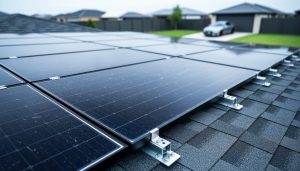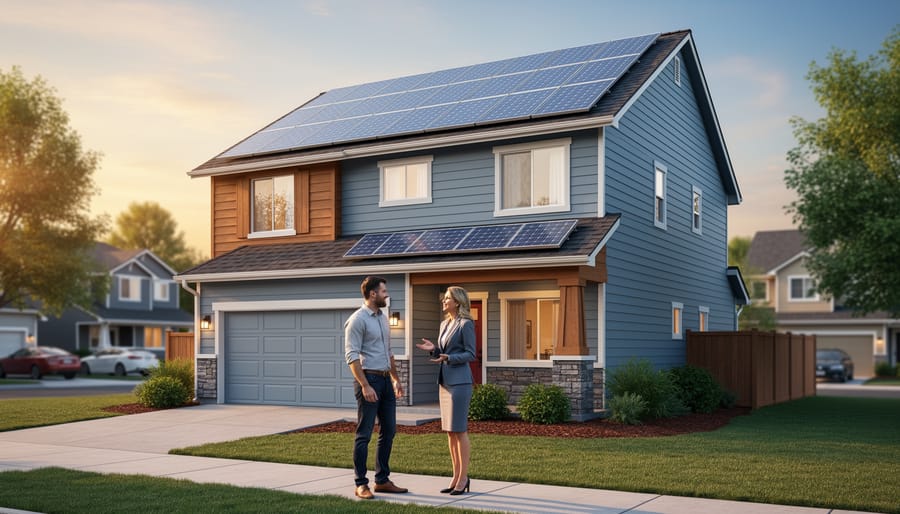
Understand your solar panel ownership structure before listing—leased systems require lender approval for buyer assumption, purchased systems with outstanding loans need payoff coordination, and fully owned panels transfer as property fixtures. Each arrangement creates distinct disclosure obligations and buyer qualification barriers that cannot be waived through as-is condition house sale clauses.
Obtain complete solar documentation immediately, including installation permits, warranty certificates, interconnection agreements with utility providers, and performance data from the past 12 months. Buyers conducting due diligence will require this evidence regardless of as-is language, and missing documentation triggers financing delays or complete loan denials from mortgage underwriters wary of unpermitted work.
Calculate your home’s adjusted market value by requesting comparative market analyses that specifically account for solar installations. Research from the Lawrence Berkeley National Laboratory demonstrates solar panels increase property values by approximately $15,000 on average, but this premium evaporates when ownership complications or maintenance concerns emerge. Properties with transferable warranties and clear title command significantly higher prices than those with lease obligations.
Target cash buyers and experienced investors who possess the technical knowledge to assess solar system condition and the financial capacity to navigate complex ownership transfers. These purchasers understand renewable energy assets and won’t be deterred by cosmetic property issues when the underlying solar infrastructure delivers proven utility savings and environmental benefits.
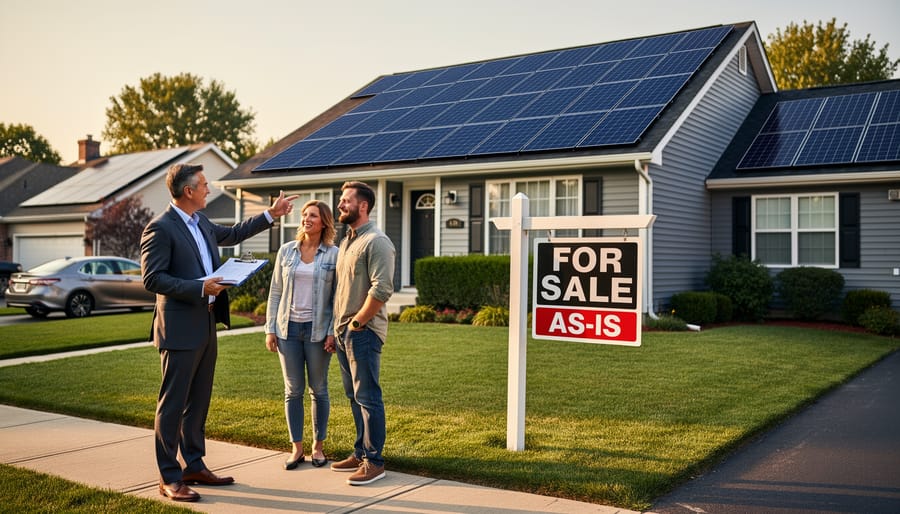
Understanding Solar Panel Ownership Models
Owned Systems: The Cleanest Transfer
When homeowners have fully paid off their solar panels, the transfer process becomes remarkably straightforward. Owned systems function as permanent fixtures of the property, similar to a roof or HVAC system, making them the most attractive scenario for as-is sales. Since no third-party financing company holds claims on the equipment, sellers face minimal paperwork beyond standard disclosures about system age, performance history, and warranty transferability.
Most manufacturers offer transferable warranties that can extend 20-25 years, providing buyers with long-term protection without additional costs. This transfer typically requires simple documentation submitted to the manufacturer. The absence of lease agreements or power purchase contracts means buyers won’t inherit monthly payments or restrictive terms that could complicate financing approval.
For sellers who invested in going solar for households through upfront payment, the primary consideration involves providing comprehensive documentation of installation permits, interconnection agreements, and maintenance records. These materials demonstrate system legitimacy and help buyers understand the asset they’re acquiring, potentially justifying higher offers despite the as-is condition of other property aspects.
Financed Systems: Hidden Loan Obligations
Solar loans represent a significant complicating factor in as-is property sales because they create a direct financial obligation that travels with the homeowner, not the property itself. Unlike leases or power purchase agreements, solar loans function as personal debt secured against the system’s value. When selling as-is, you remain legally responsible for disclosing this outstanding loan balance to prospective buyers, even though as-is status limits other warranties.
The disclosure requirement stems from the fact that buyers must either assume the loan through a qualification process with your lender or you must pay off the remaining balance at closing. Many solar loan agreements include prepayment penalties or complex payoff calculations that differ from the stated principal balance. Request a formal payoff statement from your lender at least 30 days before listing to understand your exact financial obligation.
Buyers often prefer properties with solar loans over leased systems because ownership transfers cleanly once the loan clears, eliminating ongoing third-party contracts. However, the loan balance directly reduces your net proceeds from the sale, potentially affecting your ability to accept lower offers on as-is properties that typically command discounted prices due to their condition.
Leased Systems and PPAs: The Transfer Challenge
Leased solar systems and power purchase agreements (PPAs) present the most significant obstacles when selling as-is properties. Unlike owned panels, these arrangements require transferring a contractual obligation to buyers, who must meet the solar company’s credit qualifications—typically FICO scores of 650 or higher. According to industry data, approximately 30-40% of potential buyers fail this credit screening, immediately shrinking your buyer pool.
The friction intensifies because lease terms often span 20-25 years with escalating payment structures, averaging 2-4% annual increases. Buyers inherit not just the equipment but financial commitments that may exceed traditional utility costs in later years. Solar companies maintain strict assumption policies, requiring income verification and sometimes charging transfer fees between $150-500. This vetting process adds 2-4 weeks to closing timelines, creating deal-breaking delays. Furthermore, buyers cannot modify or remove panels without breach-of-contract penalties, eliminating flexibility for roof repairs or renovations—a consideration that makes negotiation particularly challenging in as-is transactions.
Legal and Disclosure Requirements for As-Is Solar Sales

UCC-1 Financing Statements and Title Issues
When solar panels are financed through a lease or power purchase agreement, the solar company typically files a UCC-1 financing statement with your county recorder’s office. This legal document establishes the solar company’s security interest in the equipment attached to your property, effectively creating a lien that appears during title searches. Unlike traditional property liens, UCC-1 filings specifically secure personal property—in this case, the solar panels—but they complicate real estate transactions nonetheless.
Selling a home as-is does not exempt you from addressing these solar liens. Title companies require clear title before closing, and a UCC-1 filing creates a cloud that must be resolved. The buyer’s lender will refuse to fund a mortgage until the solar lien is subordinated or removed, as it takes priority over their security interest in the property. This means you cannot simply transfer the problem to the buyer, even in an as-is sale.
To clear the title, you must contact the solar company to request a UCC-3 termination statement, which removes the filing from public records. This typically requires either paying off the solar lease balance, transferring the agreement to a qualified buyer, or obtaining written subordination where the solar company agrees to position their lien behind the mortgage lender. Documentation requirements vary by state and solar provider, so initiate this process early—resolution often takes 30-60 days.
State-Specific Solar Disclosure Laws
Selling a home “as-is” doesn’t create a blanket exemption from disclosure requirements, particularly regarding solar panel installations. State laws vary significantly in what sellers must reveal, even when disclaiming property condition warranties. California, for instance, requires sellers to disclose solar lease agreements, financing arrangements, and any Property Assessed Clean Energy (PACE) liens regardless of as-is status. These disclosures fall under transfer disclosure obligations separate from property condition representations.
Arizona and Nevada mandate disclosure of renewable energy equipment ownership status and outstanding loan balances, while Florida requires sellers to inform buyers about solar easements and deed restrictions. The “as-is” designation typically protects sellers from liability regarding the physical condition of panels—such as efficiency degradation or minor damage—but cannot shield them from failing to disclose material facts about ownership, liens, or contractual obligations that would affect clear title transfer.
Several states classify undisclosed solar leases or power purchase agreements as material defects that survive as-is clauses, potentially exposing sellers to post-closing litigation. Texas courts have ruled that financial encumbrances tied to solar installations constitute title defects requiring disclosure. Consulting a real estate attorney familiar with your jurisdiction’s specific solar disclosure requirements remains essential, as federal Truth in Lending Act provisions may also apply to certain solar financing arrangements.
How Solar Panels Affect Property Valuation and Buyer Appeal
The Appraisal Problem
Appraisers face significant challenges when valuing homes with solar installations, creating a ripple effect that directly impacts as-is property offers. The fundamental issue stems from inconsistent appraisal methodologies—while some appraisers use the income approach to calculate energy savings over time, others apply cost-based models that may undervalue or overvalue the system depending on its age and condition.
The complexity intensifies with leased or PPA-owned systems. Appraisers typically assign zero or negative value to these arrangements since they represent a liability transfer rather than an asset. Even owned systems encounter valuation hurdles when documentation is incomplete. Without verifiable installation costs, warranty details, performance data, and information about solar system components, appraisers often default to conservative estimates.
This uncertainty compounds in as-is transactions. Buyers making offers on as-is properties already factor in potential repair costs and unknowns. When solar panels introduce additional valuation ambiguity—particularly regarding system functionality, remaining lifespan, and transfer complications—prudent buyers reduce their offers further to offset risk. A recent Zillow analysis found that homes with solar installations can command premiums, but only when comprehensive documentation exists and ownership is clearly established. Without these assurances, the appraised value may not reflect the system’s actual contribution to the property.
Buyer Demographics and Solar Preferences
Research from the National Association of Realtors indicates that homes with owned solar panels appeal to approximately 67% of homebuyers under age 45, compared to only 35% of buyers over 55. However, buyer enthusiasm varies significantly based on ownership structure and system transparency.
Environmental-conscious millennials and Gen Z buyers typically view solar installations as premium features, especially when systems are fully owned and come with transferable warranties. According to Zillow’s 2023 housing data, these demographics will pay a 4.1% premium for solar-equipped properties in as-is condition, provided all documentation is readily available.
Conversely, leased or financed solar systems can deter 40% of potential buyers regardless of age, primarily due to concerns about assuming payment obligations and credit approval requirements. Cash investors and house flippers often perceive solar panels as complications requiring removal or renegotiation, viewing them as liabilities rather than assets.
The key differentiator lies in information accessibility. Buyers familiar with solar energy technology demonstrate 3.2 times higher acceptance rates when sellers provide comprehensive system performance data, utility bill comparisons, and clear ownership documentation upfront. Properties marketed to educated, sustainability-focused professionals in metropolitan areas with high electricity costs consistently attract buyers who value solar installations as long-term financial advantages.
Strategic Options for Sellers
Pre-Sale Solar Agreement Resolution
Homeowners with solar loans or leases face a strategic decision when selling as-is: resolve the agreement beforehand or transfer it to buyers. Paying off a solar loan (typically $10,000-$30,000 remaining balance) before listing eliminates complications and broadens your buyer pool significantly. The upfront cost may be offset by faster sales and stronger offers, as homes with owned systems command 3-4% higher prices according to Zillow data.
Buying out a lease presents a different calculation. Lease buyout amounts often include remaining payments plus early termination fees, sometimes totaling $15,000-$40,000 depending on the contract term remaining. However, this converts a liability into an asset. Compare the buyout cost against potential sale price reductions and carrying costs from extended market time.
Financial analysis should include consultation with both solar companies and real estate professionals familiar with your local market dynamics. Some sellers discover that resolution costs less than the cumulative impact of limited buyer interest, failed transactions, and price reductions that encumbered systems typically generate in as-is sales.
Price Adjustment Strategies
Calculating appropriate price adjustments for as-is homes with solar panels requires a methodical approach that balances transparency with market competitiveness. Start by obtaining a professional assessment of the solar system’s condition, including age, remaining manufacturer warranties, and performance metrics. Systems over ten years old typically warrant 5-15% price reductions depending on their maintenance history and lease obligations.
For leased systems, discount strategies must reflect the buyer’s assumption of payment obligations. Research indicates homes with solar leases sell for 3-8% less than comparable properties, though this varies by regional solar adoption rates and electricity costs. Document all lease terms, monthly payments, and buyout options to justify your pricing to prospective buyers.
Owned systems in excellent condition can actually command premium pricing of 3-4% above market value, provided you supply complete documentation including interconnection agreements, monitoring data, and utility bill savings records. Conversely, systems requiring repairs or lacking proper permits may necessitate discounts exceeding 10% to account for buyer remediation costs. Consider obtaining competitive quotes from licensed solar contractors to establish realistic adjustment figures that protect your negotiating position while attracting serious buyers.
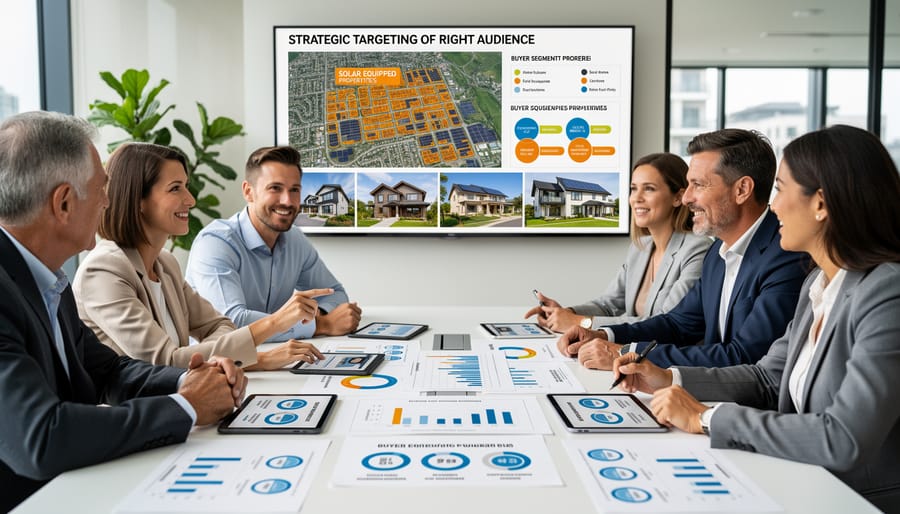
Targeting the Right Buyer Pool
Reaching the right buyers requires strategic marketing that emphasizes your home’s energy advantages. Begin by highlighting solar panels prominently in listings with clear documentation about system ownership, age, production capacity, and transferability terms. Buyers specifically seeking renewable energy systems represent your ideal audience, as they understand the value proposition and often come prepared to navigate transfer complexities.
Target environmentally conscious buyers through specialized platforms and green home networks. Include specific data: monthly energy savings, system warranty details, and average production metrics. This transparency attracts informed buyers who appreciate quantifiable benefits rather than those intimidated by unfamiliar technology.
Consider working with real estate agents experienced in solar home sales. They possess networks of buyers actively seeking energy-efficient properties and can address technical questions competently. Emphasize that your as-is sale includes comprehensive solar documentation, making the transfer process straightforward for qualified buyers. Marketing to cash buyers or those familiar with alternative energy installations often yields faster closings, as they typically conduct thorough due diligence upfront and understand lease assumptions or ownership transfers.
Common Pitfalls and How to Avoid Them
Incomplete Documentation
Even when selling a property as-is, solar panel documentation represents a non-negotiable requirement that protects both parties from legal complications. Sellers must provide complete lease agreements if the panels are financed through a power purchase agreement or third-party ownership arrangement. These contracts contain critical information about payment obligations, transfer procedures, and buyout options that directly affect the buyer’s financial responsibilities.
Ownership documentation proves who holds title to the solar installation—whether it’s the homeowner, a leasing company, or remains subject to a loan lien. Without clear chain-of-title paperwork, title companies frequently refuse to close transactions due to clouded ownership questions. Additionally, manufacturers’ warranties, inverter specifications, and system performance data help buyers assess the installation’s remaining value and operational efficiency.
Local building permits and interconnection agreements with utility companies verify that the system was legally installed and properly connected to the grid. Missing permits can trigger compliance issues during title searches, potentially derailing sales entirely. Savvy sellers compile this documentation proactively, reducing transaction friction and demonstrating good faith despite the as-is status.
Miscommunication with Solar Companies
Miscommunication with solar companies represents one of the most frequent obstacles in as-is home sales with photovoltaic systems. Establishing clear communication protocols early prevents transaction delays and unexpected complications at closing.
Begin by requesting comprehensive documentation from your solar provider at least 30 days before listing. This should include the original installation contract, current lease or loan status, warranty information, and transferability terms. Many homeowners discover restrictions or transfer fees only after accepting an offer, creating negotiation friction or deal termination.
Coordinate a three-way communication channel between yourself, your real estate agent, and the solar company’s transfer department. Solar providers typically require 2-4 weeks to process ownership transfers, so integrate this timeline into your closing schedule. Request written confirmation of all transfer requirements, including credit checks for buyers assuming leases and any prepayment conditions.
Document every interaction with dates and reference numbers. Solar companies often have separate departments for sales, billing, and transfers, leading to inconsistent information. If disagreements arise about contract terms, escalate immediately to a supervisor rather than relying on contradictory verbal assurances that won’t hold up legally.
Selling an as-is home with solar panels requires navigating a complex landscape where renewable energy meets real estate transaction law. The critical takeaway is that regardless of your property’s condition, solar panel ownership structures dictate your legal obligations and significantly influence market positioning. Whether dealing with owned systems that enhance property value or leased installations that may complicate closing, transparency about contractual arrangements remains non-negotiable even in as-is sales.
Understanding the distinction between owned and leased systems forms the foundation of successful transactions. Owned panels generally add value and appeal to environmentally conscious buyers, while leased or power purchase agreement systems introduce assumption requirements that demand clear disclosure and buyer qualification. Your pricing strategy must account for these variables, incorporating professional appraisals that properly value the solar investment while remaining competitive within local market conditions.
The residential solar market continues evolving rapidly, with improved financing options and growing consumer awareness making solar-equipped homes increasingly attractive. Industry data suggests that homes with owned solar systems command premiums in competitive markets, though regional variations persist based on electricity costs and incentive structures. As solar adoption accelerates and installation costs decline, the stigma previously associated with assuming solar obligations is diminishing among informed buyers.
Moving forward, sellers who proactively address documentation requirements, maintain system maintenance records, and work with knowledgeable real estate professionals position themselves advantageously. The as-is designation does not absolve you from disclosure obligations, but thorough preparation transforms potential obstacles into selling points for the right buyer demographic.