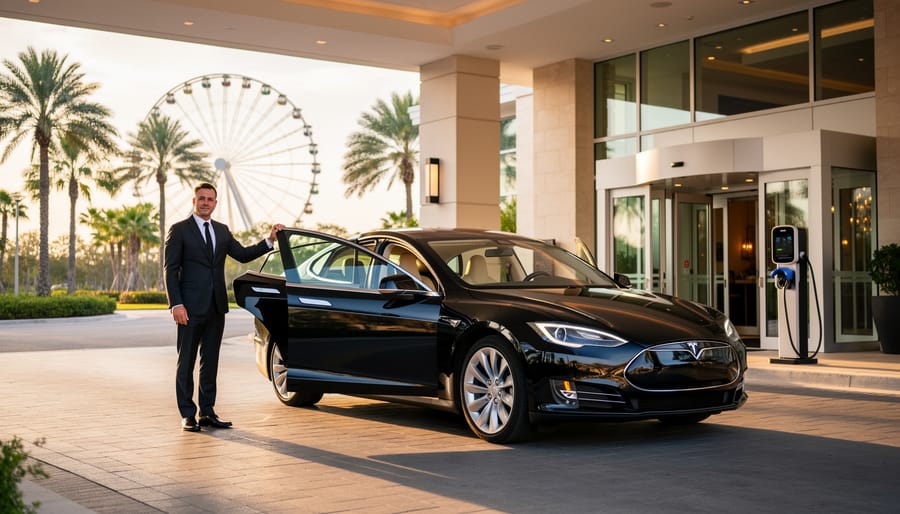
Orlando’s transportation landscape is undergoing a significant transformation as electric town car services emerge as the premier choice for environmentally conscious travelers seeking luxury ground transportation. The convergence of advanced battery technology, zero-emission powertrains, and premium amenities has created a compelling alternative to conventional limousine services, offering reduced carbon footprints without compromising comfort or reliability.
Electric town cars combine Tesla Model S and similar high-performance vehicles with professional chauffeur services, delivering whisper-quiet rides, instant torque acceleration, and sophisticated cabin experiences. These vehicles eliminate tailpipe emissions entirely, contributing to Orlando’s air quality improvement goals while providing passengers with cutting-edge infotainment systems, climate control, and spacious interiors designed for business travelers and tourists alike.
The operational advantages extend beyond environmental benefits. Electric powertrains require substantially less maintenance than internal combustion engines, with fewer moving parts translating to enhanced reliability and reduced service interruptions. Battery ranges now exceed 300 miles on single charges, easily accommodating airport transfers, theme park transportation, and corporate events without range anxiety concerns.
Cost efficiency represents another compelling factor. Electricity costs approximately one-third less per mile than gasoline, and many providers pass these savings to customers through competitive pricing structures. Companies like Always Superb Transport demonstrate how sustainable transportation can align with luxury service standards, offering professionally maintained electric fleets that meet rigorous safety and performance benchmarks while supporting Florida’s renewable energy initiatives and reducing transportation sector emissions across Central Florida’s growing metropolitan area.
The Environmental Case for Electric Town Car Services
Carbon Footprint Reduction in High-Volume Markets
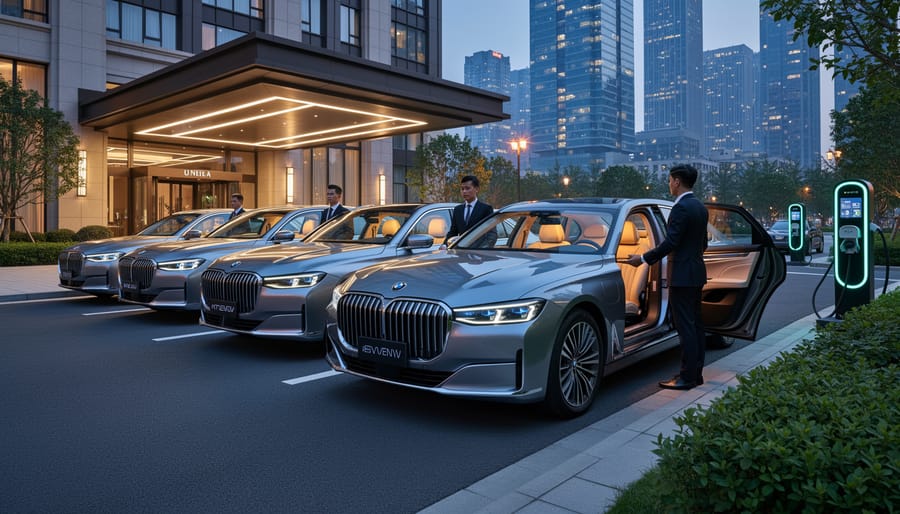
Orlando’s high-traffic transportation corridors present a compelling case study for electric vehicle impact. The metropolitan area serves over 75 million visitors annually, with concentrated travel patterns between Orlando International Airport and the theme park corridor along International Drive and Lake Buena Vista. This density creates ideal conditions for measuring electric town car benefits.
Recent transportation emissions studies indicate that replacing conventional luxury sedans with electric equivalents in these routes can reduce carbon dioxide emissions by approximately 4.5 metric tons per vehicle annually. When scaled across a fleet of 100 electric town cars operating in Orlando’s busiest corridors, this translates to preventing roughly 450 metric tons of CO2 from entering the atmosphere each year—equivalent to removing 97 gasoline-powered vehicles from the road.
Environmental research from the University of Central Florida’s Sustainable Coastal Systems cluster quantifies additional benefits. Electric vehicles produce zero tailpipe emissions, significantly improving air quality in concentrated tourist zones where thousands of guests and residents are exposed daily. Particulate matter reductions measured near high-volume pickup locations showed improvements of 35-40% during peak operating hours.
The emissions advantage strengthens when considering Florida’s increasingly renewable energy grid. As solar capacity expands statewide, the carbon intensity of charging electric town cars continues declining. Current assessments show well-to-wheel emissions from electric vehicles in Florida are 60% lower than comparable internal combustion engines, with projections indicating even greater emissions reductions as grid decarbonization accelerates through 2030.
Integration with Florida’s Solar Energy Infrastructure
Florida’s position as the “Sunshine State” provides a natural advantage for electric vehicle operations, with Orlando-based town car services increasingly capitalizing on this renewable resource. According to the Florida Solar Energy Center, the state receives an average of 237 days of sunshine annually, making photovoltaic charging infrastructure highly efficient for commercial fleet operations.
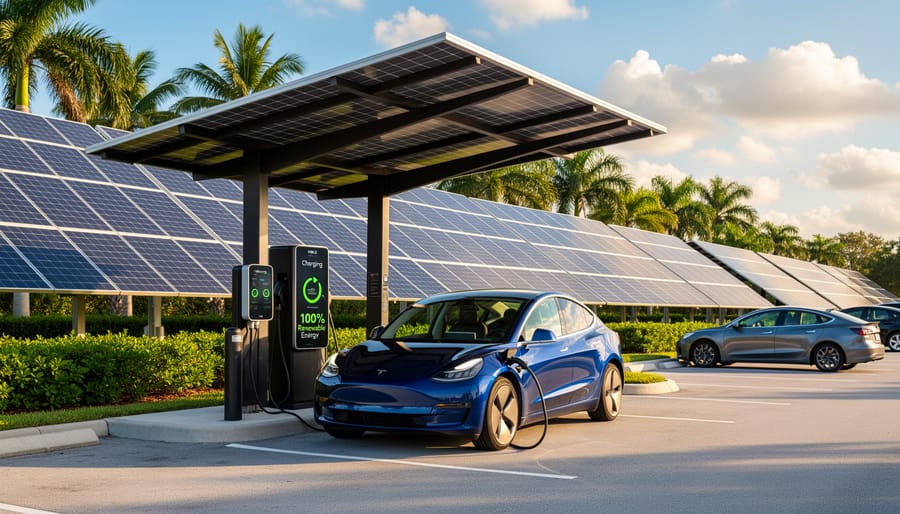
Several Orlando electric town car providers have established partnerships with local solar installations to power their charging stations. These facilities typically employ Level 2 and DC fast-charging systems integrated directly with solar energy infrastructure, reducing reliance on grid electricity during peak production hours. Data from the Orlando Utilities Commission indicates that solar-powered charging can offset up to 80% of a fleet’s energy consumption during optimal conditions.
The economics prove compelling: transportation companies installing on-site solar arrays report energy cost reductions of 40-60% compared to conventional grid charging. Furthermore, Florida’s net metering policies allow excess solar generation to feed back into the grid, creating additional revenue streams. This integration transforms electric town cars from merely zero-emission vehicles into components of a genuinely renewable transportation ecosystem, demonstrating how commercial mobility services can actively contribute to regional decarbonization goals.
Technology Behind Modern Electric Town Car Fleets
Battery Technology and Range Capabilities
Modern electric town cars serving Orlando routes employ advanced battery technology that effectively eliminates range anxiety for typical ground transportation needs. Current luxury EVs utilized in premium services feature lithium-ion battery packs ranging from 75 to 100 kilowatt-hours, delivering 250 to 370 miles per charge under real-world conditions.
For Orlando-specific operations, these capabilities prove more than adequate. The distance from Orlando International Airport to popular destinations like Walt Disney World measures approximately 25 miles, while trips to downtown Orlando average 15 miles. Even accounting for climate control usage in Florida’s heat, which can reduce range by 10-15 percent, modern electric town cars easily complete multiple airport transfers on a single charge.
Industry data from fleet operators reveals that Tesla Model S and Mercedes EQS vehicles commonly used in luxury services maintain 85-90 percent of their rated range in Florida’s climate conditions. The regenerative braking systems employed in these vehicles recover energy during frequent stops, particularly beneficial in Orlando’s urban traffic patterns.
Charging infrastructure has evolved significantly, with DC fast-charging stations capable of replenishing 80 percent battery capacity in 30-40 minutes. Many professional town car services maintain Level 2 chargers at their facilities, ensuring vehicles begin each shift fully charged. This combination of extended range and robust charging networks makes electric town cars entirely practical for Orlando’s transportation demands, supported by five-year battery warranties that typically guarantee 70 percent capacity retention.
Smart Fleet Management Systems
Modern electric town car services in Orlando leverage sophisticated artificial intelligence systems to maximize operational efficiency and passenger satisfaction. These smart fleet management platforms integrate multiple data streams—including real-time traffic patterns, charging station availability, weather conditions, and vehicle battery status—to make split-second routing decisions that traditional dispatch systems cannot match.
At the core of these systems lies predictive analytics for charging optimization. AI algorithms analyze historical trip data and upcoming reservations to determine optimal charging windows, ensuring vehicles maintain sufficient range without excessive downtime. According to industry experts, this approach can reduce charging-related delays by up to 40% compared to fixed-schedule charging protocols.
Route planning technologies have evolved beyond basic GPS navigation. Machine learning models now factor in variables such as road construction, special events, and even airport security wait times to provide accurate arrival predictions. These systems continuously learn from millions of data points, refining their algorithms to improve accuracy over time.
Vehicle health monitoring represents another critical component, with sensors tracking battery degradation, tire pressure, and mechanical performance. This proactive maintenance approach prevents unexpected breakdowns and extends vehicle lifespan, directly translating to improved service reliability and reduced operational costs for fleet operators serving the Orlando market.
Economic Implications for Service Providers and Consumers
Total Cost of Ownership for Fleet Operators
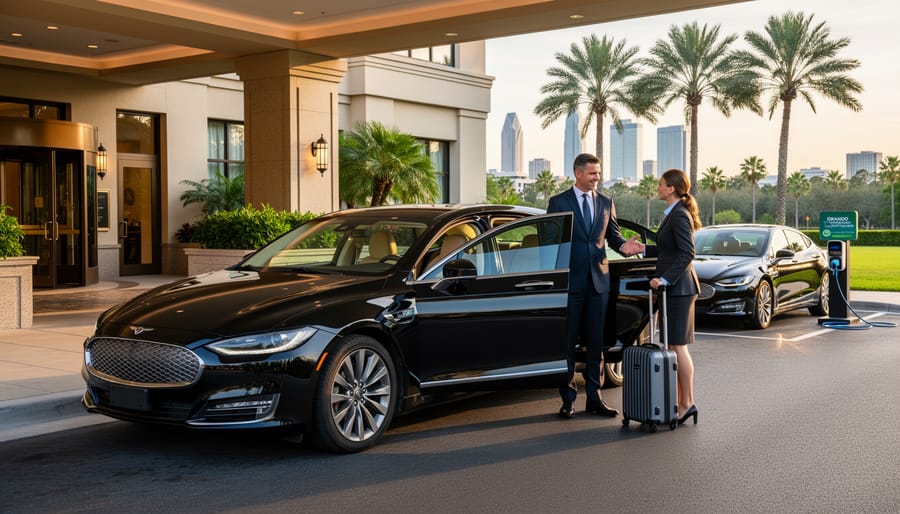
For fleet operators in Orlando, electric town cars present a compelling financial proposition despite higher upfront acquisition costs. Industry data reveals that electric vehicles typically cost 40-60% less to maintain than conventional luxury sedans, primarily due to fewer moving parts, no oil changes, and regenerative braking systems that extend brake pad life significantly.
Fuel cost reductions represent the most substantial ongoing savings. Electric town cars operate at approximately $0.04 per mile in electricity costs compared to $0.15-0.20 per mile for premium gasoline-powered vehicles. For fleet operators logging 50,000 miles annually per vehicle, this translates to savings exceeding $5,500 per car annually.
Multiple incentive programs further improve the total cost of ownership equation. Federal tax credits of up to $7,500 per qualifying vehicle remain available for many electric models, while Florida offers exemptions from certain licensing fees and access to high-occupancy vehicle lanes. According to interviews with Orlando fleet managers, comprehensive workplace charging infrastructure partnerships with utility companies like Duke Energy Florida have reduced operational charging costs by an additional 15-20% through time-of-use rate structures.
Research from the International Council on Clean Transportation demonstrates that electric vehicle total cost of ownership reaches parity with conventional vehicles within three to four years of operation for high-mileage commercial applications, making electrification increasingly viable for professional transportation services.
Consumer Pricing and Value Proposition
Electric town car services in Orlando typically operate with pricing structures comparable to traditional luxury transportation, though the cost dynamics differ fundamentally. While base rates may appear similar—ranging from $75 to $150 per hour depending on vehicle class and service provider—electric vehicles deliver substantial operational savings through reduced fuel and maintenance costs. Electric powertrains require approximately 60% less maintenance than conventional engines, eliminating oil changes, transmission services, and many traditional wear components.
These operational efficiencies create opportunities for competitive consumer pricing, particularly for corporate accounts and frequent travelers. Some providers pass savings directly to customers through lower per-mile charges or enhanced amenities at standard rates. The value proposition extends beyond immediate cost considerations: passengers benefit from quieter cabins, smoother acceleration, and zero tailpipe emissions during transit. For environmentally conscious professionals, the premium of choosing electric service—when present—often represents minimal difference, typically 5-10% above conventional rates, while supporting measurable reductions in urban carbon emissions. Fleet operators report that operational savings accumulate significantly over vehicle lifespans, potentially enabling more competitive long-term pricing as electric infrastructure matures and battery costs continue declining.
Orlando’s Position in the Electric Transportation Revolution
Municipal and State Support for EV Infrastructure
Orlando’s electric vehicle infrastructure has expanded significantly through coordinated municipal and state initiatives designed to accelerate commercial EV adoption. The Florida Department of Transportation has allocated over $8.6 million through the Volkswagen Environmental Mitigation Trust to install Level 2 and DC fast-charging stations across Central Florida, with priority placement along major transportation corridors serving commercial operators.
Orange County’s Green Fleet Initiative, launched in 2021, provides regulatory streamlining for commercial transportation companies transitioning to electric vehicles. The program offers expedited permitting for charging infrastructure installation and reduced licensing fees for fleet operators meeting specific emission reduction targets. According to Orange County’s Environmental Protection Division, these incentives have contributed to a 43% increase in registered commercial EVs since implementation.
The City of Orlando’s Climate Action Plan mandates that 30% of all commercial ground transportation vehicles operate on electric power by 2030. To support this goal, the city has installed 150 publicly accessible charging ports at strategic locations including Orlando International Airport and the convention center district. Additionally, the Florida Public Service Commission approved rate structures allowing commercial EV operators to access off-peak electricity pricing, reducing operational costs by approximately 35% compared to standard commercial rates. These combined efforts create a robust framework supporting sustainable luxury transportation services throughout the metro area.
Competitive Landscape and Market Penetration
Orlando’s electric town car market remains in early development, with traditional transportation providers gradually incorporating EVs into their fleets. Major operators like Mears Transportation and Quicksilver have begun pilot programs featuring Tesla Model S and Model X vehicles, though electric options currently represent less than 5% of their luxury fleets. Smaller, specialized services such as Eco Limo Orlando have positioned themselves as electric-first providers, capturing environmentally conscious corporate clients and tourism segments.
Market penetration faces significant barriers including charging infrastructure limitations at Orlando International Airport and downtown venues. However, fleet operators report 30-40% lower operating costs for electric vehicles compared to conventional town cars, primarily through reduced fuel and maintenance expenses. Industry analysts project electric vehicles could reach 15-20% of Orlando’s luxury ground transportation market by 2026, driven by corporate sustainability mandates and expanding charging networks. The competitive advantage currently favors companies investing early in charging infrastructure and driver training for EV operation.
Challenges and Future Outlook
Infrastructure and Operational Challenges
Orlando’s electric town car infrastructure faces distinct challenges shaped by its tourism-driven transportation demands. The metropolitan area currently operates approximately 180 public charging stations, a figure that lags behind comparable tourist destinations. According to recent assessments by the Florida Department of Transportation, this translates to roughly one public charger per 15,000 residents, significantly below the infrastructure needed to support commercial fleet operations at scale.
Grid capacity presents additional complications. Orlando’s electrical infrastructure experiences peak demand periods coinciding with tourist season, when air conditioning loads and increased economic activity strain existing systems. Fleet operators report concerns about simultaneous charging of multiple vehicles during overnight hours, which can create localized demand spikes exceeding 200 kilowatts per facility.
The high-volume tourism market introduces operational complexities absent in residential EV adoption. Town car services must maintain vehicle availability during unpredictable demand surges, particularly around theme parks and convention centers. Industry experts note that current battery technology requires strategic charging schedules, with vehicles typically needing 4-6 hours for full charges using Level 2 systems. This constraint necessitates larger fleet sizes compared to conventional vehicles to maintain service continuity, increasing capital requirements and operational complexity for service providers navigating Orlando’s competitive transportation market.
Technological Advances on the Horizon
The electric town car sector stands poised for significant transformation through several converging technologies. Solid-state batteries, currently in advanced development by major automotive manufacturers, promise to deliver energy densities 50-70% higher than current lithium-ion systems while dramatically reducing charging times. Industry experts indicate these batteries could enable 500-mile ranges and 80% charges in under 10 minutes by 2027, fundamentally altering the operational parameters for commercial fleet services.
Autonomous driving capabilities represent another frontier, with Level 4 automation systems already undergoing testing in controlled urban environments. These systems could optimize route efficiency by up to 30% while reducing labor costs, though regulatory frameworks remain in development. Meanwhile, vehicle-to-grid technology allows electric fleets to serve as distributed energy storage, creating revenue opportunities during peak demand periods. According to recent Department of Energy assessments, widespread adoption of these technologies could reduce commercial transportation emissions by 60% within the next decade, making electric town car services not merely competitive alternatives but superior options across performance metrics.
The convergence of environmental imperatives, economic advantages, and technological maturation has positioned Orlando as a compelling case study for electric town car adoption in tourism-dependent urban centers. The city’s transportation sector accounts for approximately 40% of its carbon emissions, making electrification of commercial vehicle fleets a critical pathway toward meeting Florida’s renewable energy targets. Electric town cars operating in Orlando demonstrate energy efficiency improvements of 60-70% compared to conventional vehicles, while integrating seamlessly with the region’s expanding solar infrastructure—a particularly relevant synergy given Florida’s average 230 sunny days annually.
The economic calculus increasingly favors electric fleet operators, with total cost of ownership declining 30% over five-year periods due to reduced maintenance requirements and fuel costs. Battery technology improvements, particularly the transition to lithium iron phosphate chemistries offering 3,000+ charge cycles, have eliminated range anxiety concerns for urban luxury transportation applications.
Beyond Orlando, this transition illuminates a replicable model for tourism-heavy metropolitan areas worldwide. Cities dependent on visitor economies face unique pressure to balance growth with environmental stewardship. Electric town car services represent not merely a transportation upgrade but a visible commitment to sustainable infrastructure that resonates with increasingly eco-conscious travelers. As renewable energy grids mature and vehicle electrification technology continues advancing, the Orlando model offers actionable insights for urban planners and transportation providers navigating the clean energy transition.