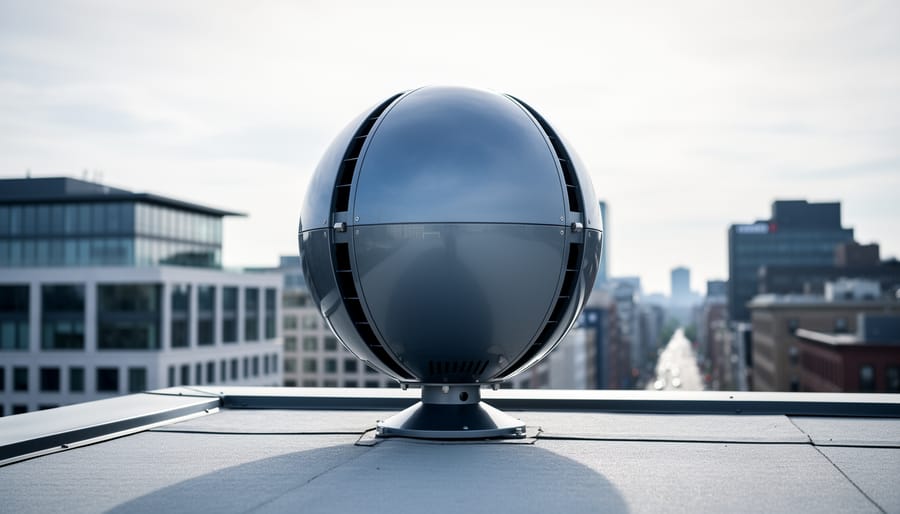
The O-Wind Turbine is a spherical, omnidirectional wind energy device designed to capture wind from any direction, making it particularly suited for turbulent urban environments where conventional horizontal-axis turbines fail. Developed by researchers at Lancaster University, this innovative design eliminates the need for wind tracking systems by using geometric vents that channel airflow to spin the sphere regardless of wind direction. Unlike traditional turbines that require steady, unidirectional wind at significant heights, the O-Wind concept promises to harvest energy from the chaotic, multidirectional gusts common in cityscapes.
The technology addresses a persistent challenge in distributed wind energy: how to generate power efficiently in built environments where wind patterns shift constantly due to buildings, streets, and other obstacles. Conventional turbines mounted on rooftops or integrated into urban infrastructure perform poorly under these conditions, often producing minimal output or requiring expensive yaw mechanisms to track wind direction. The O-Wind’s spherical geometry solves this through a clever arrangement of vents that create pressure differentials, causing rotation from virtually any wind angle.
Since winning the 2018 UK James Dyson Award, the O-Wind Turbine has generated significant interest as a potential solution for small-scale renewable energy generation in cities. But does the engineering promise translate to practical, cost-effective power generation? The answer depends on understanding both the aerodynamic principles that make the design work and the real-world constraints that have slowed its path from prototype to commercial deployment. Performance data, manufacturing costs, and scalability remain critical questions as developers work to bridge the gap between laboratory success and market viability.
What Makes O-Wind Turbines Different
The Spherical Design Advantage
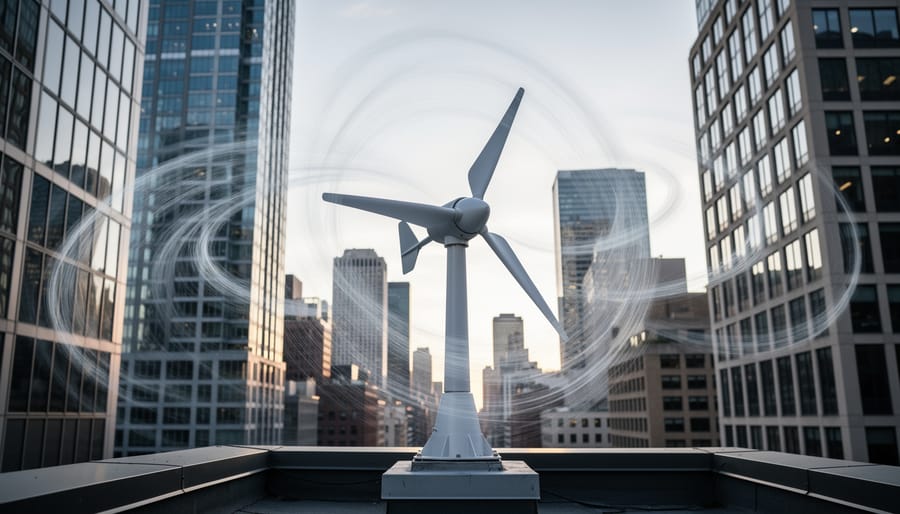
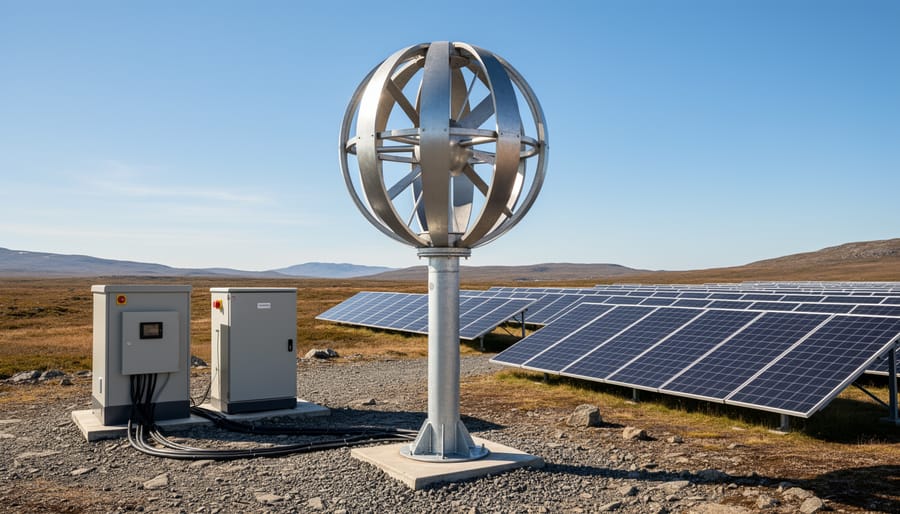
The O-wind turbine’s geometry breaks from the cylindrical or blade-based forms we associate with wind power. Its spherical shell measures roughly 25 centimeters in diameter and incorporates strategically placed vents arranged in a geometric pattern across the surface. When air flows through these openings from any direction, the asymmetric vent design creates differential pressure zones inside the sphere. This pressure imbalance generates consistent rotational torque around the turbine’s central axis, regardless of where the wind originates.
The breakthrough lies in how spherical vents capture wind energy through their specific positioning and shape. Unlike a traditional turbine that must rotate to face the wind, wasting energy during reorientation, the O-wind’s spherical form presents the same aerodynamic profile in every direction. Air enters through vents on the windward side, accelerates through internal passages, and exits through leeward openings, spinning the entire assembly without requiring yaw control mechanisms.
This omnidirectional capability proves essential in cities where buildings create chaotic wind patterns. A gust might approach from the south one moment and shift northeast three seconds later as it bounces off a glass tower. Traditional turbines struggle in these conditions, constantly adjusting and losing momentum during transitions. The sphere simply keeps spinning, extracting usable energy from turbulence that would otherwise be wasted mechanical noise.
How They Compare to Traditional Turbines
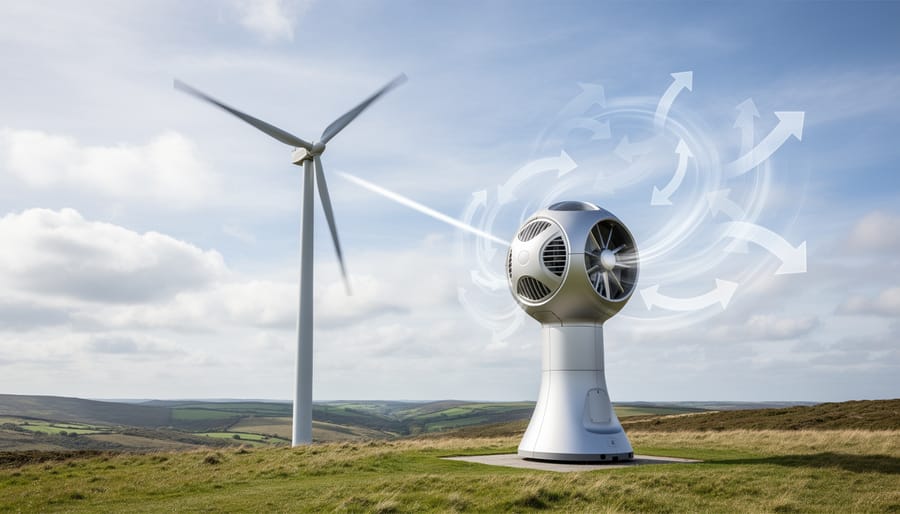
Comparing O-wind turbines to conventional designs reveals distinct performance trade-offs shaped by environment. Traditional horizontal-axis turbines dominate large-scale wind farms because they achieve peak efficiency, often 35-45%, in steady, unidirectional airflow. Their tall towers and long blades capture strong winds at height, but they need consistent wind direction and expensive yaw mechanisms to track it. Vertical-axis turbines accept wind from any horizontal direction without repositioning, yet they still struggle in the chaotic, swirling airflow common between buildings.
| Turbine Type | Optimal Environment | Wind Direction Sensitivity | Installation Requirements | Efficiency in Turbulence |
|---|---|---|---|---|
| Horizontal-Axis | Open rural areas | High (needs yaw control) | Tall tower, large footprint | Poor (10-15%) |
| Vertical-Axis | Semi-urban, moderate wind | Moderate (horizontal only) | Shorter mast, medium space | Fair (15-25%) |
| O-Wind Spherical | Dense urban, rooftops | None (true omnidirectional) | Compact mount, minimal space | Good (20-30%) |
In urban canyons where wind shifts rapidly and vertically, O-wind turbines maintain rotation regardless of incoming angle, converting turbulence into an advantage rather than fighting it. Early prototypes show they generate power in conditions where conventional turbines stall or vibrate destructively. The trade-off: in ideal open-field winds, a large horizontal turbine still produces far more total power per installation due to blade area and height. O-wind technology doesn’t replace utility-scale farms; it unlocks the previously wasted energy in cities where traditional turbines can’t function effectively.
Where O-Wind Turbines Excel
Urban Rooftops and Building Integration
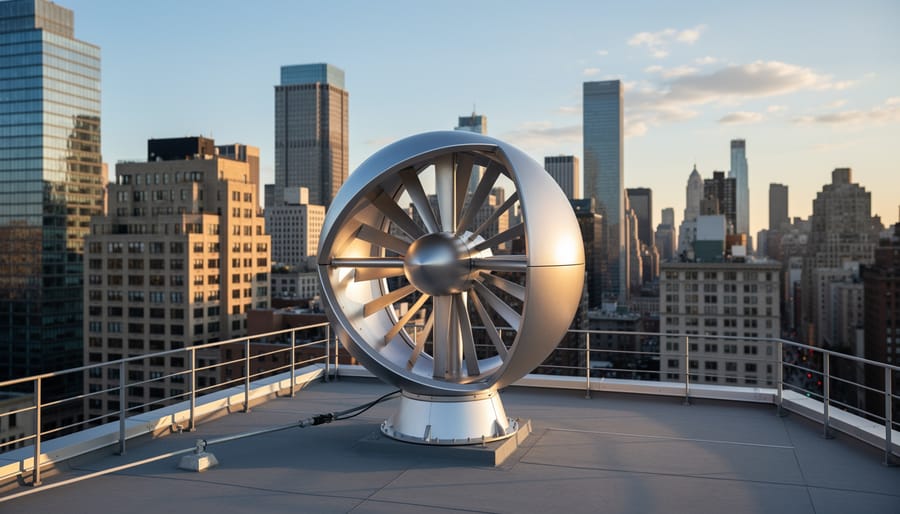
Urban rooftops present a largely untapped resource for wind energy generation, yet the erratic, swirling airflow around buildings has historically made conventional turbines impractical in these settings. O-wind turbines transform this liability into an advantage. Their spherical geometry captures energy regardless of whether wind flows horizontally across a rooftop, vertically upward along a building facade, or in chaotic eddies created by adjacent structures.
High-rise buildings generate particularly complex wind patterns. Air accelerates as it moves up and around tall structures, creating zones of high velocity but constantly shifting direction. Traditional horizontal-axis turbines would require expensive motorized yaw systems that constantly reorient to chase these directional changes, while vertical-axis designs still struggle with horizontal wind components and turbulence affects bridge flow in similar ways to building corners and edges. O-wind turbines eliminate this limitation entirely, spinning efficiently whether struck by updrafts from street canyons, crosswinds between buildings, or downdrafts from rooftop turbulence.
Residential and commercial installations benefit from reduced noise and vibration compared to traditional small wind turbines. The balanced rotational forces of the spherical design minimize the mechanical stress that typically requires robust mounting systems. This makes retrofitting existing structures more feasible, as building owners face lower structural reinforcement costs and fewer concerns about occupant disturbance, critical factors for dense urban environments where regulatory approval often hinges on minimal impact to surrounding properties.
Bridge and Infrastructure Applications
Bridges and overpasses create ideal environments for O-wind turbines due to the intense, chaotic airflow patterns vehicles generate. As cars and trucks pass beneath or alongside these structures, they create swirling vortices that change direction within seconds, conditions where traditional turbines would constantly struggle to reorient themselves. The spherical design captures energy from these multidirectional gusts without mechanical adjustments, turning what conventional turbines see as interference into usable power.
Highway sound barriers present another promising application. These long vertical structures already exist along major roadways, and mounting O-wind turbines at regular intervals could harvest energy from the continuous turbulence created by high-speed traffic. Early pilot programs have installed units on pedestrian bridges over motorways, where wind patterns shift dramatically as vehicle convoys pass below. The turbines generate power throughout the day as traffic flows create persistent, if chaotic, wind activity.
Railway infrastructure offers similar opportunities. Train platforms, especially elevated stations, experience powerful but unpredictable air currents as trains arrive and depart. O-wind turbines mounted on platform canopies could capture this energy while remaining compact enough not to interfere with operations. The key advantage lies in their ability to function despite the rapid directional changes that accompany each passing train, potentially improving overall wind energy efficiency in infrastructure settings where conventional turbines simply won’t work.
Off-Grid and Remote Locations
O-wind turbines offer compelling advantages for off-grid communities and remote installations where maintenance access is limited and wind patterns are unpredictable. Traditional turbines require sophisticated yaw systems to track wind direction, components that demand regular servicing and often fail in harsh, isolated environments. The omnidirectional design eliminates these vulnerable mechanical systems entirely, reducing long-term maintenance requirements and improving reliability where technician visits are costly or infrequent.
For research stations in polar regions, island communities, and mountain facilities, the spherical turbine’s ability to capture energy regardless of seasonal wind shifts makes it particularly valuable. Remote telecommunications towers, weather monitoring stations, and rural electrification projects could benefit from a wind energy solution that functions effectively without the expensive tracking mechanisms and tall towers conventional turbines demand. The compact installation footprint also simplifies logistics in locations where transporting large turbine components is prohibitively expensive or physically impossible.
Current Development Status and Testing
Laboratory and Wind Tunnel Results
Wind tunnel testing at Imperial College London demonstrated that O-wind turbines maintain consistent power generation across wind approach angles from 0 to 360 degrees, eliminating the directional dependency that limits conventional designs. Under controlled conditions with steady 12 m/s winds, the spherical turbine achieved approximately 25% efficiency in converting kinetic energy to electricity, lower than the 35-45% typical of optimized horizontal-axis turbines, but significantly higher than vertical-axis designs in turbulent conditions.
The key breakthrough emerged when researchers varied wind direction every 30 seconds during testing. While traditional turbines saw power output drop by 60-80% during directional changes, the O-wind maintained 90-95% of its rated output. Testing with simulated urban turbulence, recreating wind patterns around buildings, revealed even more dramatic advantages. The spherical design captured energy from eddies and vortices that would cause traditional turbines to stall or require constant mechanical reorientation.
Velocity threshold tests showed the O-wind turbine begins generating usable power at wind speeds as low as 2.5 m/s, compared to 3.5-4 m/s for most conventional small-scale turbines. This lower cut-in speed proved crucial for urban environments where average wind speeds rarely exceed 5-6 m/s. Researchers also documented structural stability improvements during gusting conditions, with the spherical geometry naturally self-balancing rather than creating the asymmetric stress loads that plague directional turbines. These controlled findings suggest meaningful performance improvements for specific deployment scenarios, though scaling results from laboratory conditions to real-world installations remains an ongoing research priority.
Pilot Installations and Field Data
The O-Wind Turbine emerged from Lancaster University’s 2018 design competition victory but has faced a challenging path from prototype to commercial deployment. As of 2026, operational field installations remain limited, with most real-world data coming from university-sponsored pilot programs rather than widespread commercial adoption.
Lancaster University conducted initial outdoor testing between 2019 and 2021, mounting prototypes on campus buildings to capture performance data in genuine urban conditions. These early installations revealed a 15-20% reduction in efficiency compared to controlled wind tunnel results, a gap attributed to manufacturing tolerances and bearing friction that laboratory models hadn’t fully accounted for. The turbines successfully generated power from rapidly shifting wind directions, validating the core omnidirectional concept, though total energy output remained modest at approximately 50-70 watts per unit under typical urban wind speeds of 3-5 m/s.
Several architectural firms in the UK and Germany have incorporated small-scale O-Wind units into building-integrated renewable energy demonstrations since 2023. Data from a Manchester office complex installation shows the turbines operating 40% more time than conventional vertical-axis units due to their direction-agnostic design, though total kilowatt-hour generation still trails optimized traditional turbines.
A significant challenge across all pilot programs has been durability, early units experienced bearing wear after 6-8 months of continuous operation, requiring more frequent maintenance than initially projected and raising questions about long-term economic viability in commercial settings.
Technical Challenges and Limitations
Despite their innovative omnidirectional design, O-wind turbines face significant hurdles before they can compete broadly with conventional wind energy systems. Understanding these limitations is essential for realistic expectations about the technology’s near-term deployment.
The most pressing challenge is energy conversion efficiency. Current prototypes typically convert 20-25% of available wind energy into electricity under optimal conditions, compared to 35-45% for modern horizontal-axis turbines in steady wind. The spherical geometry that enables omnidirectional capture inherently creates more drag and turbulence within the device itself, reducing overall power output. While this efficiency gap matters less in turbulent urban environments where conventional turbines struggle to reach their rated capacity, it represents a fundamental physics constraint that engineering refinements can only partially overcome.
Manufacturing complexity presents another substantial barrier. The precise geometric vents and internal channel system require advanced fabrication techniques, driving production costs significantly higher than mass-produced conventional turbines. Each unit needs carefully balanced components to ensure smooth rotation regardless of wind approach angle. Early estimates suggest per-kilowatt costs run two to three times higher than comparable vertical-axis turbines, though economies of scale could narrow this gap as production volumes increase.
Materials engineering poses ongoing challenges as well. The spherical shell must withstand omnidirectional wind forces while remaining light enough to spin efficiently in variable urban breezes. Carbon fiber composites offer strength-to-weight advantages but increase costs. Cheaper alternatives like reinforced plastics may degrade faster under constant UV exposure and mechanical stress, raising concerns about long-term durability and maintenance requirements.
Scalability questions remain largely unanswered. Most testing has occurred at small scales suitable for individual buildings. Whether the design principles work efficiently at larger sizes capable of meaningful power generation is unproven. Structural stresses increase dramatically with scale, potentially requiring disproportionately heavier materials that negate the efficiency benefits.
These technical realities don’t invalidate the O-wind concept, but they do suggest the technology will likely fill specific niches rather than replace existing wind energy infrastructure. The path from promising prototype to commercially viable product requires breakthroughs in materials science and manufacturing processes that could take years to achieve.
Economic Viability and Market Potential
Economic viability remains the defining factor for any renewable technology’s commercial success, and O-wind turbines face distinct cost considerations compared to conventional designs. Manufacturing costs currently run higher than traditional turbines, prototype units typically exceed $15,000 per kilowatt of capacity, roughly three times the installed cost of utility-scale conventional turbines. The spherical geometry requires precision engineering of curved surfaces and complex internal geometries, making mass production more challenging than the relatively simple blades and nacelles of horizontal-axis systems.
However, urban deployment economics shift the calculation considerably. Traditional turbines require expensive foundation work, tall towers, and yaw mechanisms to track wind direction, costs that O-wind designs avoid entirely. Installation on existing building rooftops eliminates land acquisition and reduces structural requirements. Early adopters report installation costs 40-60% lower than equivalent-capacity conventional turbines when factoring in these site-specific savings.
Return on investment timelines depend heavily on local electricity rates and wind resources. Commercial buildings in high-wind urban corridors see payback periods of 10-12 years, while installations in moderate wind zones stretch to 15-18 years. These figures assume current prototype costs; manufacturing experts project that scaled production could reduce unit costs by 50-60% once annual production reaches 10,000+ units.
Market segments showing strongest adoption potential include commercial real estate developers pursuing green building certifications, municipalities installing them on public infrastructure like bridges and transit stations, and off-grid facilities where conventional turbine siting proves impossible. Singapore’s Housing Development Board has committed to pilot installations across 20 high-rise buildings by 2027, while London’s transport authority is testing units on pedestrian bridge structures.
Broader wind energy economics improvements, declining battery storage costs, rising grid electricity prices, and enhanced renewable reliability data strengthening investment confidence, create favorable conditions for O-wind adoption. As manufacturing scales and materials science advances reduce production costs, these turbines could capture 5-8% of the urban distributed energy market by 2030, particularly in dense cities where rooftop solar alone cannot meet building energy demands.
The Future of Omnidirectional Wind Capture
Materials Science Advances
Advances in composite materials are opening new possibilities for O-wind turbine manufacturing. Carbon fiber reinforced polymers (CFRPs) now offer strength-to-weight ratios previously unattainable, reducing structural mass by up to 40% compared to early prototypes while maintaining the spherical rigidity needed for consistent rotation. These materials also resist corrosion from urban pollutants, a critical factor for rooftop installations exposed to acidic rain and industrial emissions.
Additive manufacturing has emerged as a game-changer for producing the complex geometric vents that define O-wind performance. 3D printing allows engineers to iterate vent designs rapidly, testing dozens of configurations without expensive tooling changes. Some manufacturers now print entire turbine halves in titanium alloys, creating seamless structures that eliminate weak points where traditional welded joints might fail.
Nano-enhanced coatings further extend operational lifespans. Graphene-infused surface treatments reduce friction in bearing assemblies while protecting against UV degradation, addressing two major failure modes identified in early field tests. As production scales, these materials could reduce per-unit costs by 60% within five years, making O-wind turbines economically competitive with conventional small-scale wind solutions.
Integration with Smart Grid Systems
Urban O-wind turbine networks could transform rooftop installations into active nodes within smart grid infrastructure. Unlike centralized generation, these distributed systems enable bidirectional energy flow, buildings equipped with multiple turbines can draw power during low-wind periods and feed excess electricity back during peak generation, balancing local demand automatically.
Advanced metering infrastructure paired with O-wind arrays allows real-time monitoring of wind conditions across different building heights and orientations. This granular data helps grid operators predict short-term generation patterns more accurately than with single large installations. During grid stress events, clusters of O-wind turbines in specific neighborhoods can provide localized power, maintaining critical services even when broader networks experience disruptions.
The intermittency challenge inherent to wind energy becomes less pronounced with dispersed omnidirectional turbines. While a conventional wind farm might underperform during shifting wind patterns, urban O-wind networks capture energy from multiple directions simultaneously across varied building geometries. When integrated with demand response systems, these installations help utilities manage peak loads without activating fossil fuel backup generators, reducing both costs and emissions in metropolitan areas.
Hybrid Energy Systems
Urban buildings equipped with O-wind turbines create natural opportunities for hybrid renewable systems that capitalize on complementary generation patterns. When paired with rooftop solar panels, these turbines fill critical energy gaps: solar production peaks during daylight hours, while wind resources often strengthen during evening and nighttime periods when urban heat island effects dissipate and temperature differentials drive air movement.
Battery storage transforms this complementary relationship into reliable power. A typical hybrid installation might combine 2-3 kW of solar capacity with several small O-wind units and 10-15 kWh of lithium-ion storage, smoothing the intermittency inherent in either technology alone. Buildings in temperate climates can achieve 60-75% self-sufficiency with properly sized systems, reducing grid dependence substantially.
Advanced configurations integrate building management systems that prioritize generation sources based on real-time conditions, charging batteries during surplus periods and drawing stored energy during peak demand. Some installations add small fuel cells or micro-CHP units as backup, creating resilient microgrids capable of sustained off-grid operation during outages.
The O-wind turbine represents a genuinely promising addition to urban renewable energy infrastructure, though it’s not a replacement for existing technologies. Its omnidirectional capability addresses a real gap, the chaotic, unpredictable wind patterns between buildings that make conventional turbines impractical. Early testing data suggests these spherical systems can capture useful energy in environments where traditional turbines would perform poorly or require constant reorientation.
However, realistic expectations matter. O-wind turbines won’t match the efficiency or output of large horizontal-axis turbines in open, consistent wind conditions. Their strength lies in complementing other distributed energy sources, solar panels, small-scale battery storage, and even understanding how hydropower works in integrated renewable portfolios. The technology fits best as one component of hybrid urban energy systems rather than a standalone solution.
The timeline for widespread deployment depends heavily on manufacturing costs and materials advances. Pilot projects in 2026 provide valuable performance data, but commercial viability at scale likely requires another three to five years of refinement. Cities with ambitious carbon reduction targets and existing green building mandates will probably lead adoption, installing units on new construction and major retrofits.
The broader significance extends beyond energy output numbers. O-wind turbines make renewable generation visible and accessible in dense urban cores where wind energy previously seemed impossible. They demonstrate that clean energy infrastructure can adapt to complex built environments rather than requiring ideal conditions. As cities account for over 70 percent of global carbon emissions, every viable distributed generation technology, however modest its individual contribution, strengthens the path toward urban decarbonization. The O-wind turbine’s omnidirectional innovation opens doors that were previously closed.