A home solar power solution is a photovoltaic system installed on residential property that converts sunlight into electricity for household consumption, either supplementing or replacing grid-supplied power. These systems typically consist of solar panels mounted on rooftops or ground arrays, paired with inverters that transform direct current into usable alternating current, along with optional battery storage for energy independence during outages or peak-demand periods.
Solar adoption has accelerated dramatically as panel efficiency has improved and costs have dropped nearly 90% since 2010. For homeowners evaluating whether solar makes financial sense in 2026, the calculus extends beyond environmental benefits to include immediate utility savings, property value increases averaging 4.1% according to recent appraisals, and protection against escalating electricity rates. The federal Investment Tax Credit continues to incentivize installation, though state-level programs vary considerably in generosity and structure.
Understanding what distinguishes grid-tied systems from off-grid configurations, how net metering agreements affect payback periods, and which panel technologies deliver optimal performance for specific climate zones requires navigating substantial technical complexity. This article breaks down the core components and operational principles behind residential solar installations, examines the three primary system architectures available to homeowners, and provides practical guidance for matching system specifications to household energy profiles. Much like understanding how hydro works requires grasping conversion efficiency principles, evaluating solar solutions demands familiarity with capacity factors, degradation rates, and seasonal production variability that determine real-world performance beyond manufacturer specifications.
What Home Solar Power Solutions Mean for Homeowners
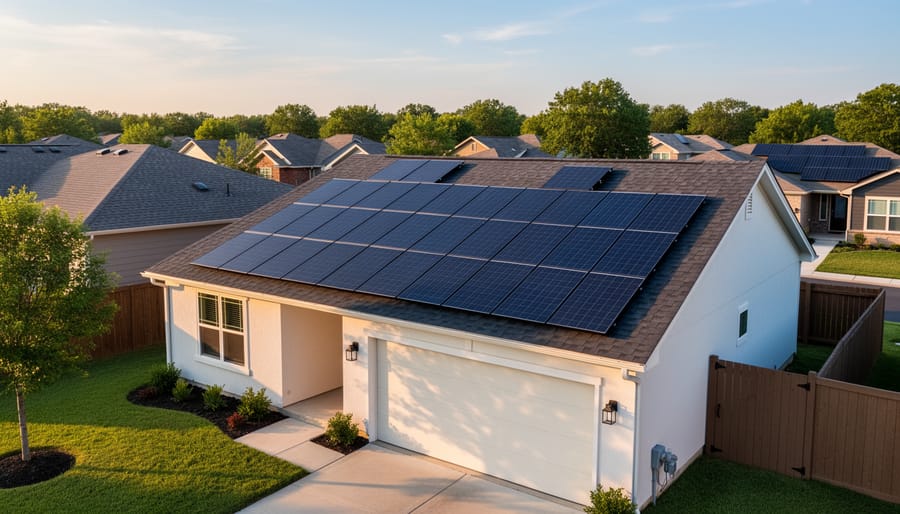
Home solar power solutions represent the complete ecosystem required to transform sunlight into electricity for your household. Rather than a single product, these solutions encompass solar panels, inverters, mounting hardware, monitoring systems, and often battery storage, all professionally integrated with your home’s electrical infrastructure. The goal is straightforward: generate clean electricity on-site rather than purchasing all your power from the utility grid.
This shift from pure grid dependence to self-generation fundamentally changes how homeowners interact with energy. In a grid-tied configuration, your solar array produces electricity during daylight hours, powering your home’s immediate needs while sending excess production back to the utility. This arrangement, formalized through net metering agreements, allows homeowners to build credits when production exceeds consumption and draw from those credits during evenings or cloudy periods. Understanding how net metering works proves essential for evaluating the economic benefits of solar installation, as billing structures vary significantly by utility and jurisdiction.
Modern residential energy management treats solar as the primary generation source, with grid connection serving as backup or overflow capacity. Off-grid configurations eliminate utility dependence entirely, relying on battery banks to store surplus generation for nighttime use. These standalone systems require larger storage capacity and more careful energy budgeting but deliver complete independence from utility infrastructure and its associated costs or vulnerabilities. Most homeowners opt for grid-tied systems that balance financial optimization with practical reliability, though hybrid approaches combining grid connection with battery backup have gained traction as storage costs decline through 2026.
How Home Solar Power Systems Work
The Role of Inverters and Smart Controllers
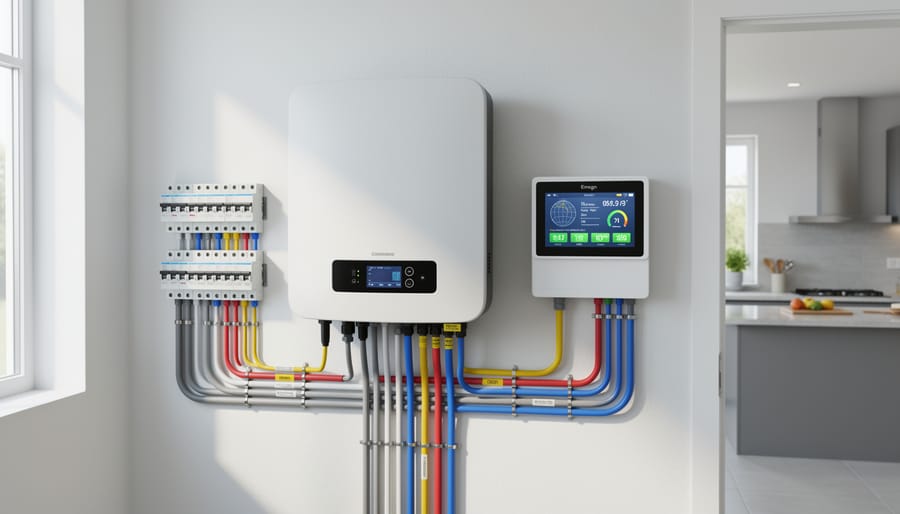
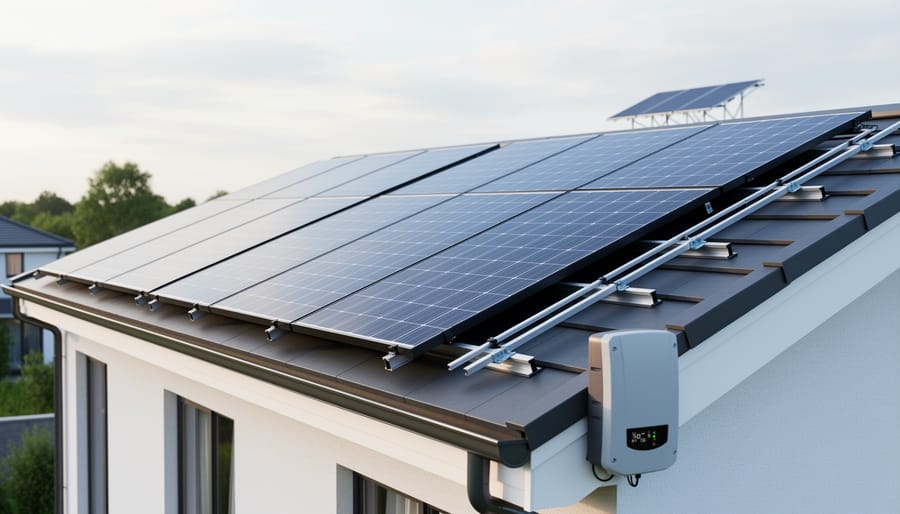
Inverters serve as the brain of a solar power system, converting the direct current (DC) electricity your panels generate into alternating current (AC) that powers household appliances. This conversion happens thousands of times per second, and the inverter’s efficiency, typically 96-98% in quality units as of 2026, directly affects how much generated energy you actually use.
Three main inverter architectures dominate residential installations. String inverters connect multiple panels in series to a single conversion unit, offering simplicity and lower upfront costs but creating a vulnerability: shading or malfunction in one panel reduces output across the entire string. Microinverters attach to individual panels, eliminating the weakest-link problem and allowing panel-level optimization, though at higher equipment costs. Power optimizers split the difference, pairing DC optimization at each panel with a central inverter for AC conversion, balancing performance gains against budget constraints.
Smart controllers have transformed inverters from passive converters into active system managers. Current models continuously monitor voltage, frequency, and power quality while communicating with utility grids to support grid stability during high solar generation periods. They log performance data panel-by-panel, alert homeowners to issues before they escalate, and can throttle output when necessary to meet grid requirements.
These controllers enable remote diagnostics that slash maintenance costs. A homeowner in Arizona can share real-time system data with their installer in minutes, identifying whether a production drop stems from equipment failure, debris accumulation, or seasonal sun angle changes.
Advanced inverters now integrate with home energy management systems, coordinating solar generation with battery storage, EV charging schedules, and time-of-use rate structures. This orchestration maximizes self-consumption and minimizes grid dependence, translating technical capability into measurable cost savings.
Core Components of Home Solar Power Solutions
Solar Panel Technologies
The three main solar panel technologies available for home installations differ meaningfully in their construction, performance characteristics, and suitability for specific applications.
Monocrystalline panels, recognizable by their uniform dark appearance and rounded cell edges, represent the efficiency leader in residential solar. These panels use silicon wafers cut from single-crystal ingots, achieving conversion efficiencies between 20% and 23% in standard residential products, with premium models reaching 24% as of 2026. Their superior efficiency means homeowners can generate more power from limited roof space, making them ideal for properties with shading constraints or smaller available installation areas. The trade-off comes in upfront cost, as monocrystalline panels typically command a 15% to 25% price premium over polycrystalline alternatives.
Polycrystalline panels feature a distinctive blue, speckled appearance created by their multi-crystal silicon composition. With efficiencies ranging from 17% to 20%, they require slightly more roof area to produce equivalent power output. However, their lower manufacturing costs make them economically attractive for homeowners with ample unshaded roof space where the efficiency difference matters less than total system cost.
Thin-film technologies, including amorphous silicon and cadmium telluride variants, offer the lowest efficiency at 11% to 15% but excel in specific scenarios. Their flexible form factor enables installation on curved surfaces, and their superior performance in partial shade or high temperatures makes them viable for challenging environments. Research pipelines show promise in perovskite-silicon tandem cells, which achieved 33% efficiency in laboratory settings during 2025, though commercial availability remains several years distant.
Energy Storage Options
Energy storage transforms solar panels from daytime-only generators into around-the-clock power sources. Residential battery systems store excess electricity produced during sunny hours for use after dark or during outages, fundamentally changing how solar installations function.
Lithium-ion chemistry dominates the 2026 residential market due to its high energy density, long cycle life, and declining costs. These batteries typically last 10-15 years and maintain 70-80% capacity after thousands of charge-discharge cycles. Manufacturers like Tesla, LG, and Enphase have standardized modular designs that integrate seamlessly with inverter systems, making installation straightforward for certified technicians.
Storage capacity is measured in kilowatt-hours, representing how much electricity a battery can hold. A typical home uses 25-30 kWh daily, though peak evening demand might only require 10-15 kWh. Most residential batteries range from 10-20 kWh per unit, with systems expandable through multiple modules. Proper sizing requires analyzing your consumption patterns, critical loads, and whether you want partial backup or complete off-grid capability.
That distinction matters significantly. Backup power systems support essential circuits during outages, refrigeration, lighting, medical equipment, for hours or days depending on usage and available sunlight for recharging. Full off-grid capability requires substantially larger battery banks, often 40+ kWh, plus oversized solar arrays to ensure charging even during winter’s shorter days. The cost difference is considerable: backup systems might add $10,000-15,000 to installation costs, while true off-grid setups often exceed $30,000 in storage alone.
Emerging solid-state batteries promise higher energy density and improved safety, though they remain in development for residential applications as of 2026.
Types of Home Solar Installations
Grid-Tied Systems
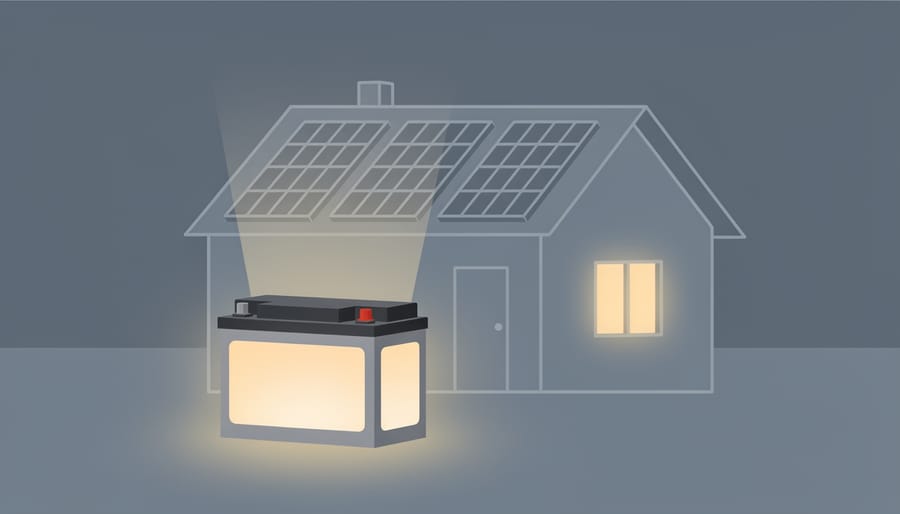
Grid-tied systems connect directly to the utility grid without battery storage, representing roughly 85% of residential solar installations in 2026. When your panels generate more electricity than your home consumes, the excess flows back to the grid through a bidirectional meter. Your utility credits this surplus against future consumption through net metering arrangements, effectively using the grid as virtual storage. Most utilities offer one-to-one credit ratios, though some have shifted to time-of-use valuations that pay less for midday solar production than evening grid consumption.
The trade-off for this cost-effective approach is zero backup capability during outages. Even with bright sunlight, safety regulations require grid-tied inverters to shut down when the grid fails, preventing backfeeding that could endanger utility workers. Homeowners seeking resilience typically consider backup alternatives or upgrade to hybrid configurations.
Installation requires an interconnection agreement with your utility, which specifies technical standards, metering arrangements, and insurance requirements. Permitting processes vary by jurisdiction but generally involve electrical and building permits plus final inspection before your system receives permission to operate. Grid-tied systems deliver the fastest payback periods since they avoid battery costs while maximizing solar utilization through net metering.
Hybrid Systems with Battery Backup
Hybrid systems merge the cost advantages of grid-tied solar with the security of battery storage, creating a middle ground that’s increasingly popular as battery prices decline. Unlike pure grid-tied installations, these systems store excess generation in lithium-ion battery banks, typically 10-20 kWh for average homes, allowing homeowners to discharge stored energy during evening peak hours or outages. This configuration maintains net metering benefits during normal operation while providing backup power when the grid fails.
The key technical feature is automatic islanding: when utility power drops, the system instantly disconnects from the grid to prevent backfeeding, then switches to battery mode within milliseconds. Modern hybrid inverters manage this transition seamlessly, powering critical loads like refrigeration, medical equipment, and communications. Unlike generators, the switchover is silent and instantaneous.
Economics favor hybrids in regions with time-of-use rates or frequent outages. Battery additions typically cost $8,000, $15,000 installed as of 2026, with federal tax credits reducing net expense. The storage component enhances energy reliability while enabling load shifting, storing cheap midday solar for expensive evening consumption. Payback periods vary by utility rate structures, but most hybrid systems achieve positive returns within 10-12 years when accounting for resilience value and escalating grid electricity costs.
Practical Applications and Use Cases
Home solar power solutions adapt to diverse residential scenarios, each with distinct energy needs and constraints. A typical suburban family might install a 6-8 kW grid-tied system primarily for monthly electricity cost reduction, offsetting 70-90% of their utility bills while maintaining grid connection for reliability. These installations often pair with time-of-use rate strategies, shifting consumption to daylight hours when solar generation peaks.
Rural properties frequently pursue greater energy independence. A farmhouse with unreliable grid service might deploy a 10 kW hybrid system with 20 kWh of battery storage, ensuring operation during outages while reducing dependence on distant utility infrastructure. Agricultural applications extend beyond the home, powering irrigation pumps, barn lighting, and equipment charging stations without upgrading expensive rural grid connections.
Urban installations face space constraints but still deliver value. Townhouse owners with limited roof area might install compact 3-4 kW systems using high-efficiency monocrystalline panels, maximizing output per square meter. Condominium buildings increasingly adopt shared solar arrays on common roof space, distributing generated power across multiple units through community solar arrangements.
Common applications span a practical spectrum:
- Monthly electricity cost reduction through net metering credits
- Peak demand management to avoid high time-of-use charges
- Electric vehicle charging with renewable energy
- Emergency backup power during grid outages
- Off-grid living enablement in remote locations
- Hot water heating integration via solar thermal or electric resistance
- Pool and spa operation cost mitigation
- Home office power reliability for remote professionals
Climate considerations shape implementation. Arizona homeowners maximize year-round generation with minimal seasonal variation, while Pacific Northwest installations account for winter production drops. Coastal properties in hurricane zones prioritize wind-resistant mounting and rapid shutdown capabilities. Some homeowners even compare wind and solar options for their property, though wind faces stricter residential zoning limitations. The unifying factor across contexts: properly sized systems deliver measurable returns regardless of geographic or demographic differences.
System Sizing and Energy Assessment
Determining the right solar system size requires a data-driven analysis of your household’s energy profile and site characteristics. Professional installers typically begin with 12 months of utility bills to establish baseline consumption, measured in kilowatt-hours (kWh), and identify seasonal variations. A household using 900 kWh monthly needs roughly a 7-8 kW system in most U.S. climates, though this figure shifts based on sun exposure and panel efficiency.
Roof assessment examines orientation, pitch, shading, and available square footage. South-facing roofs between 15-40° pitch capture optimal sunlight in the Northern Hemisphere, but east-west configurations work when south-facing space is limited. Each kilowatt of capacity requires approximately 50-75 square feet, depending on panel efficiency. Installers use tools like solar pathfinders and satellite imagery to model shading from trees, chimneys, and neighboring structures throughout the year.
Geographic location dramatically affects system sizing. A 6 kW array in Arizona generates more annual energy than an 8 kW system in Maine due to solar irradiance differences, the Southwest averages 5.5-7 peak sun hours daily versus 3.5-4.5 in the Northeast. Local climate data, temperature coefficients (panels lose efficiency in extreme heat), and average cloud cover all factor into production estimates.
Your energy goals shape the calculation. Bill offset, reducing grid dependence by 70-100%, is the most common target, but some homeowners size for future consumption increases like EV energy options or pool installations. Off-grid ambitions require oversizing by 25-40% to account for storage losses and consecutive low-sun days. Reputable installers provide production guarantees and detailed modeling reports before you commit.
Installation Considerations and Requirements
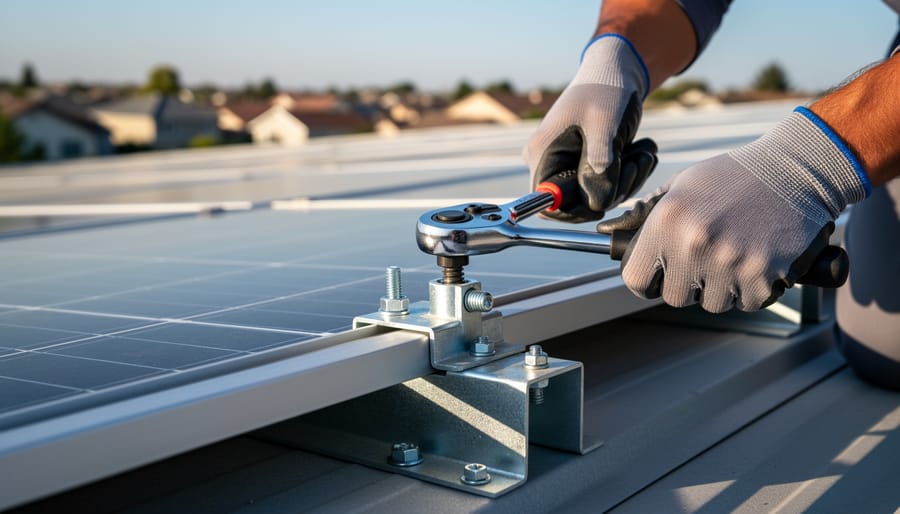
Installing a home solar power system requires more than simply mounting panels on your roof. Success depends on several foundational assessments that professionals conduct before any equipment arrives.
Structural evaluation comes first. Engineers examine roof age, material condition, and load-bearing capacity to ensure the structure can safely support panel arrays for 25+ years. Older roofs may need replacement before installation proceeds, completing this work first avoids costly panel removal and reinstallation later. Roof pitch and orientation matter too, with south-facing slopes at 15-40 degree angles ideal in North America, though east-west configurations work for many properties.
Your existing electrical system receives scrutiny next. Many homes built before 2000 require panel upgrades to accommodate solar inverters and safely handle bidirectional power flow. Licensed electricians assess whether your main service panel has sufficient capacity or needs expansion from typical 100-amp to 200-amp service.
Permitting represents the administrative hurdle homeowners often underestimate. Local building departments require structural, electrical, and sometimes fire safety permits. Your installer typically handles applications, but approval timelines vary wildly, from two weeks in solar-friendly jurisdictions to three months in municipalities with complex review processes. Homeowner association approval adds another layer in planned communities.
Utility interconnection agreements formalize your grid connection and net metering arrangement. Utilities inspect the installation before authorizing operation, verifying safety disconnects and proper metering equipment. This final step can take days or weeks depending on utility workload and scheduling.
Frequently Asked Questions
Home solar power solutions raise predictable questions for prospective buyers, particularly around long-term performance and financial implications. Industry data and manufacturer specifications provide clear answers to the most common concerns.
How long do solar panels last?
Modern solar panels typically carry 25-year performance warranties and often continue generating electricity for 30-40 years, though output gradually declines by roughly 0.5% annually. The inverter usually requires replacement after 10-15 years, while panels themselves can outlast the original system design life.
What happens during cloudy weather?
Solar panels continue generating electricity on overcast days, producing 10-25% of their rated capacity depending on cloud density. Systems are sized to account for seasonal weather variations, and grid-tied installations draw supplemental power when solar production drops below household demand.
Do solar panels require maintenance?
Solar systems need minimal maintenance beyond occasional cleaning to remove dust, pollen, or debris that can reduce efficiency. Annual inspections checking electrical connections and inverter performance help identify issues early, but most systems operate reliably with little intervention.
How does solar affect home insurance?
Most homeowners policies cover solar installations as permanent fixtures, though you should inform your insurer and may see a modest premium increase reflecting the added property value. Some insurers offer discounts for homes with renewable energy systems.
Property value concerns consistently emerge in homeowner discussions. Multiple real estate studies indicate that solar installations increase home sale prices, with buyers willing to pay premiums for properties with owned (not leased) systems that demonstrably reduce energy costs. The specific value added varies by region, electricity rates, and system size, but installations typically recover their cost through both energy savings and resale appreciation.
Installation approaches split between professional contractors and DIY efforts. While purchasing components separately can reduce upfront costs, self-installation forfeits warranty coverage, professional design optimization, and inspection certification that most jurisdictions require for grid connection. Permitting, electrical code compliance, and roof penetration waterproofing present significant challenges for inexperienced installers, making professional installation the practical choice for most homeowners despite the higher initial expense.
Home solar power solutions have matured into proven, accessible technology for homeowners seeking energy independence and long-term cost savings. The systems available in 2026 offer reliable performance across diverse residential contexts, from suburban grid-tied installations to rural properties requiring full autonomy. Understanding the core components, how photovoltaic conversion works, and the differences between system types empowers you to evaluate whether solar fits your energy goals and property characteristics.
The economic case strengthens as equipment costs decline and efficiency improves, yet success still depends on proper system sizing matched to your consumption patterns and roof conditions. Professional assessment remains essential. A qualified installer evaluates structural capacity, optimal panel placement, appropriate inverter technology, and whether battery storage aligns with your backup needs and budget.
Beyond individual benefits, residential solar adoption contributes meaningfully to grid decarbonization and energy resilience at scale. Each home installation reduces fossil fuel demand and demonstrates the viability of distributed generation. Your decision should rest on careful analysis of your specific situation, financial capacity, and energy priorities rather than universal prescriptions. Solar technology works, but informed implementation makes the difference between adequate performance and genuine return on investment.