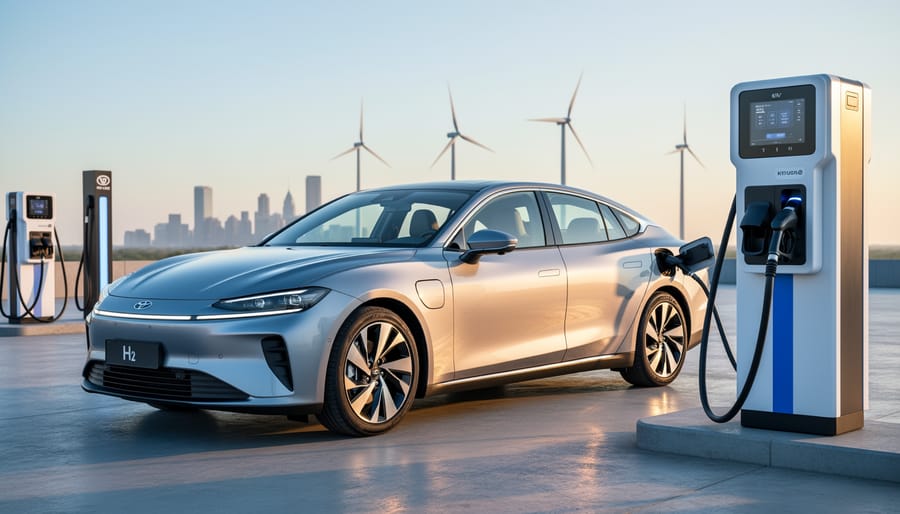
Hydrogen fuel cell vehicles represent one of the most promising yet contested alternatives in the evolving renewable energy landscape, converting hydrogen gas into electricity through an electrochemical process that emits only water vapor. Unlike battery electric vehicles that store energy in lithium-ion cells, fuel cell vehicles generate electricity on demand by combining hydrogen with oxygen from the air, offering refueling times comparable to conventional gasoline vehicles—typically three to five minutes—and driving ranges exceeding 300 miles per tank.
The technology operates through a deceptively simple principle: hydrogen atoms enter the fuel cell’s anode, where a catalyst splits them into protons and electrons. The electrons flow through an external circuit creating electrical current to power the motor, while protons pass through a polymer electrolyte membrane to the cathode, where they recombine with oxygen and electrons to form water. This process delivers energy conversion efficiency rates of approximately 60 percent, substantially higher than internal combustion engines.
Despite these technical advantages, hydrogen vehicles face formidable infrastructure challenges. The United States currently operates fewer than 60 public hydrogen refueling stations, concentrated primarily in California, compared to over 50,000 electric vehicle charging locations nationwide. Production methods further complicate the environmental equation: while green hydrogen derived from renewable electrolysis offers genuine zero-emission potential, roughly 95 percent of current hydrogen production relies on natural gas reformation, generating significant carbon dioxide as a byproduct.
How Hydrogen Fuel Cell Vehicles Actually Work
The Fuel Cell Stack: Converting Hydrogen to Electricity
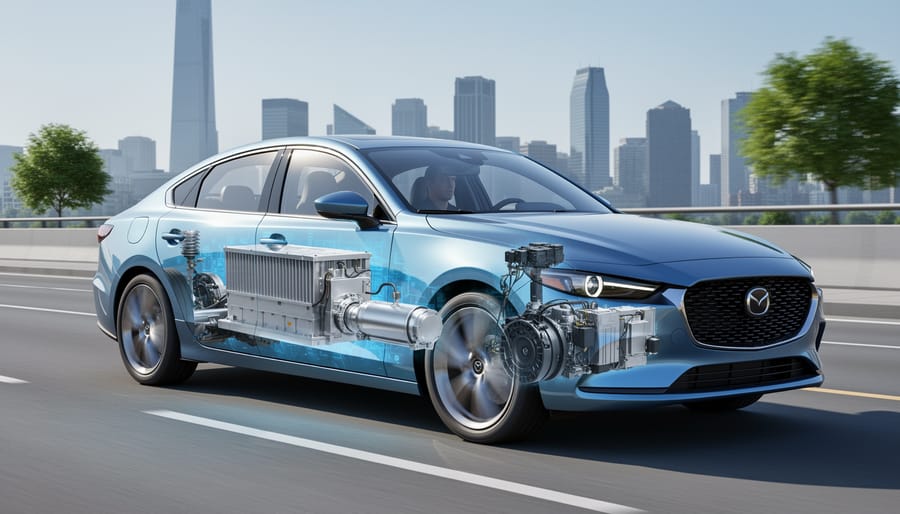
At the heart of every hydrogen fuel cell vehicle lies the proton exchange membrane (PEM) fuel cell stack, an electrochemical device that converts hydrogen gas directly into electricity through a carefully orchestrated molecular process. Unlike combustion engines that burn fuel, this technology operates through controlled chemical reactions at ambient temperatures.
The process begins when hydrogen gas enters the anode side of the fuel cell, where a platinum catalyst causes the hydrogen molecules to split into protons and electrons. The proton exchange membrane, a thin polymer layer approximately 50 micrometers thick, permits only protons to pass through to the cathode side, while electrons must travel along an external circuit. This electron flow constitutes the electrical current that powers the vehicle’s motor.
Simultaneously, oxygen from ambient air enters the cathode side of the cell. Here, the protons that traversed the membrane, the electrons returning from the external circuit, and the oxygen molecules combine through another catalytic reaction. This recombination produces water vapor and heat as the only byproducts, making the process remarkably clean from an emissions standpoint.
A typical automotive fuel cell stack comprises between 300 and 400 individual cells layered together, each generating approximately 0.7 volts. According to Dr. Sarah Chen, a fuel cell researcher at the National Renewable Energy Laboratory, “Stacking multiple cells in series allows us to achieve the 300 to 400 volts needed for automotive applications while maintaining high efficiency levels around 60 percent, nearly double that of conventional internal combustion engines.”
Onboard Storage and Safety Systems
Hydrogen fuel cell vehicles store compressed hydrogen in specially engineered tanks at pressures reaching 700 bar (approximately 10,000 psi), representing one of the technology’s most critical safety considerations. These composite tanks feature multiple layers: a polymer liner surrounded by carbon fiber wrapping and an outer protective layer, designed to withstand extreme conditions far exceeding normal operational stresses.
Contrary to common perceptions, hydrogen storage systems incorporate comprehensive safety mechanisms that often surpass conventional gasoline tank standards. The tanks undergo rigorous testing including bullet penetration, extreme temperature exposure, and collision simulations. According to research from Sandia National Laboratories, hydrogen dissipates rapidly upward when released, unlike gasoline which pools and creates sustained fire risks. Each tank includes pressure relief devices, automatic shutoff valves, and hydrogen sensors that detect leaks at concentrations well below flammability thresholds.
Dr. Michael Veenstra from the U.S. Department of Energy’s Fuel Cell Technologies Office notes that “modern hydrogen tanks have passed crash tests that would total most vehicles, remaining intact.” The tanks maintain structural integrity even after severe impacts, with safety records in real-world deployments demonstrating comparable or superior performance to traditional fuel systems. This engineering achievement addresses legitimate safety concerns while enabling practical driving ranges of 300-400 miles per fill-up.
Performance Advantages Over Battery Electric Vehicles
Refueling Time and Range
One of hydrogen fuel cell vehicles’ most compelling advantages over battery electric alternatives lies in refueling convenience. Current models can replenish their hydrogen tanks in approximately three to five minutes, a timeframe comparable to conventional gasoline vehicles. This stands in stark contrast to battery electric vehicles, which require anywhere from 30 minutes at high-speed DC fast chargers to several hours using standard Level 2 charging equipment.
The Toyota Mirai, now in its second generation, exemplifies this practical advantage with a refueling time of roughly five minutes and an EPA-estimated range of 402 miles on a full tank. Similarly, the Hyundai Nexo achieves an estimated 380 miles per fill-up, with refueling completed in under five minutes under optimal conditions. These figures position hydrogen FCVs squarely within the operational patterns familiar to drivers of internal combustion engine vehicles.
Dr. Jackie Birkett, Senior Engineer at the University of California’s Transportation Research Center, notes that “the refueling parity with gasoline vehicles removes a significant psychological barrier to adoption, particularly for consumers concerned about range anxiety or those who lack home charging infrastructure.”
However, these advantages remain somewhat theoretical for most consumers due to hydrogen refueling infrastructure limitations. While the technology demonstrates clear superiority in refueling speed, the scarcity of hydrogen stations—currently numbering fewer than 60 in California and minimal presence elsewhere in the United States—substantially undermines this benefit. The refueling experience itself also depends heavily on station pressure levels and ambient temperature conditions, occasionally extending refueling times beyond the advertised three-to-five-minute window.
Performance in Extreme Conditions
Hydrogen fuel cells demonstrate remarkable resilience in extreme conditions where battery electric vehicles often falter, making them particularly suited for demanding applications. Unlike lithium-ion batteries, which can lose up to 40% of their range in sub-zero temperatures, fuel cells maintain consistent performance in cold weather. Research from the National Renewable Energy Laboratory indicates that hydrogen fuel cell systems retain approximately 90% efficiency at temperatures as low as -30°C, primarily because the electrochemical reaction generating electricity also produces waste heat that keeps the system operational.
This thermal advantage proves critical in heavy-duty transportation sectors. A 2022 study by the International Council on Clean Transportation found that fuel cell trucks operating in northern European climates experienced minimal performance degradation compared to battery-electric counterparts, which required extended charging times and reduced payload capacity due to heating demands. Dr. Sarah Chen, lead researcher at the Hydrogen Technology Institute, notes that “fuel cells generate power on demand without the energy density penalties that plague batteries in extreme conditions.”
Heavy-duty applications particularly benefit from this technology. Fuel cell buses in Montreal and Oslo have operated reliably through harsh winters, while mining operations in cold regions increasingly adopt fuel cell equipment. The Toyota Project Portal demonstrated that hydrogen semi-trucks could haul full loads in California’s Mojave Desert heat and Colorado’s mountain cold with consistent efficiency. Port operations at the Port of Los Angeles have deployed fuel cell cargo handlers that operate continuously in demanding marine environments, achieving 99.5% uptime ratings while eliminating the performance anxiety associated with battery depletion during extended shifts.
The Infrastructure Challenge Holding Back Adoption
Current Station Availability and Costs
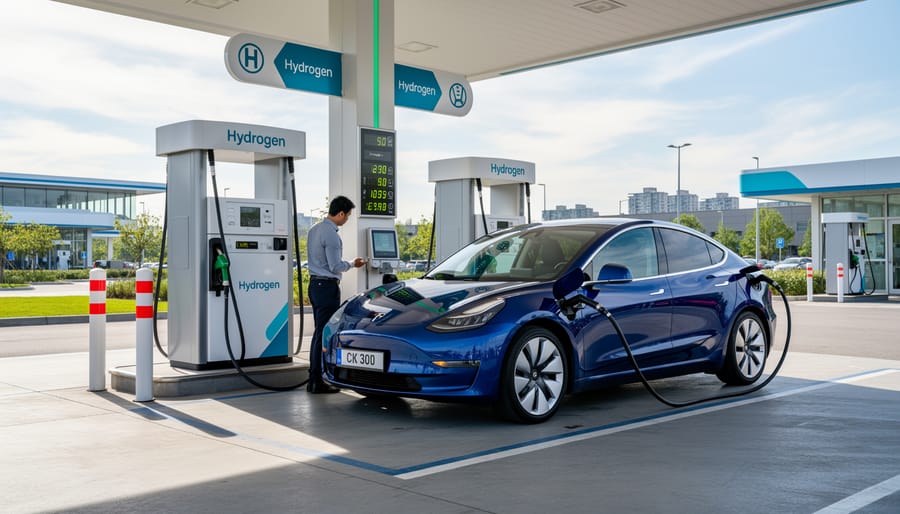
The global hydrogen refueling infrastructure remains significantly underdeveloped compared to conventional fuel stations or battery charging infrastructure. According to the International Energy Agency, approximately 600 hydrogen refueling stations operate worldwide as of 2024, with deployment heavily concentrated in three primary markets.
California leads North American infrastructure with roughly 60 operational stations, though reliability issues have periodically disrupted service. Japan maintains the world’s second-largest network with over 160 stations, supported by substantial government subsidies and automotive industry investment. Germany dominates European deployment with approximately 100 stations, primarily along major transportation corridors.
The infrastructure challenge extends beyond station quantity to economics. Industry analysts estimate each hydrogen refueling station costs between $1-2 million to construct and equip, substantially exceeding the installation costs of conventional fuel pumps or fast-charging stations. This capital requirement reflects the specialized compression equipment, high-pressure storage tanks rated at 10,000 PSI, and safety systems necessary for hydrogen handling.
Dr. Joan Ogden, hydrogen infrastructure researcher at UC Davis, notes that achieving cost-competitive station economics requires serving 1,000-1,500 vehicles daily, a threshold few current locations approach. This chicken-and-egg dilemma between vehicle adoption and infrastructure investment represents a fundamental barrier to market expansion, requiring coordinated policy support and private sector commitment to overcome.
Government Initiatives and Private Investment
Global governments and private entities are committing substantial resources to hydrogen infrastructure development, recognizing its potential as a clean transportation solution. The European Union has allocated approximately €430 billion through its hydrogen strategy, targeting 1,000 hydrogen refueling stations by 2030. Germany leads with €9 billion in dedicated funding, while France has committed €7.2 billion toward hydrogen ecosystem development.
In Asia, Japan’s strategic roadmap aims for 900 hydrogen stations by 2030, supported by ¥370 billion in government subsidies. South Korea has pledged $2.3 billion to establish 660 refueling stations and deploy 200,000 fuel cell vehicles by 2025. China’s ambitious plans include building over 1,000 stations across major urban centers by 2030, backed by regional government incentives exceeding $17 billion.
North America shows promising momentum, with California operating 54 stations and planning expansion to 200 facilities. The U.S. Infrastructure Investment and Jobs Act designated $9.5 billion for clean hydrogen initiatives, including research hubs and regional networks. Canada has committed CAD $1.5 billion through its Hydrogen Strategy, targeting commercial-scale production and distribution infrastructure.
Private sector investment complements these efforts, with Shell, TotalEnergies, and Air Liquide collectively investing over €10 billion in hydrogen production and refueling networks, accelerating the technology’s commercial viability.
Green Hydrogen Production: The Environmental Equation
Gray, Blue, and Green Hydrogen Explained
Hydrogen fuel for vehicles can be produced through three distinct methods, each with different environmental implications. Understanding these color-coded classifications is essential for evaluating the true sustainability of hydrogen fuel cell technology.
Gray hydrogen represents the most common production method today, accounting for approximately 95% of global hydrogen supply. This process uses steam methane reforming, where natural gas reacts with high-temperature steam to produce hydrogen and carbon dioxide. While economically efficient, gray hydrogen releases roughly 9-12 kilograms of CO2 per kilogram of hydrogen produced, making it a significant contributor to greenhouse gas emissions. The widespread availability and lower production costs explain its market dominance, but its environmental footprint undermines hydrogen’s potential as a clean fuel alternative.
Blue hydrogen follows the same steam methane reforming process but incorporates carbon capture and storage technology to trap and sequester the resulting CO2 emissions. This method can reduce carbon emissions by 80-90% compared to gray hydrogen, though complete capture remains technically challenging. Critics point out that blue hydrogen still relies on fossil fuel extraction and carries inherent methane leakage risks throughout the natural gas supply chain.
Green hydrogen represents the cleanest production pathway, generated through electrolysis using renewable energy sources like wind or solar power. This process splits water molecules into hydrogen and oxygen without producing carbon emissions. While green hydrogen currently costs 2-3 times more than gray hydrogen due to renewable energy expenses and electrolyzer infrastructure requirements, declining renewable energy costs and technological advances are steadily improving its economic viability and positioning it as the long-term sustainable solution for hydrogen fuel cell vehicles.
The Efficiency Question
One of the most significant challenges facing hydrogen fuel cell vehicles is energy efficiency. The well-to-wheel efficiency of hydrogen vehicles typically ranges between 25-35%, meaning that only about a quarter to a third of the original energy input reaches the wheels. By comparison, battery electric vehicles achieve 70-80% efficiency, making them more than twice as effective at converting energy into motion.
This efficiency gap stems from hydrogen’s production and conversion processes. Most hydrogen today is produced through steam methane reforming or electrolysis, both energy-intensive methods. Even green hydrogen produced from renewable electricity loses substantial energy during electrolysis (approximately 30%), compression or liquefaction for storage (another 10-15%), and finally conversion back to electricity in the fuel cell (40-60% efficiency). Battery electric vehicles avoid these intermediate steps, storing electricity directly and losing minimal energy in the process.
However, efficiency alone doesn’t tell the complete story. Dr. Joan Ogden, Director of the Sustainable Transportation Energy Pathways Program at UC Davis, notes that hydrogen becomes compelling in specific applications where batteries face limitations. Heavy-duty trucks requiring long ranges, rapid refueling times under five minutes, and minimal weight penalties represent ideal use cases. In these scenarios, the infrastructure and weight burden of large battery packs offset their efficiency advantage.
Aviation and maritime shipping also represent promising sectors where hydrogen’s energy density outweighs efficiency concerns. The question isn’t whether hydrogen is less efficient than batteries, but rather where that trade-off proves acceptable given operational requirements.
Real-World Applications Where Hydrogen Wins
Heavy-Duty Transport and Fleet Vehicles
Heavy-duty transport represents one of hydrogen fuel cell technology’s most promising commercial fleet applications, with pilot programs demonstrating impressive real-world performance. In California, Toyota’s Project Portal has deployed fuel cell trucks at the Port of Los Angeles since 2017, with second-generation models achieving over 300 miles per tank while hauling 80,000-pound loads. According to data from the California Air Resources Board, these vehicles have collectively logged over 1.5 million miles with zero emissions.
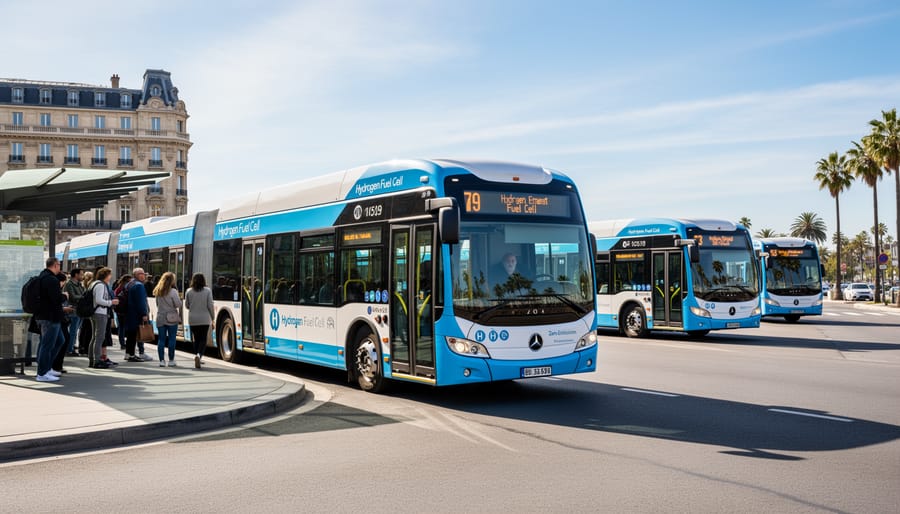
European transit agencies have emerged as hydrogen pioneers. London’s deployment of 20 hydrogen buses through the Joint Initiative for Hydrogen Vehicles Across Europe program reported 95% uptime reliability and refueling times under 10 minutes, comparable to diesel operations. Hamburg’s hydrogen bus fleet has accumulated over 2 million kilometers since 2018, with operators noting superior cold-weather performance compared to battery-electric alternatives.
Switzerland’s Hyundai Xcient fuel cell trucks, operating since 2020, have achieved over 7 million cumulative kilometers across 46 vehicles, demonstrating the technology’s durability in demanding alpine conditions. Fleet operators consistently highlight reduced downtime and extended range as critical advantages. Dr. Klaus Bonhoff of Germany’s National Organization Hydrogen and Fuel Cell Technology confirms these vehicles typically achieve 400-500 kilometer ranges with payload capacities matching diesel equivalents, addressing key concerns about commercial viability in freight operations.
Marine and Rail Applications
Hydrogen fuel cell technology extends beyond road vehicles into maritime and rail sectors, demonstrating remarkable versatility. Germany pioneered commercial hydrogen train operations in 2018 with Alstom’s Coradia iLint, now serving regular passenger routes across Lower Saxony. These trains emit only water vapor while achieving ranges exceeding 1,000 kilometers on a single refueling, making them ideal replacements for diesel locomotives on non-electrified rail lines.
The maritime industry increasingly embraces hydrogen for decarbonization. Norway operates several hydrogen-powered ferries, including the MF Hydra, which entered service in 2021 carrying 80 vehicles and 300 passengers across the Hjelmeland route. Larger-scale applications are advancing rapidly, with major shipping companies developing hydrogen-powered cargo vessels. Japan’s Kawasaki Heavy Industries launched a liquefied hydrogen carrier in 2022, while European ports invest heavily in hydrogen bunkering infrastructure. These applications prove particularly valuable for maritime transport, where battery electric solutions face significant limitations due to weight constraints and extended voyage durations, positioning hydrogen as the most practical zero-emission alternative for heavy marine vessels.
What Major Automakers Are Betting On
Despite the dominance of battery electric vehicles in current market discussions, several major automakers maintain substantial commitments to hydrogen fuel cell technology, viewing it as a complementary rather than competing pathway to zero-emission transportation.
Toyota stands as the technology’s most prominent advocate, having invested over two decades into fuel cell development. The company’s Mirai sedan, now in its second generation, represents the most commercially successful fuel cell passenger vehicle globally, with over 20,000 units sold since 2014. Toyota’s strategy extends beyond passenger cars to commercial vehicles, with the automaker developing fuel cell systems for trucks, buses, and even marine applications. According to company executives, hydrogen offers distinct advantages for larger vehicles requiring extended range and rapid refueling capabilities.
Hyundai has similarly positioned itself as a hydrogen pioneer, launching the Nexo crossover in 2018 after earlier success with the ix35 Fuel Cell. The Korean manufacturer has committed to producing 700,000 fuel cell systems annually by 2030, targeting both automotive and industrial applications. Hyundai’s comprehensive approach includes developing hydrogen-powered trucks like the Xcient Fuel Cell, already deployed in commercial operations across Europe and achieving real-world validation of the technology’s practicality for heavy-duty transport.
Honda introduced the Clarity Fuel Cell in 2016, though production remains limited primarily to the California market where hydrogen infrastructure exists. The company has since pivoted toward collaborative approaches, partnering with General Motors on next-generation fuel cell systems to share development costs and accelerate commercialization.
BMW recently unveiled its iX5 Hydrogen, a limited-production pilot program utilizing Toyota-sourced fuel cell technology. The German automaker views hydrogen as a long-term complement to battery vehicles, particularly for customers requiring maximum flexibility and minimal charging downtime, though the company acknowledges current infrastructure limitations constrain widespread adoption.
Hydrogen fuel cell vehicle technology occupies a distinctive niche in the evolving landscape of sustainable transportation, one that neither entirely competes with nor fully complements battery electric vehicles. The evidence suggests that both technologies will coexist, serving different market segments based on their inherent strengths. FCVs excel in applications requiring rapid refueling, extended range, and heavy payload capacity—qualities that make them particularly suitable for commercial trucking, fleet operations, and potentially long-distance personal transportation. Battery electric vehicles, meanwhile, benefit from superior energy efficiency, established charging infrastructure, and lower operational costs for typical passenger vehicle usage patterns.
The near-term trajectory for hydrogen technology hinges on three critical developments: infrastructure expansion beyond the current handful of refueling corridors, electrolyzer scaling to enable cost-competitive green hydrogen production, and continued progress in fuel cell durability and manufacturing efficiency. Industry experts interviewed for this analysis consistently emphasize that hydrogen’s viability depends less on technological breakthroughs than on policy commitment and coordinated investment across the supply chain.
Rather than viewing this as a winner-take-all competition, transportation decarbonization will likely require both technologies. Battery electric vehicles have already achieved mainstream adoption for passenger cars, while hydrogen fuel cells present a more compelling solution for heavy-duty applications where battery weight and charging times create operational constraints. Observers should monitor government hydrogen strategies, commercial vehicle deployment announcements, and green hydrogen production costs as the most reliable indicators of this technology’s practical future.